
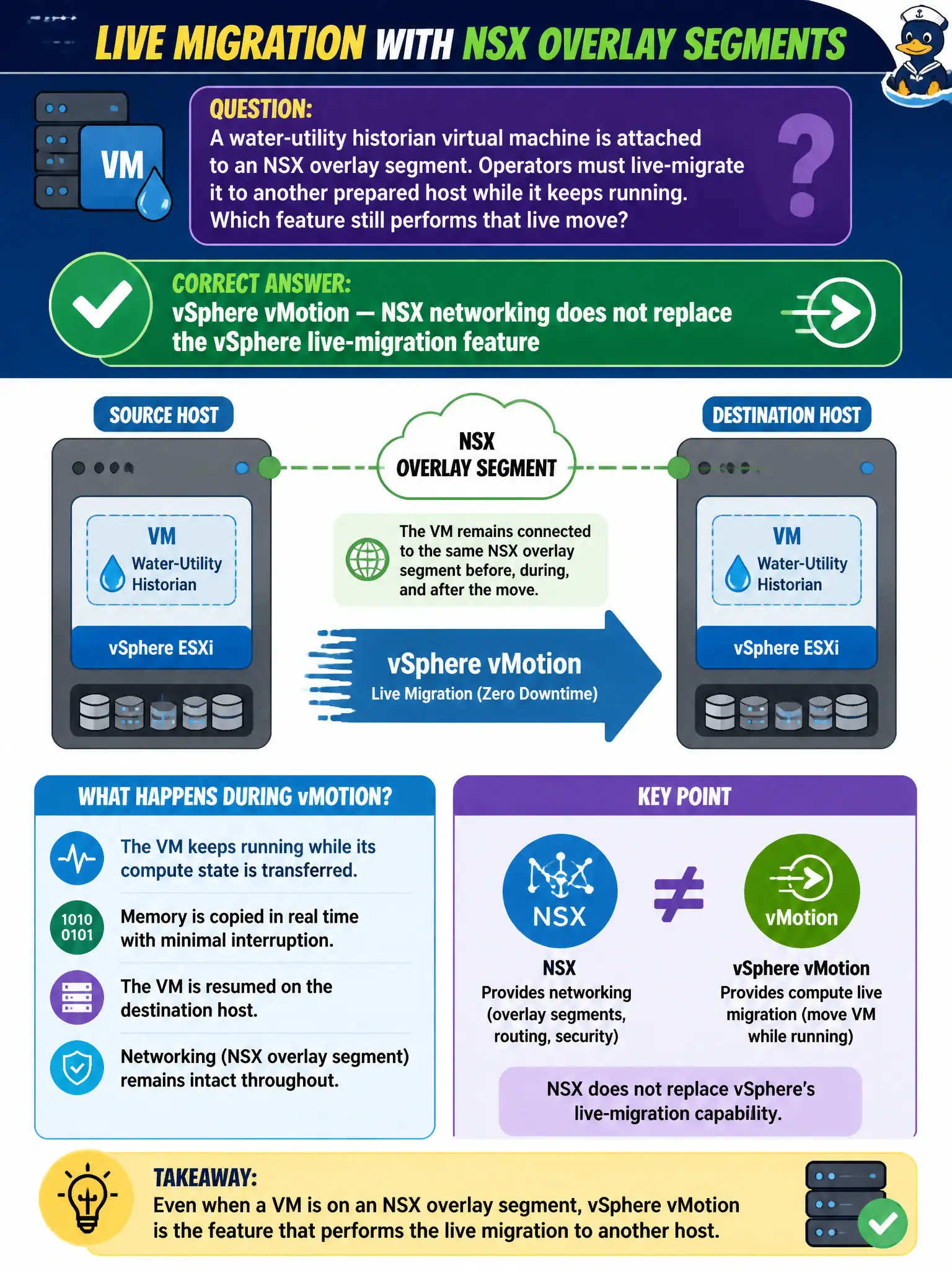
A water-utility historian virtual machine is attached to an NSX overlay segment. Operators must live-migrate it to another prepared host while it keeps running. Which feature still performs that live move?
Select an answer to reveal the explanation.
Short Explanation
Even when the historian rides an NSX overlay, the moving van is still vMotion. The destination host just needs to be a transport node so the overlay port still exists. Bridging and Geneve do not relocate a running guest.
Full Explanation
A water-utility historian virtual machine attached to an NSX overlay segment that must live-migrate to another prepared host while keeping running still uses vSphere vMotion. NSX networking does not replace the vSphere live-migration feature; the destination host must be an NSX transport node so the overlay port can be instantiated there, but that prerequisite is not a different migration product. Civic SCADA-adjacent historian workloads therefore move with the same vMotion workflow operators already know. NSX bridging extends Layer 2 between a segment and a VLAN so bare-metal and VM endpoints can share a broadcast domain; it does not move a guest between hypervisors. Geneve encapsulation carries overlay frames and is not itself a migration feature. Storage vMotion relocates virtual disks between datastores and is not required whenever a vNIC is connected to a segment—compute vMotion alone suffices when disks stay put. Exam caveat: stems often imply that overlay attachment changes which product performs live migration. At VCTA-NV depth, vMotion remains the live move; NSX readiness of the destination is a fabric condition, not a substitute feature name. Operational check: confirm the destination ESXi host is prepared in the same overlay transport zone, that the historian segment is available there, initiate vMotion, verify the guest stays powered on and reachable on the overlay IP, and only then clear the source host for maintenance.