
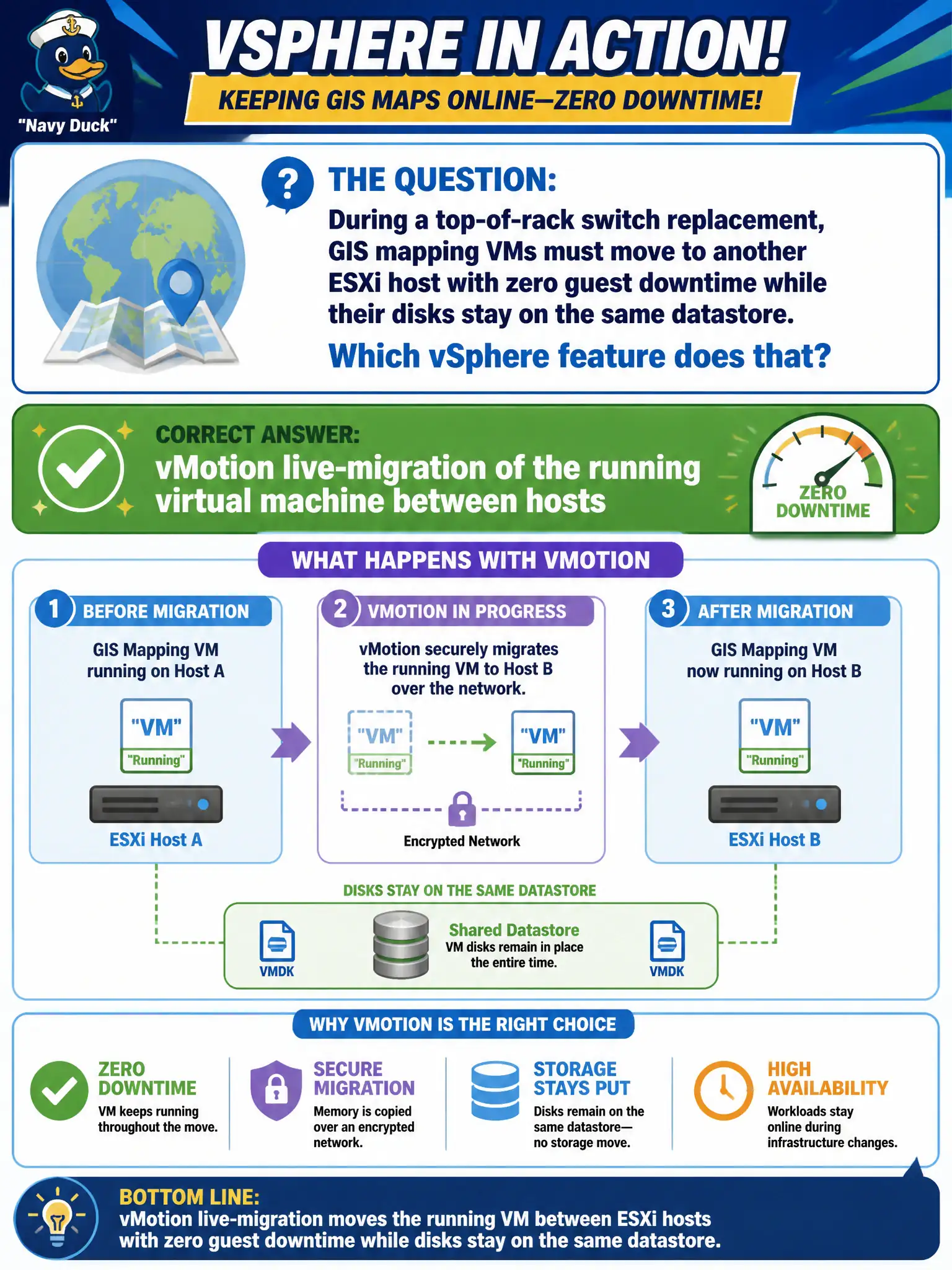
During a top-of-rack switch replacement, GIS mapping VMs must move to another ESXi host with zero guest downtime while their disks stay on the same datastore. Which vSphere feature does that?
Select an answer to reveal the explanation.
Short Explanation
vMotion is moving the running GIS guest to another host while the disks stay put—like moving a meeting to another room without hanging up. Storage vMotion would move the disks. Geneve and bridging are NSX packet features, not live compute migration.
Full Explanation
During a top-of-rack switch replacement, GIS mapping VMs that must move to another ESXi host with zero guest downtime while their disks stay on the same datastore require vMotion live-migration of the running virtual machine between hosts. vMotion is moving the meeting to another room without hanging up—compute relocates, disks can remain on the original datastore. Storage vMotion of the virtual disks to a new array is a different feature that moves disk files between datastores; it is not the host-move with disks staying put. NSX Geneve encapsulation of the virtual machine is overlay transport between TEPs, not the live-migration feature that relocates a running guest. NSX bridging of the GIS VLAN onto an overlay segment extends L2 between a segment and a VLAN; it does not move a running VM to another host. Exam caveat: when NSX is present, the destination host must still support the VM’s networking (for example be a transport node for an overlay segment), but the migration feature remains vMotion. Operational check: initiate vMotion of a GIS VM to a host on the surviving network path before the ToR work, confirm the guest session stays up, and verify the datastore location of the VMDKs is unchanged after the move completes.