
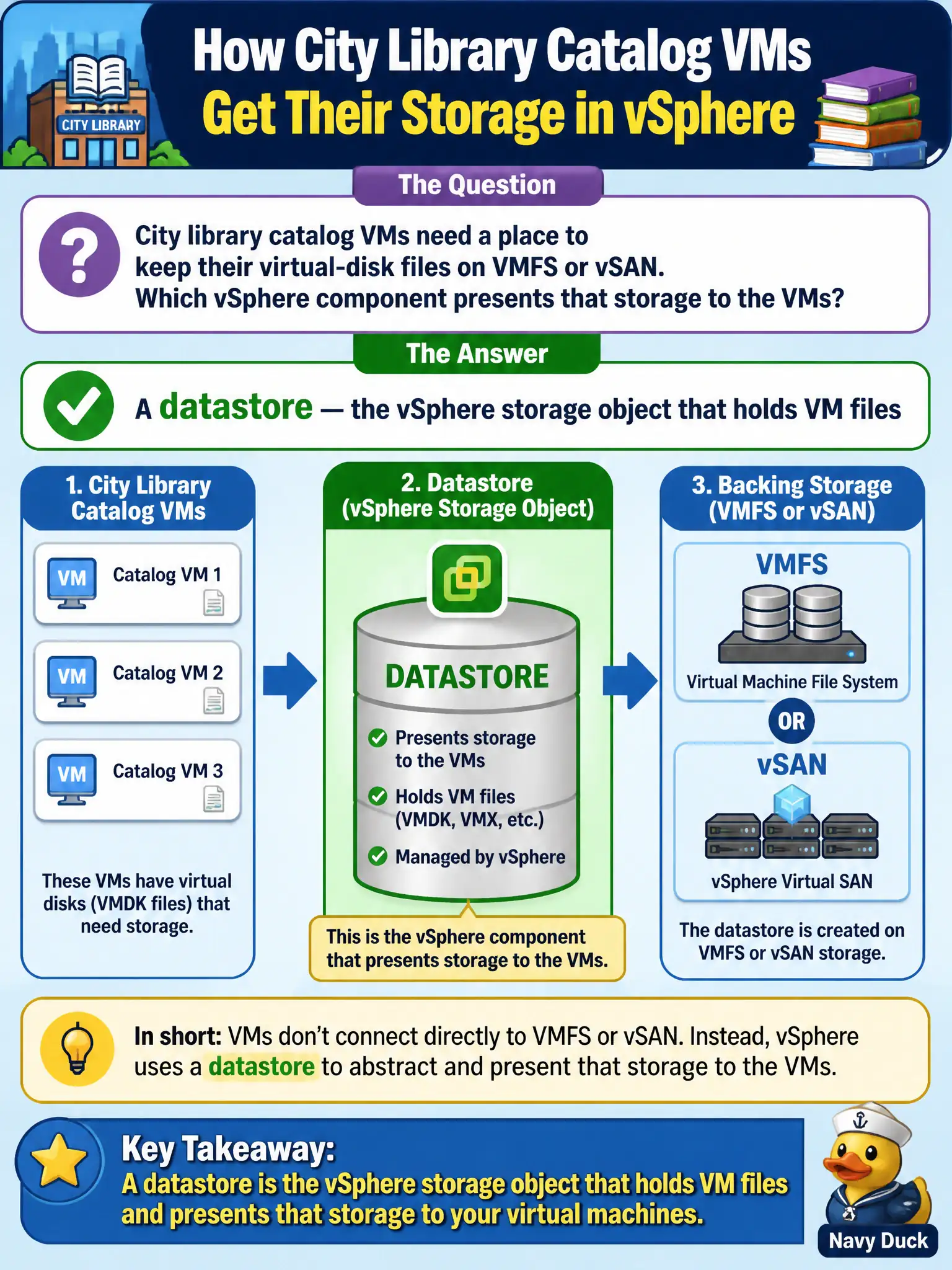
City library catalog VMs need a place to keep their virtual-disk files on VMFS or vSAN. Which vSphere component presents that storage to the VMs?
Select an answer to reveal the explanation.
Short Explanation
A datastore is the library shelf where the VMDK books sit. VMFS or vSAN can back that shelf, but the vSphere object the VM uses is still the datastore. NSX segments and gateways move packets; they do not present disks.
Full Explanation
City library catalog VMs that need a place to keep their virtual-disk files on VMFS or vSAN use a datastore—the vSphere storage object that holds VM files. A datastore is the library shelf where the VMDK books sit; VMFS or vSAN may back that shelf, but the object the VM uses remains the datastore in inventory and in path references. An NSX overlay segment that carries block I/O instead of Ethernet frames is a category error: segments carry network frames for guest connectivity, not VMFS/vSAN datastore semantics. A Tier-0 gateway that publishes LUNs directly to guests confuses north-south routing with storage presentation and is not how catalog disks are presented. A transport zone that mounts VMFS to every vNIC likewise mixes NSX span with storage mounting and invents a capability that is not the datastore model. Exam caveat: datastores are vSphere inventory objects; NSX does not replace the datastore when guests need virtual disks. Networking must still reach storage VMkernel services when vSAN or IP storage is used. Operational check: in vCenter, confirm catalog VMs have VMDKs on the intended datastore, that the datastore is mounted on the relevant hosts, and that no operator is looking in NSX segments or Tier-0 objects for the disk files during a storage migration or capacity review.