
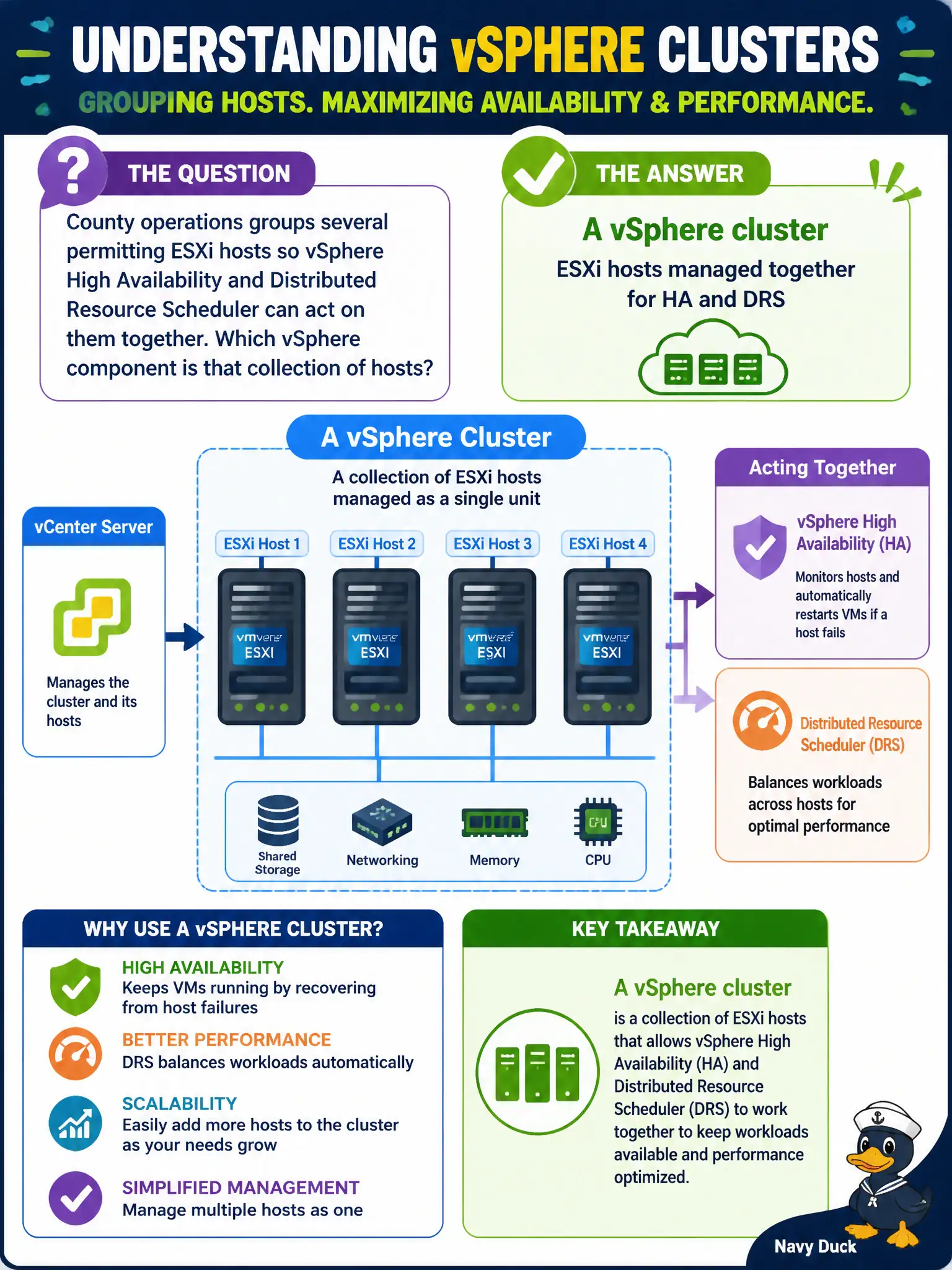
County operations groups several permitting ESXi hosts so vSphere High Availability and Distributed Resource Scheduler can act on them together. Which vSphere component is that collection of hosts?
Select an answer to reveal the explanation.
Short Explanation
A cluster is the city bus barn: several hosts parked together so HA and DRS can treat them as one pool. An NSX Edge cluster is a different barn used for centralized network services. Geneve segments and vSAN fault domains do not create that HA/DRS host group.
Full Explanation
County operations grouping several permitting ESXi hosts so vSphere High Availability and Distributed Resource Scheduler can act on them together are forming a vSphere cluster—ESXi hosts managed together for HA and DRS. A cluster is the city bus barn: several hosts parked together so availability and placement features treat them as one compute pool. An NSX Edge cluster that fronts north-south NAT for the county is a different “barn” used for Edge service HA; it is not the vSphere compute cluster object that enables VM restart and DRS balancing. A Geneve overlay segment shared by every host is a Layer-2 network construct, not the grouping of hosts for HA/DRS. A vSAN fault domain that replaces the need to group hosts is incorrect—fault domains refine failure domains inside vSAN; they do not replace creating a vSphere cluster for HA and DRS. Exam caveat: the same physical hosts may be a vSphere cluster, contribute to vSAN, and be NSX transport nodes, but the object that enables HA/DRS togetherness is the vSphere cluster. Operational check: in vCenter, confirm the permitting hosts are members of one cluster with HA and DRS settings enabled; distinguish that object from any NSX Edge cluster listed in NSX Manager when documenting the county’s availability design.