
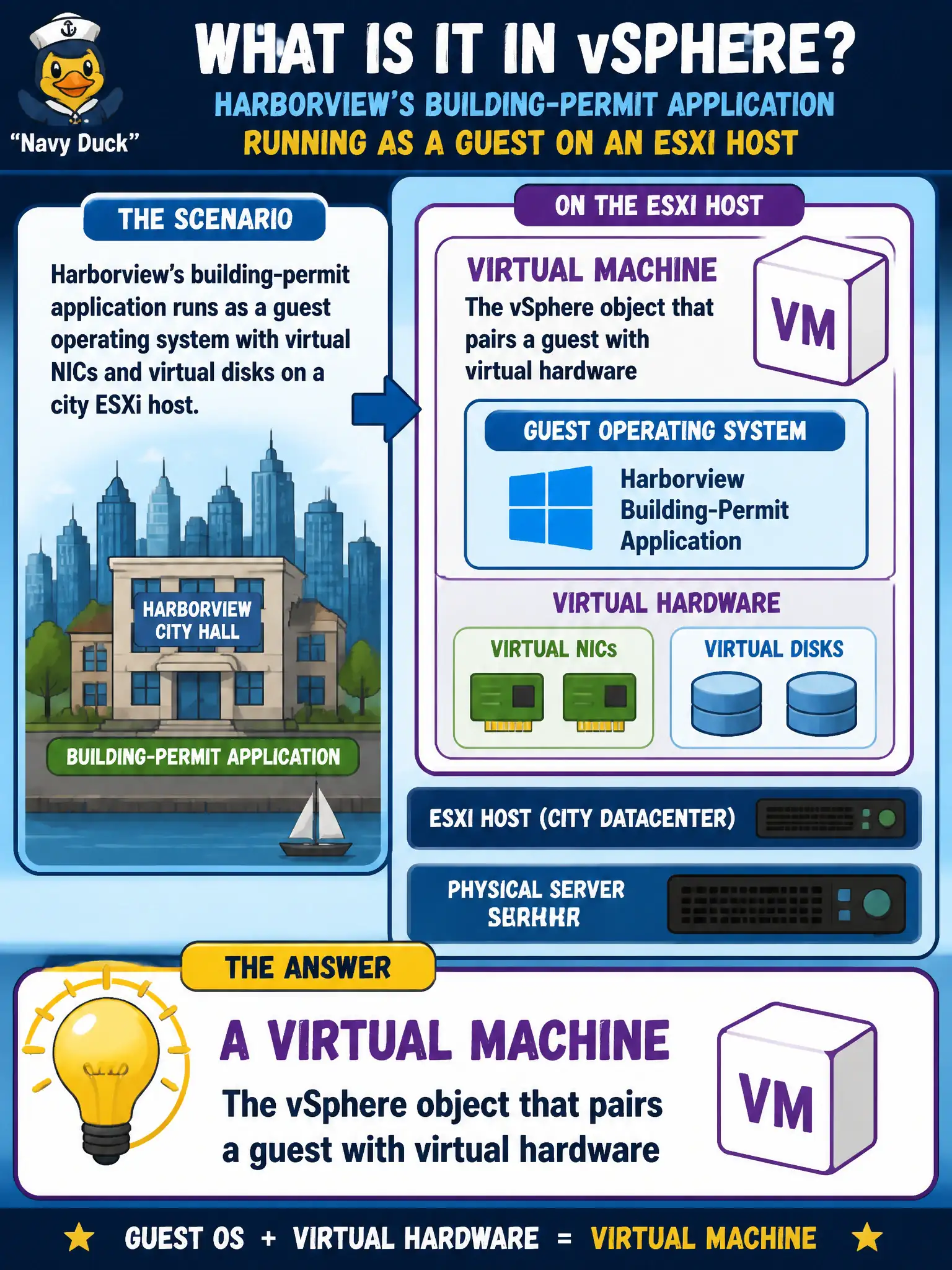
Harborview's building-permit application runs as a guest operating system with virtual NICs and virtual disks on a city ESXi host. Which vSphere component is that guest plus its virtual hardware?
Select an answer to reveal the explanation.
Short Explanation
Think of the permit app as a complete apartment, not just a hallway or a lock. The guest OS plus its virtual NIC, CPU, and disks is a vSphere virtual machine. An NSX Edge or transport zone is a different object and is not created just because a guest has a vNIC.
Full Explanation
Harborview’s building-permit application running as a guest operating system with virtual NICs and virtual disks on a city ESXi host is a virtual machine—the vSphere object that pairs a guest with virtual hardware. Think of the permit app as a complete apartment, not just a hallway or a lock: guest OS plus vCPU, memory, vNIC, and virtual disks together form the VM. An NSX Edge node that is created automatically whenever a guest has a vNIC is false; Edges are deployed as dedicated service transport nodes for centralized services, not auto-spawned for every application vNIC. A Tier-1 gateway object stored only in NSX Manager inventory is a logical routing construct that fronts tenant networks, not the guest-plus-virtual-hardware object. A transport zone that encapsulates the guest kernel misuses the transport-zone concept; zones define which transport nodes may host segments, not the VM object itself. Exam caveat: Edges and other appliances are also VMs underneath, but the exam identification here is the general vSphere VM component for a workload guest. Operational check: in vCenter, open the permit VM and review virtual hardware (CPU, memory, disks, network adapters); confirm it is inventoried as a VM on an ESXi host, not as a Tier-1 object or transport-zone entry in NSX alone.