
A vendor proposes VMware Horizon as the city's SDDC network-virtualization pillar. Why is that the wrong product family?
Select an answer to reveal the explanation.
Short Explanation
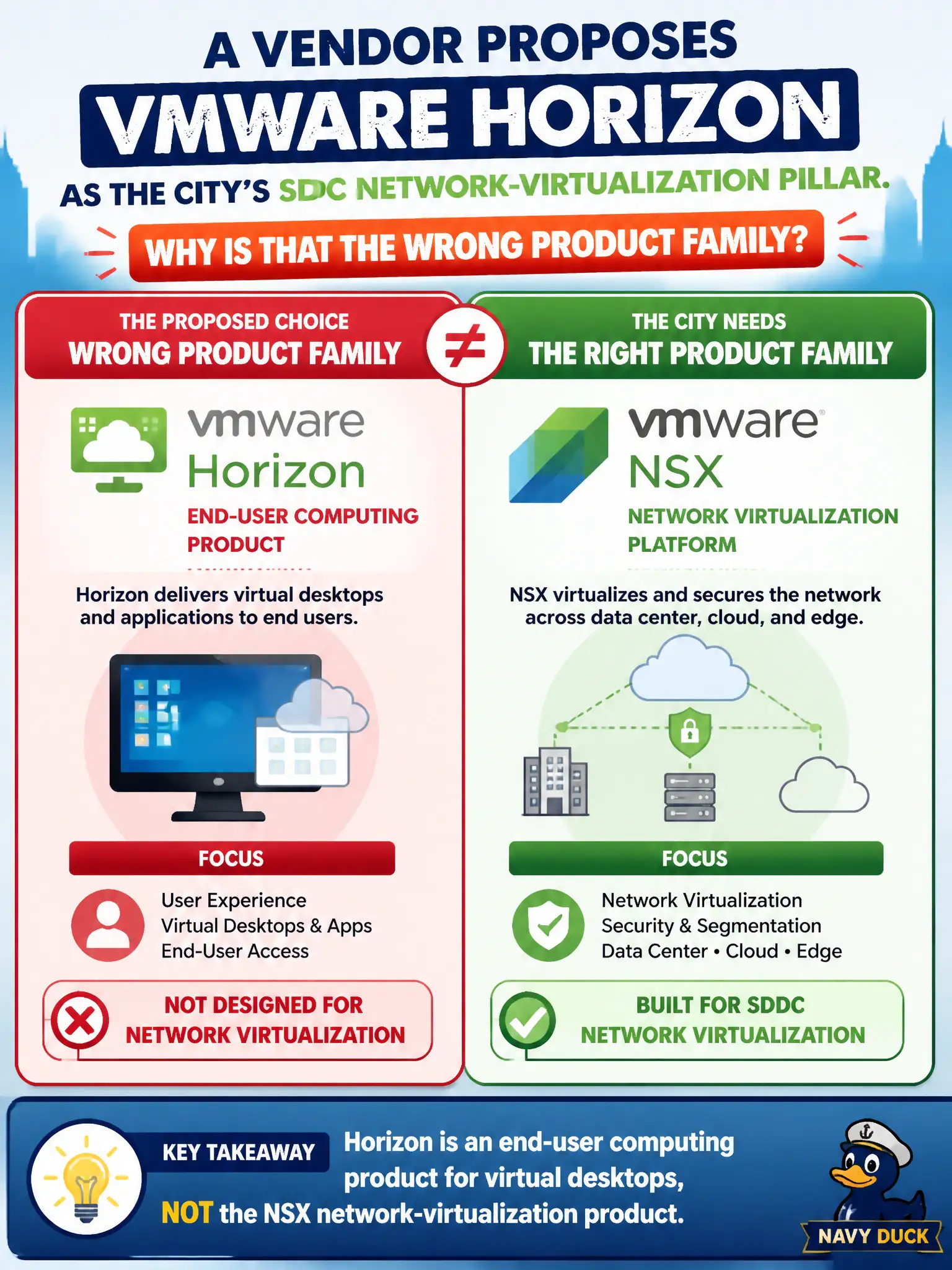
Horizon publishes virtual desktops. It is not the city's overlay, firewall, and logical-router product. That network pillar is NSX-T. Horizon is not Geneve, not vSAN, and not the NSX Manager cluster.
Full Explanation
A vendor proposing VMware Horizon as the city’s SDDC network-virtualization pillar is pointing at the wrong product family. Horizon is an end-user computing product for virtual desktops and published applications, not the NSX network-virtualization product that supplies overlay, distributed firewall, and logical routing for civic workloads. Claiming Horizon is the overlay encapsulation protocol NSX-T uses instead of Geneve is false—Geneve remains the NSX-T encapsulation, and Horizon is not an encapsulation format. Claiming Horizon is the VMware SDDC storage product that replaces vSAN confuses desktops with datastores and would leave the city without hyperconverged storage. Claiming Horizon is the three-node NSX Manager cluster confuses EUC control planes with NSX management appliances. Exam caveat: Horizon often appears in municipal designs for clerks and remote staff, but architecture questions that ask for the network pillar still expect NSX-T. Do not let familiar EUC branding overwrite SDDC pillar identification on the exam or in an RFP response. Operational check: in the BOM or architecture review, place Horizon under end-user computing; place NSX-T under network virtualization; and reject any statement that Horizon replaces Geneve, vSAN, or the NSX Manager cluster before the city signs the network-virtualization line item. File the corrected BOM line items with procurement so Horizon stays scoped to desktops and NSX-T remains the funded network-virtualization line.