
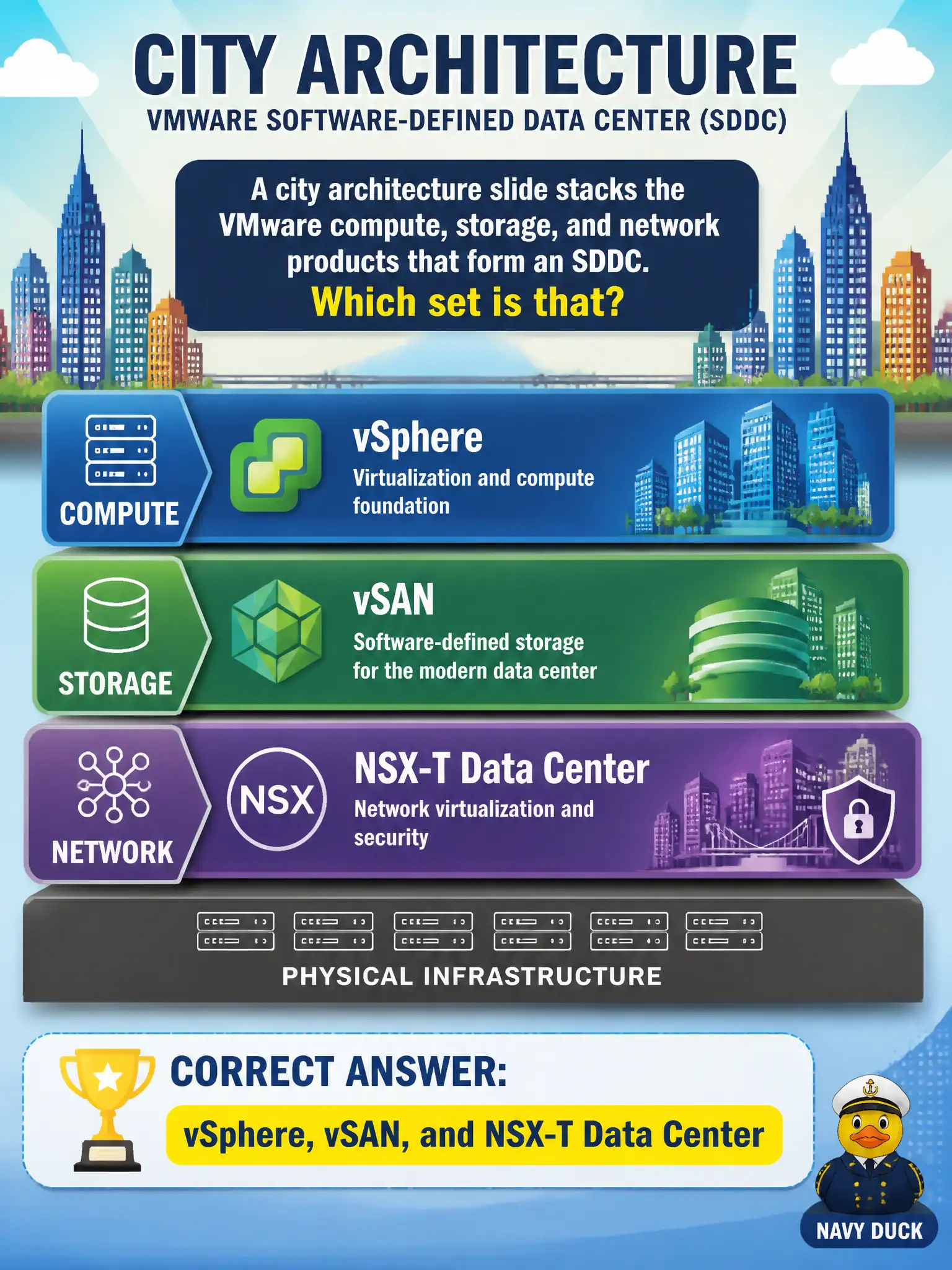
A city architecture slide stacks the VMware compute, storage, and network products that form an SDDC. Which set is that?
Select an answer to reveal the explanation.
Short Explanation
The three SDDC logos are the hypervisor, the software datastore, and the virtual network: vSphere, vSAN, and NSX-T. Horizon stacks are desktops, Carbon Black stacks are endpoint security, and Intelligence, HCX, or Service Mesh are add-ons—not the required three pillars.
Full Explanation
A city architecture slide that stacks the VMware compute, storage, and network products forming an SDDC is naming vSphere, vSAN, and NSX-T Data Center. Those three logos are the hypervisor platform, the software datastore, and the virtual network—the classic civic SDDC pillar set taught at associate level. Horizon, App Volumes, and Workspace ONE form an end-user computing and digital-workspace stack for desktops and device access, not the three infrastructure pillars of the SDDC. Carbon Black, AppDefense, and Intelligent Hub are security and workspace-adjacent products, not the compute/storage/network triad. NSX Intelligence, HCX, and NSX Service Mesh are valuable add-ons or adjacent technologies for visibility, migration, or service connectivity; they are not the three required SDDC pillars. Exam caveat: exam guides emphasize vSphere, vSAN, and NSX as the core SDDC products; EUC and security portfolios are separate conversation tracks. Do not invent a “three pillars” set from analytics or migration tools when the slide asks for the SDDC stack. Operational check: on the city’s reference architecture slide, label compute as vSphere, storage as vSAN, and network as NSX-T; place Horizon, Carbon Black, or Intelligence in adjacent capability rows rather than as pillar replacements, and align the procurement BOM to the same three logos. Freeze that labeled triad in the city reference deck so subsequent vendors cannot redefine the pillars as Horizon, Carbon Black, or Intelligence add-ons.