
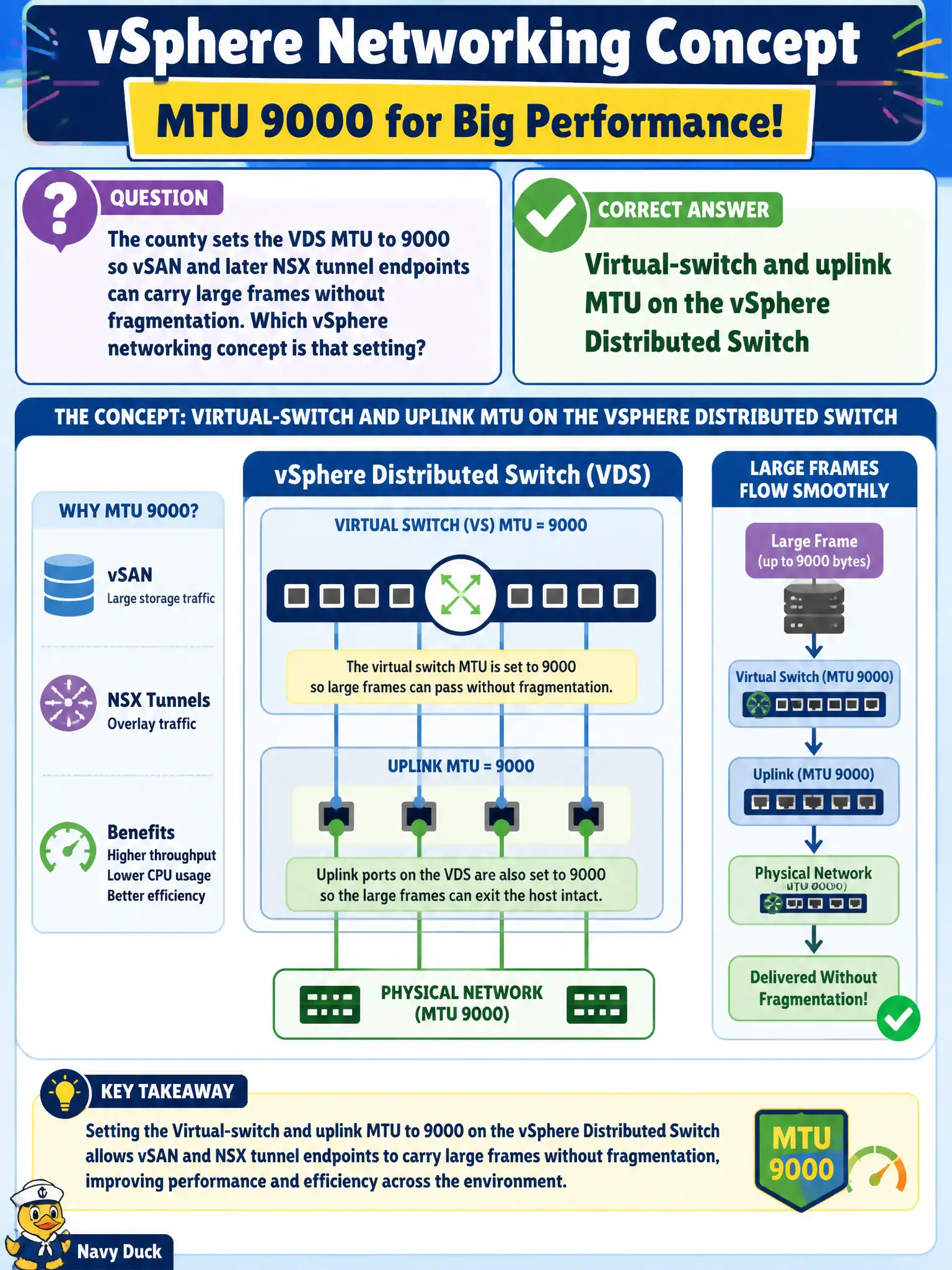
The county sets the VDS MTU to 9000 so vSAN and later NSX tunnel endpoints can carry large frames without fragmentation. Which vSphere networking concept is that setting?
Select an answer to reveal the explanation.
Short Explanation
MTU is the tunnel height on the vSphere road before you add extra wrapping. The county raises it on the VDS so vSAN and later Geneve frames fit. That is a vSphere uplink setting, not a firewall timer, a BGP timer, or a Carbon Black scan.
Full Explanation
Setting the VDS MTU to 9000 so vSAN and later NSX tunnel endpoints can carry large frames without fragmentation is configuring virtual-switch and uplink MTU on the vSphere Distributed Switch. MTU is the tunnel height on the vSphere road before extra wrapping is added; civic operators raise it end to end so large storage and Geneve frames fit without fragmentation. An NSX Distributed Firewall session timer controls session aging for firewall state, not frame size on the wire. A Tier-0 BGP keepalive interval tunes routing adjacency timers toward the external network, unrelated to VDS MTU. A Carbon Black sensor scan interval schedules endpoint scanning and never sets host or uplink MTU. Exam caveat: MTU must be consistent across hosts, uplinks, and physical switches between endpoints; raising only the VDS while leaving the ToR at 1500 still causes problems. Associate depth is identifying MTU as the switch/uplink size setting, not calculating every overhead byte on the exam. Operational check: set VDS and VMkernel MTU as designed (for example 9000), verify physical switch MTU along the path, and test large pings or vSAN/NSX health checks to confirm no fragmentation or silent drops between hosts that will host TEPs or vSAN.