
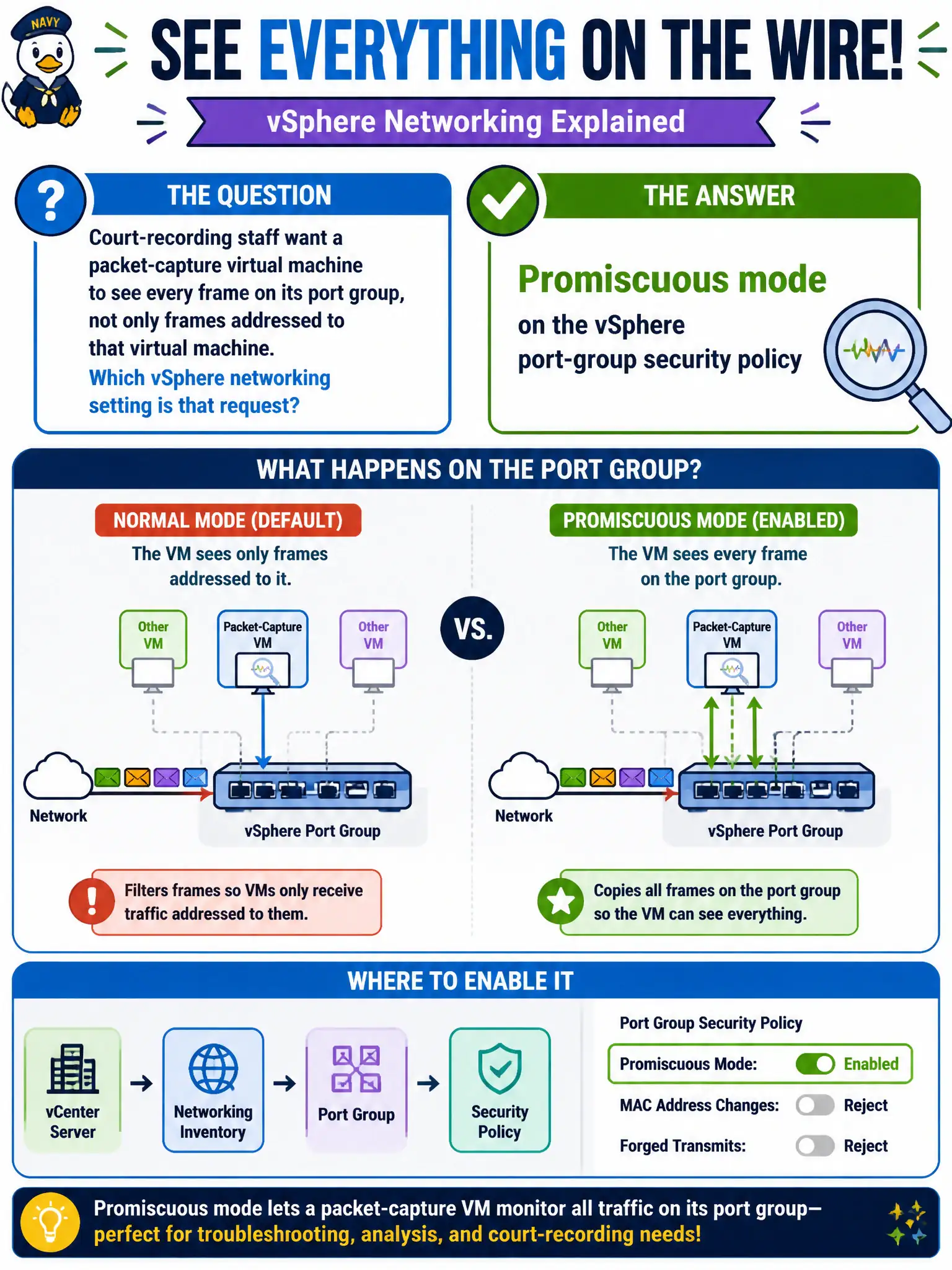
Court-recording staff want a packet-capture virtual machine to see every frame on its port group, not only frames addressed to that virtual machine. Which vSphere networking setting is that request?
Select an answer to reveal the explanation.
Short Explanation
Promiscuous mode is a security-camera setting on the vSphere jack: the capture VM is allowed to see every frame on that port group. It is not an NSX firewall rule and not a vMotion VMkernel port.
Full Explanation
Court-recording staff who need a packet-capture virtual machine to see every frame on its port group—not only frames addressed to that VM—are asking for promiscuous mode on the vSphere port-group security policy. Promiscuous mode is a security-camera setting on the vSphere jack: when enabled, the capture VM may receive all frames on that port group for analysis. An NSX Distributed Firewall allow-any rule permits traffic that would otherwise be blocked; it does not make a guest see frames not destined to it on a vSphere port group. An NSX gateway-firewall identity rule is an identity-based north-south or gateway policy concept, not the vSphere port-group security switch for sniffing. A VMkernel adapter enabled for vMotion carries host live-migration service traffic and does not grant a guest promiscuous visibility on a VM port group. Exam caveat: promiscuous mode, MAC address changes, and forged transmits are the classic vSphere port-group security trio; enabling promiscuous mode has security implications and is usually limited to capture or nested environments. It is not a substitute for proper SPAN or monitoring design in every civic case. Operational check: enable promiscuous mode only on the capture port group (or a dedicated capture network), attach the capture VM, and confirm it receives broadcasts and other hosts’ frames on that group; leave production port groups restrictive unless a documented exception exists.