
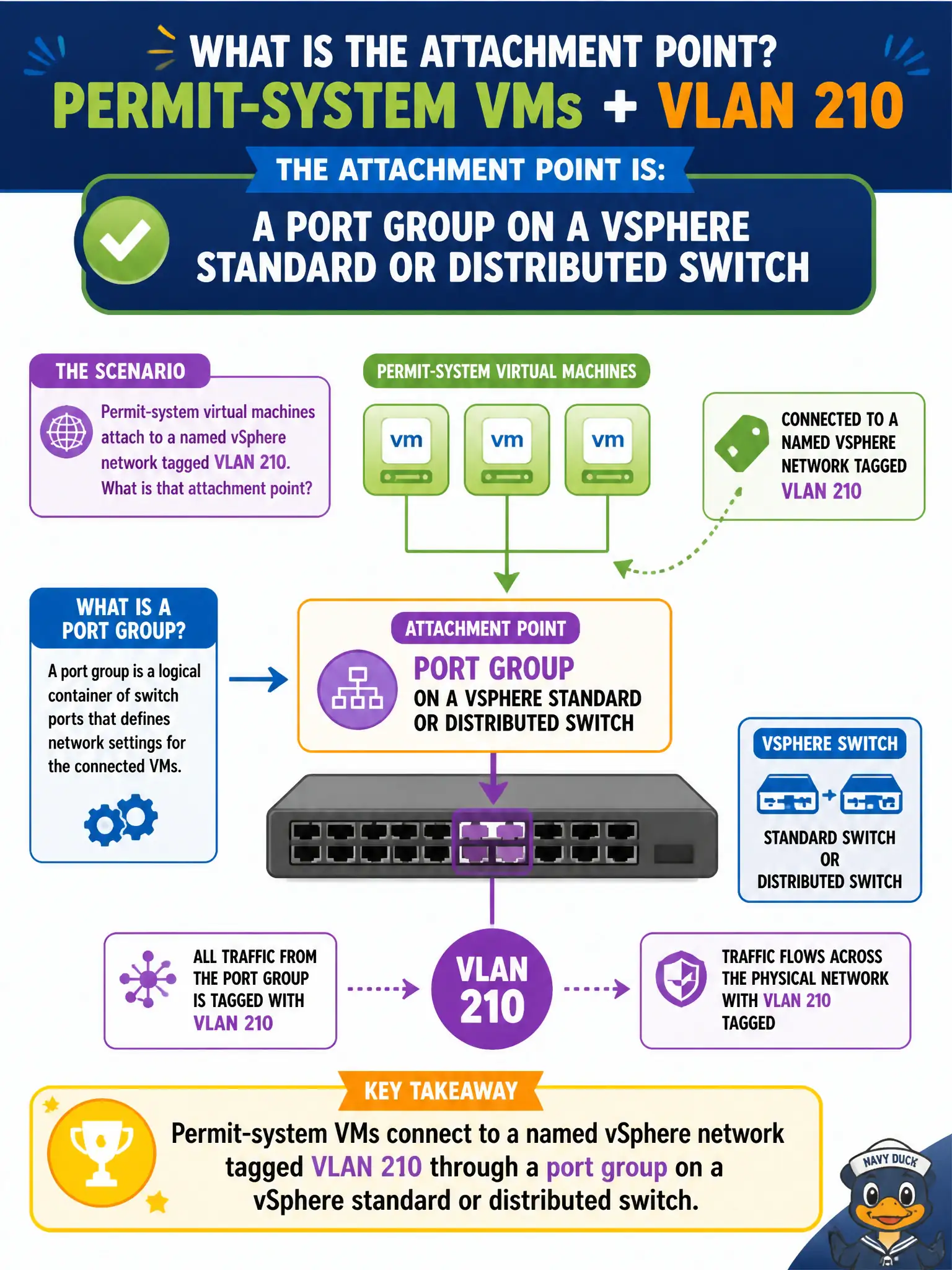
Permit-system virtual machines attach to a named vSphere network tagged VLAN 210. What is that attachment point?
Select an answer to reveal the explanation.
Short Explanation
A port group is the labeled wall jack the permit VMs plug into. VLAN 210 is just the tag on that jack. A transport zone, Tier-0, or VTEP is an NSX fabric object, not the vSphere attachment name on the virtual switch.
Full Explanation
Permit-system virtual machines attach to a named vSphere network tagged VLAN 210 at a port group on a vSphere standard or distributed switch. The port group is the labeled wall jack: it names the network, carries the VLAN tag (or other policies), and is what the guest vNIC selects in inventory. Civic operators should think of VLAN 210 as the paint on that jack, not as an NSX fabric membership the guest OS joins by itself. An NSX transport zone that the guest operating system joins directly is incorrect—transport zones are NSX span constructs for prepared transport nodes, not a guest attachment the OS “joins.” An NSX Tier-0 gateway that every virtual NIC must plug into confuses north-south routing with L2 attachment; vNICs attach to segments or port groups, not directly into Tier-0 as a universal plug. A Geneve VTEP created automatically inside the permit application confuses underlay tunnel endpoints on hosts with the application’s attachment point. Exam caveat: after NSX, opaque networks or segments may appear in vCenter as attachment choices, but the classic vSphere attachment named here is still the port group on a VSS or VDS. Operational check: edit the permit VM’s network adapter settings and confirm it is connected to the intended port group with VLAN 210; from the guest, verify tagging and L2 reachability match that port group, not an unrelated NSX object name.