
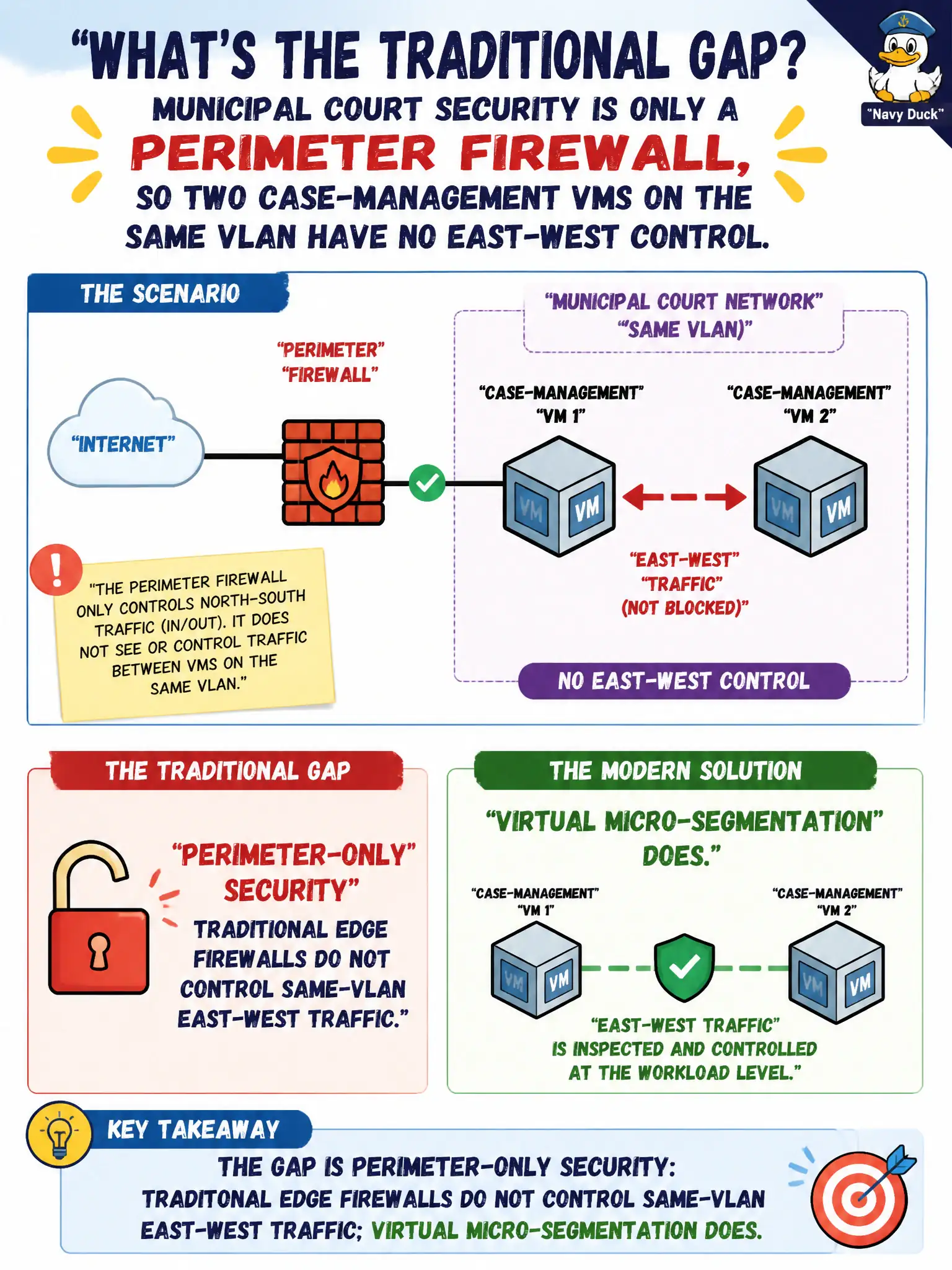
Municipal court security is only a perimeter firewall, so two case-management VMs on the same VLAN have no east-west control. Which traditional gap is that?
Select an answer to reveal the explanation.
Short Explanation
A perimeter firewall is the courthouse front door. Two VMs on the same VLAN are already inside the building and can talk in the hallway. Micro-segmentation puts a checkpoint between those rooms.
Full Explanation
Perimeter-only security leaves same-VLAN east-west traffic uncontrolled, so two municipal court case-management VMs on one VLAN can talk freely past the edge firewall. Virtual micro-segmentation closes that gap with distributed policy between workloads. A perimeter firewall does not inspect all same-VLAN east-west by default. Carbon Black does not replace network controls between those VMs. Horizon published apps are not the court's east-west firewall for server tiers. Exam caveat: micro-segmentation requires accurate grouping and default-deny design; buying NSX alone without policy still leaves lateral risk. Operational check: place two court test VMs on the same segment and verify DFW denies unexpected ports while allowing only documented application flows. Keep municipal naming and change tickets aligned with the software objects so civic audits can trace intent. Prefer verifying with a non-production agency workload before promoting the same pattern to life-safety systems. Record realization state and underlay health in the runbook used by on-call city operators. Keep municipal naming and change tickets aligned with the software objects so civic audits can trace intent. Prefer verifying with a non-production agency workload before promoting the same pattern to life-safety systems.