
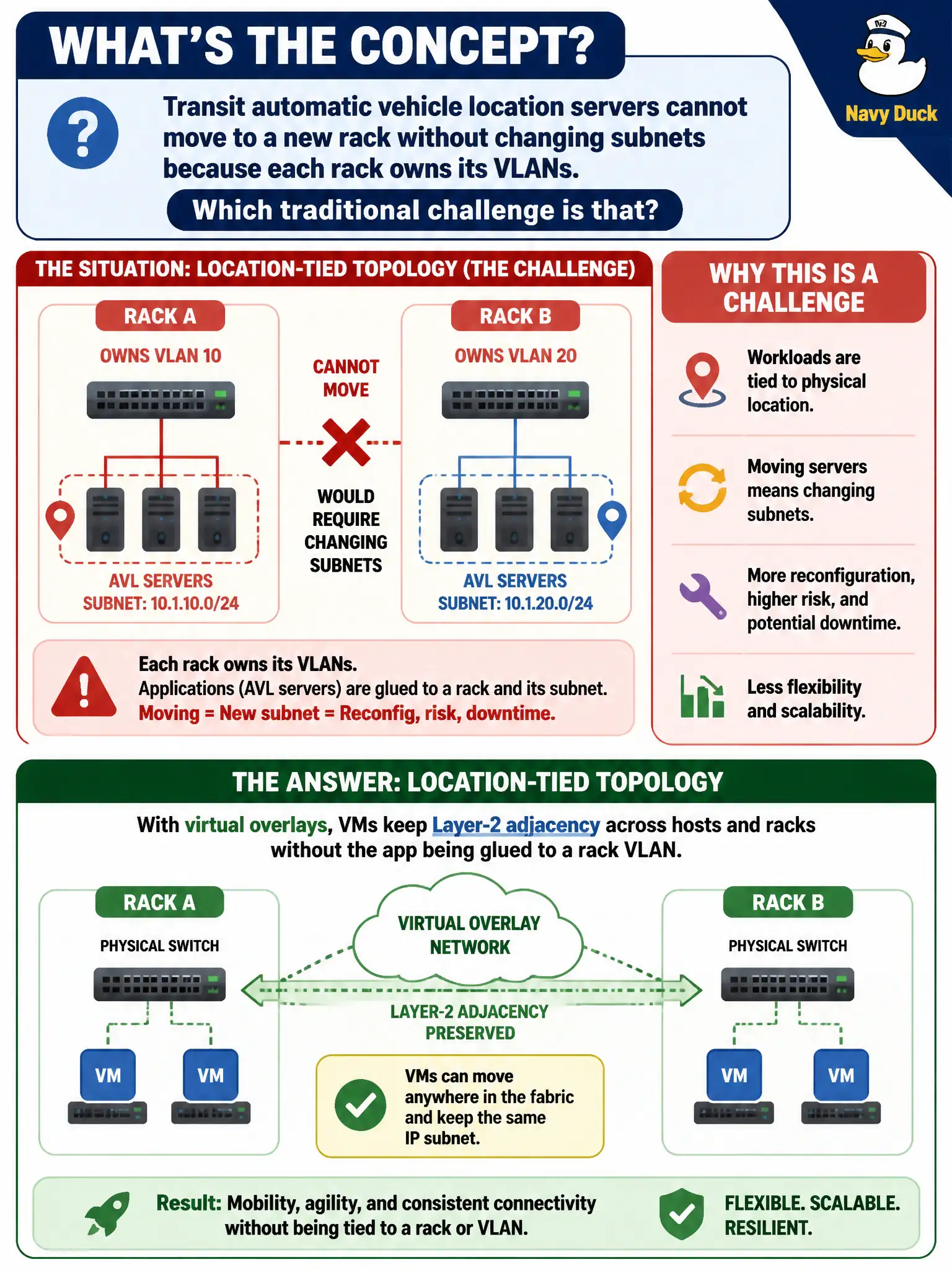
Transit automatic vehicle location servers cannot move to a new rack without changing subnets because each rack owns its VLANs. Which traditional challenge is that?
Select an answer to reveal the explanation.
Short Explanation
Rack-tied VLANs are like bus routes that only work on one street. Overlays let the AVL VMs keep their neighborhood even if they roll to another rack. The app should not have to change its address just because facilities moved a server.
Full Explanation
Location-tied topology appears when transit AVL servers cannot move racks without changing subnets because each rack owns its VLANs. Virtual overlays let VMs keep Layer-2 adjacency across hosts and racks without gluing the application to a rack VLAN, so mobility no longer implies renumbering. Overlays do not force every AVL subnet to the rack VLAN. Horizon Cloud Pod networking is a different problem domain. vSAN stretched clusters address storage/site patterns and are not the only way to keep IPs after a rack move. Exam caveat: destination hosts must be transport nodes on the same overlay networking fabric; overlays enable mobility but do not excuse unprepared clusters. Operational check: vMotion an AVL test VM across racks on an overlay segment and confirm IP and L2 adjacency remain without a subnet change. Keep municipal naming and change tickets aligned with the software objects so civic audits can trace intent. Prefer verifying with a non-production agency workload before promoting the same pattern to life-safety systems. Record realization state and underlay health in the runbook used by on-call city operators. Keep municipal naming and change tickets aligned with the software objects so civic audits can trace intent.