
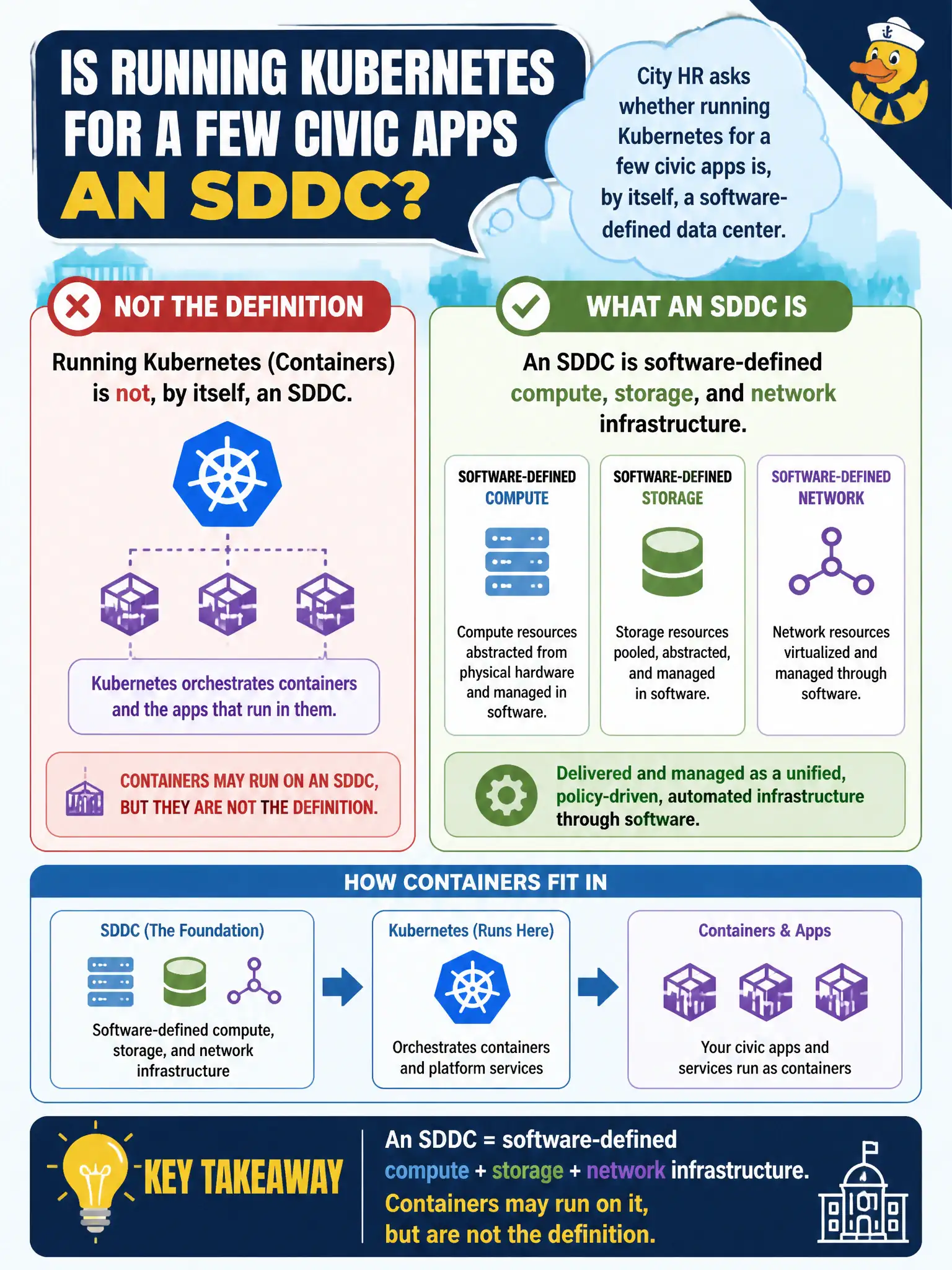
City HR asks whether running Kubernetes for a few civic apps is, by itself, a software-defined data center. What should the candidate identify?
Select an answer to reveal the explanation.
Short Explanation
Containers can live in an SDDC, but they are not the definition. SDDC still means software-defined compute, storage, and networking—whether the workload is a VM or a pod.
Full Explanation
An SDDC is software-defined compute, storage, and network infrastructure; containers may run on it but are not themselves the definition. City HR asking whether Kubernetes for a few civic apps equals an SDDC should hear that pods can be workloads on an SDDC, yet SDDC status still depends on virtualized infrastructure pillars and operating model. Kubernetes is not the official VMware name for NSX-T. Running containers does not automatically imply vSAN and NSX-T are in place. Requiring every city app to be a container with vSphere removed invents a false exclusivity. Exam caveat: Tanzu or upstream Kubernetes often integrates with NSX for container networking, but that integration is complementary, not a renaming of SDDC. Operational check: inventory whether compute, storage, and network services are software-defined for the cluster estate; treat Kubernetes adoption as a workload platform decision separate from whether those pillars exist. Keep municipal naming and change tickets aligned with the software objects so civic audits can trace intent. Prefer verifying with a non-production agency workload before promoting the same pattern to life-safety systems. Record realization state and underlay health in the runbook used by on-call city operators.