
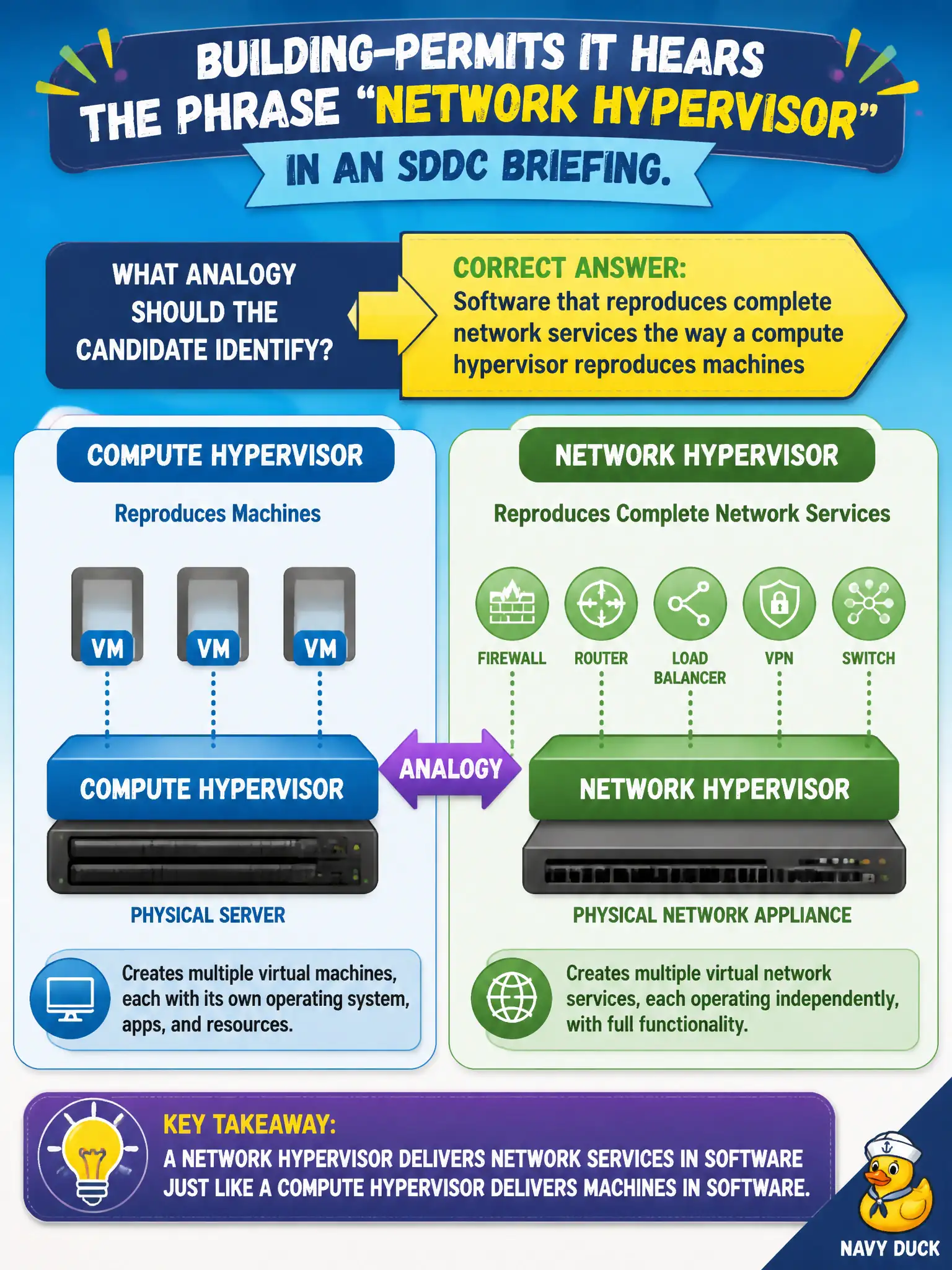
Building-permits IT hears the phrase “network hypervisor” in an SDDC briefing. What analogy should the candidate identify?
Select an answer to reveal the explanation.
Short Explanation
A compute hypervisor pretends to be many servers. A network hypervisor pretends to be the switches, routers, and firewalls. Same idea, different closet.
Full Explanation
A "network hypervisor" is software that reproduces complete network services the way a compute hypervisor reproduces machines. Building-permits IT should map the analogy to NSX-style network virtualization: logical switching, routing, and security services are presented as software constructs on a shared underlay, just as VMs are presented on shared hosts. It is not a Horizon Connection Server, which brokers desktops. It is not a Carbon Black sensor, which performs endpoint security. It is not merely a physical chassis OS that cannot be virtualized; the point of the phrase is software reproduction of network functions. Exam caveat: the analogy teaches scope—full network services in software—without claiming the physical underlay disappears. Operational check: list the network services the city now creates as NSX objects (segment, gateway, DFW) and confirm operators describe them as software services analogous to VMs rather than as new chassis SKUs. Keep municipal naming and change tickets aligned with the software objects so civic audits can trace intent. Prefer verifying with a non-production agency workload before promoting the same pattern to life-safety systems. Record realization state and underlay health in the runbook used by on-call city operators.