
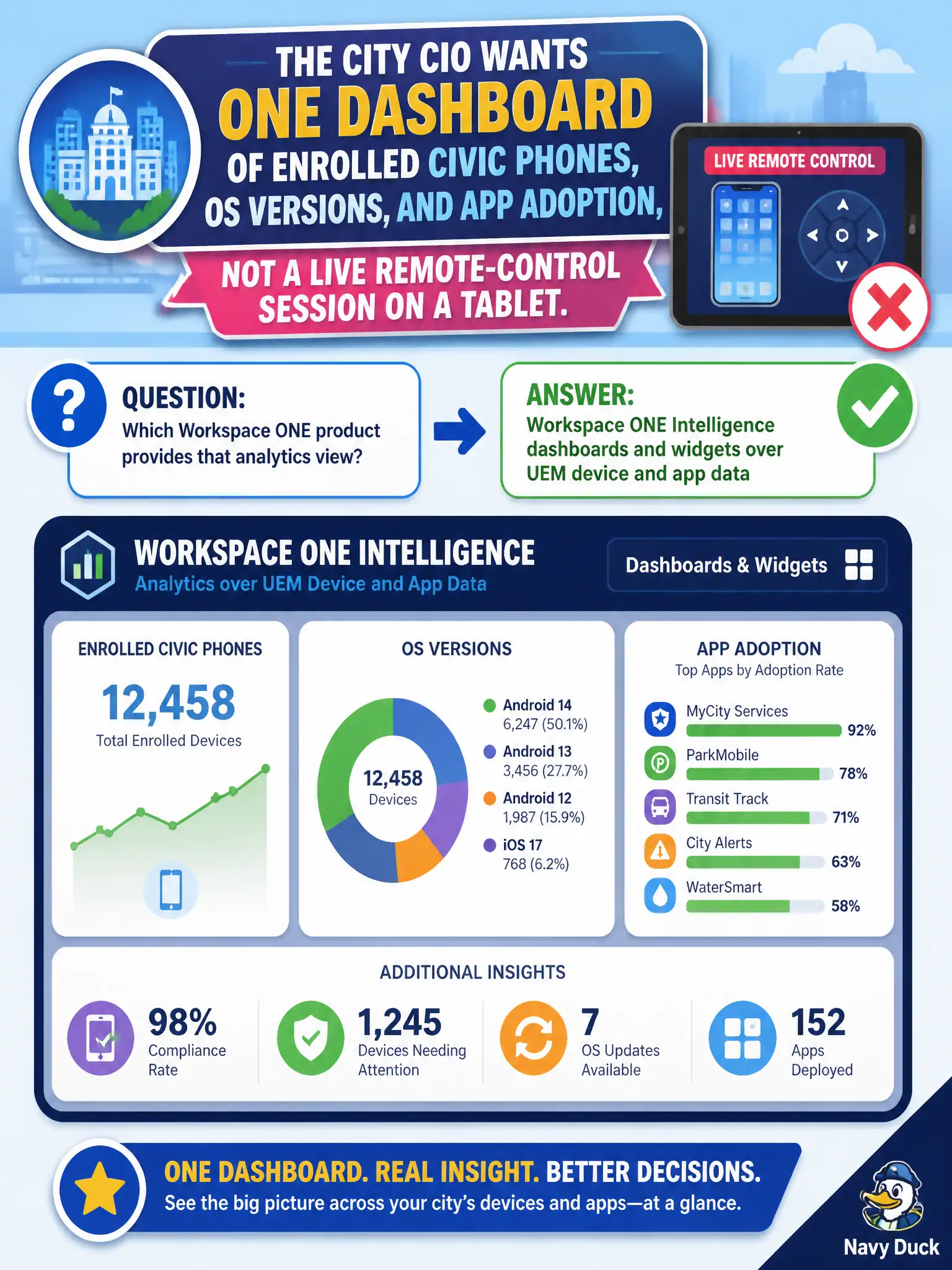
The city CIO wants one dashboard of enrolled civic phones, OS versions, and app adoption, not a live remote-control session on a tablet. Which Workspace ONE product provides that analytics view?
Select an answer to reveal the explanation.
Short Explanation
Think of Intelligence as the city hall scoreboard, not the flashlight you shine into one desk drawer. It rolls up enrolled phones, OS versions, and app adoption. Assist is the flashlight; Help Desk and NSX are other buildings.
Full Explanation
For a city CIO who needs one municipal scoreboard of enrolled phones, OS versions, and app adoption—not a live view of a single tablet—Workspace ONE Intelligence is the product that consumes Unified Endpoint Management device and application telemetry and presents it as dashboards and widgets. That is the associate-depth analytics plane for civic fleet visibility across departments such as permitting, parks, and public works. Think of Intelligence as city hall’s operations dashboard: it aggregates many endpoints into inventory and adoption views rather than intervening on one device. Workspace ONE Assist is the remote-support product for a single UEM-managed endpoint; it answers a help-desk session, not a CIO dashboard. Horizon Help Desk surfaces live VDI session metrics for a clerk desktop and does not inventory civic phones. NSX Manager inventories Geneve overlay segments and belongs to the network virtualization plane, not Workspace ONE UEM analytics. Exam caveat: Intelligence reports and widgets depend on UEM (and related) data being available to Intelligence; licensing and connector or data-feed health matter, and Intelligence does not replace Assist for remote control or Horizon Help Desk for VDI sessions. Operational check: open an Intelligence dashboard for the city’s enrolled mobile fleet, confirm OS-version and app-adoption widgets populate from UEM devices, and verify that starting Assist on one inspector phone does not appear as the CIO’s fleet scoreboard.