
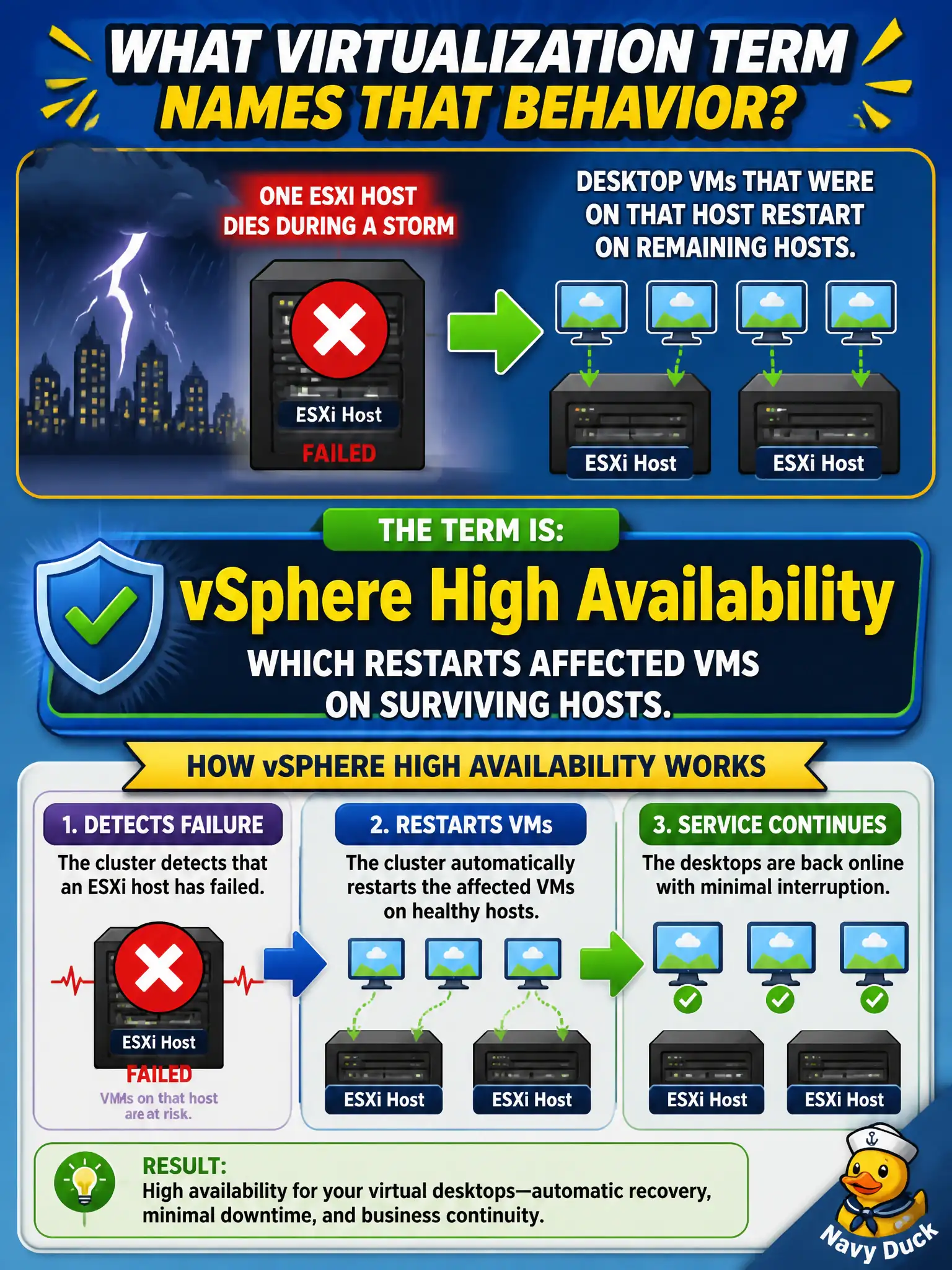
One ESXi host in the city's Horizon cluster dies during a storm. Desktop VMs that were on that host restart on remaining hosts. Which virtualization term names that behavior?
Select an answer to reveal the explanation.
Short Explanation
When a host dies, HA is the civic generator that starts those desktop VMs on another host. DRS is the load balancer for living VMs, not the crash restart. UAG and DEM do not reboot guests after an ESXi failure.
Full Explanation
When one ESXi host dies and desktop VMs restart on remaining hosts, that behavior is vSphere High Availability. In municipal EUC terms, treat the endpoint as a window into city systems when the architecture says so, not as the system of record for the files or apps in the stem. Distractor concept: DRS balances load among living hosts; it is not what restarts VMs after a host crash. Distractor concept: Unified Access Gateway does not reboot guest VMs when Blast disconnects. Distractor concept: Dynamic Environment Manager remaps profiles; it does not restart VMs on surviving hosts. Exam caveat: Host failure → VM restart = HA; DRS is live balancing, UAG/DEM are not host-failure restart. Operational check: Simulate or review HA events on the Horizon cluster and confirm desktop VMs restart on surviving hosts after host loss. Record the chosen control and the rejected failure modes in the civic change ticket or runbook so on-call staff and auditors share the same rationale after the next maintenance window. Re-validate after personnel or image changes that the same control still meets the city's continuity, security, and support expectations for this service. Helpdesk coaching tip aligned to the conversational brief: When a host dies, HA is the civic generator that starts those desktop VMs on another host. DRS is the load balancer for living VMs, not the crash restart. UAG and DEM do not reboot guests after an ESXi failure.