
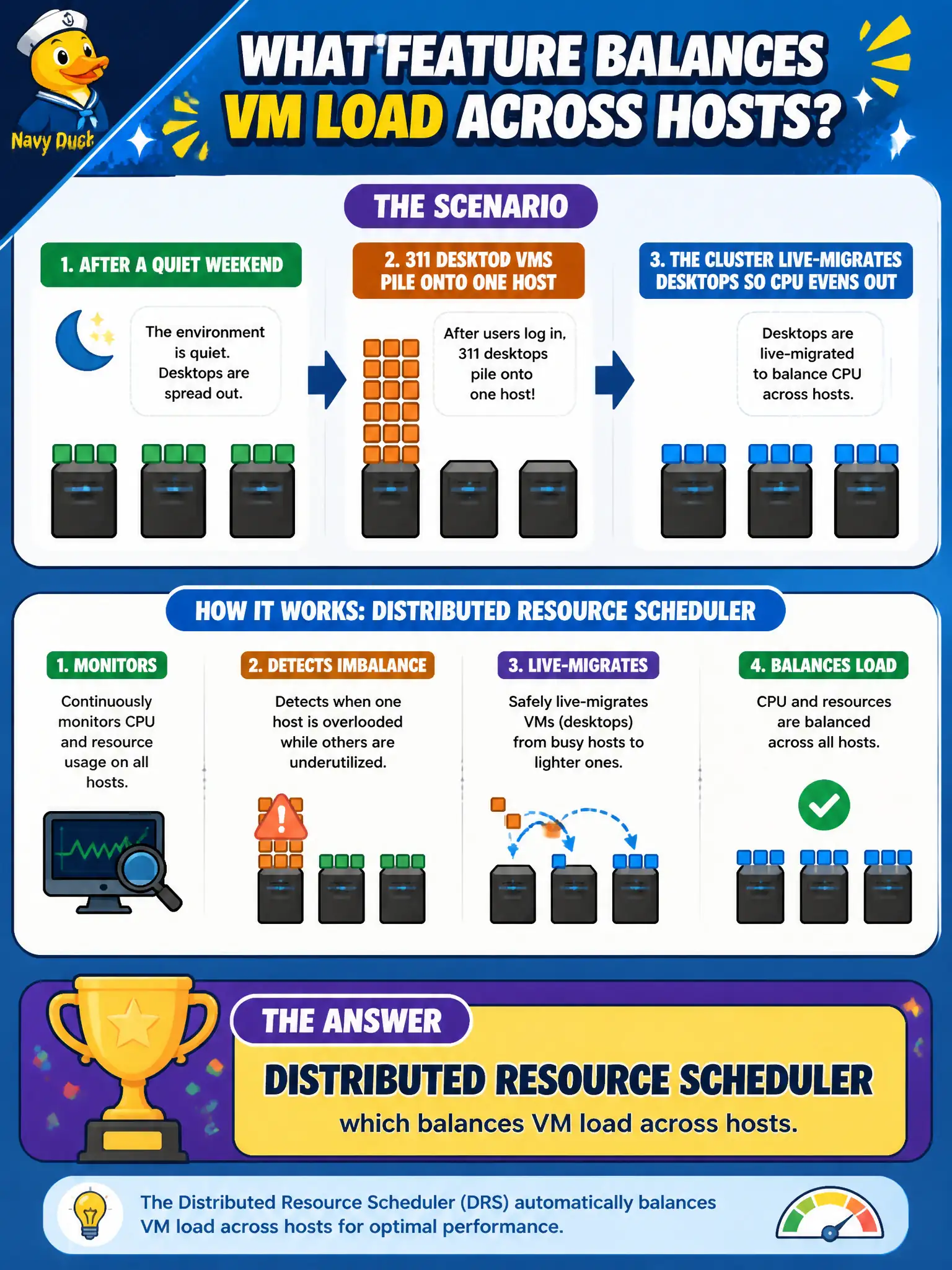
After a quiet weekend, 311 desktop VMs pile onto one host. The cluster then live-migrates some desktops so CPU evens out. Which feature did that?
Select an answer to reveal the explanation.
Short Explanation
VMs stacking on one host is like every 311 clerk lining up at one window. DRS moves some desktops to another host so CPU evens out. HA restarts VMs after a crash; it is not that weekday shuffle.
Full Explanation
After quiet hours pile 311 desktop VMs onto one host and the cluster live-migrates some for even CPU, that feature is Distributed Resource Scheduler. In municipal EUC terms, treat the endpoint as a window into city systems when the architecture says so, not as the system of record for the files or apps in the stem. Distractor concept: HA restarts VMs after host failure; it is not the weekday load-balancing engine. Distractor concept: Horizon Help Desk does not vMotion sessions when a clerk reports slowness as the cluster balancer. Distractor concept: UEM compliance does not move VMs that fail posture checks across ESXi hosts. Exam caveat: Live load balancing across hosts = DRS; do not call it HA, Help Desk, or UEM compliance. Operational check: Watch DRS recommendations/migrations after imbalance and confirm CPU evens without treating it as an HA failover story. Record the chosen control and the rejected failure modes in the civic change ticket or runbook so on-call staff and auditors share the same rationale after the next maintenance window. Re-validate after personnel or image changes that the same control still meets the city's continuity, security, and support expectations for this service.