
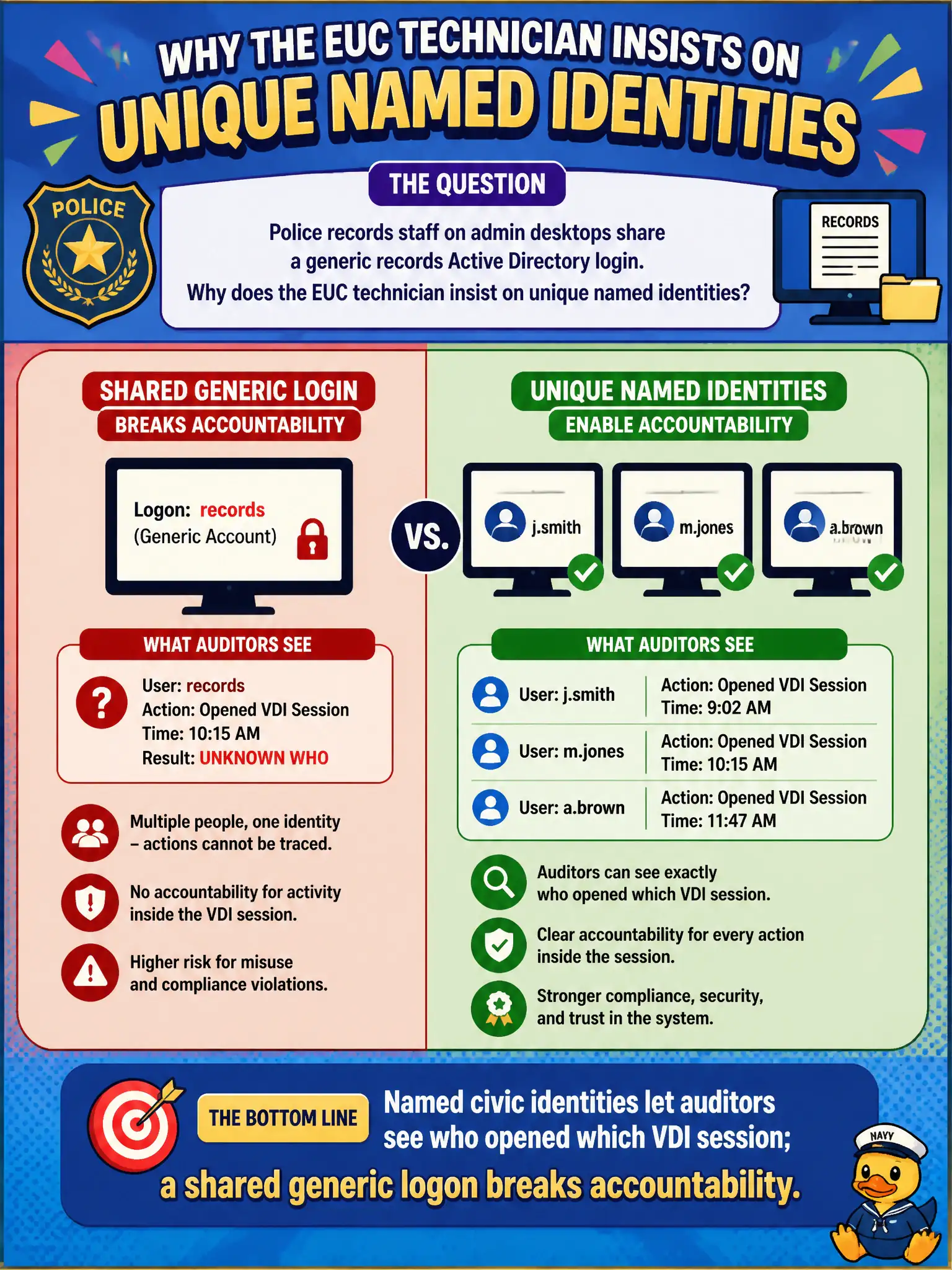
Police records staff on admin desktops share a generic records Active Directory login. Why does the EUC technician insist on unique named identities?
Select an answer to reveal the explanation.
Short Explanation
A shared records login is like one key on a hook labeled everyone. When something happens in a VDI session, nobody can say which clerk was there. Unique named identities are how IAM keeps an audit trail.
Full Explanation
Unique named civic identities let auditors see who opened which police-records VDI session; a shared generic AD logon breaks accountability. In municipal EUC terms, treat the endpoint as a window into city systems when the architecture says so, not as the system of record for the files or apps in the stem. Distractor concept: Shared generic logons are not required for App Volumes writable volumes. Distractor concept: Horizon Client does not require every clerk to use the same SAM account name. Distractor concept: UEM enrollment does not require a department-wide shared device password as the identity model. Exam caveat: Accountability stems reject shared generic accounts regardless of packaging or client myths. Operational check: Entitle named accounts only, open a session, and show audit/event data identifying the individual clerk—not a shared records login. Record the chosen control and the rejected failure modes in the civic change ticket or runbook so on-call staff and auditors share the same rationale after the next maintenance window. Re-validate after personnel or image changes that the same control still meets the city's continuity, security, and support expectations for this service.