
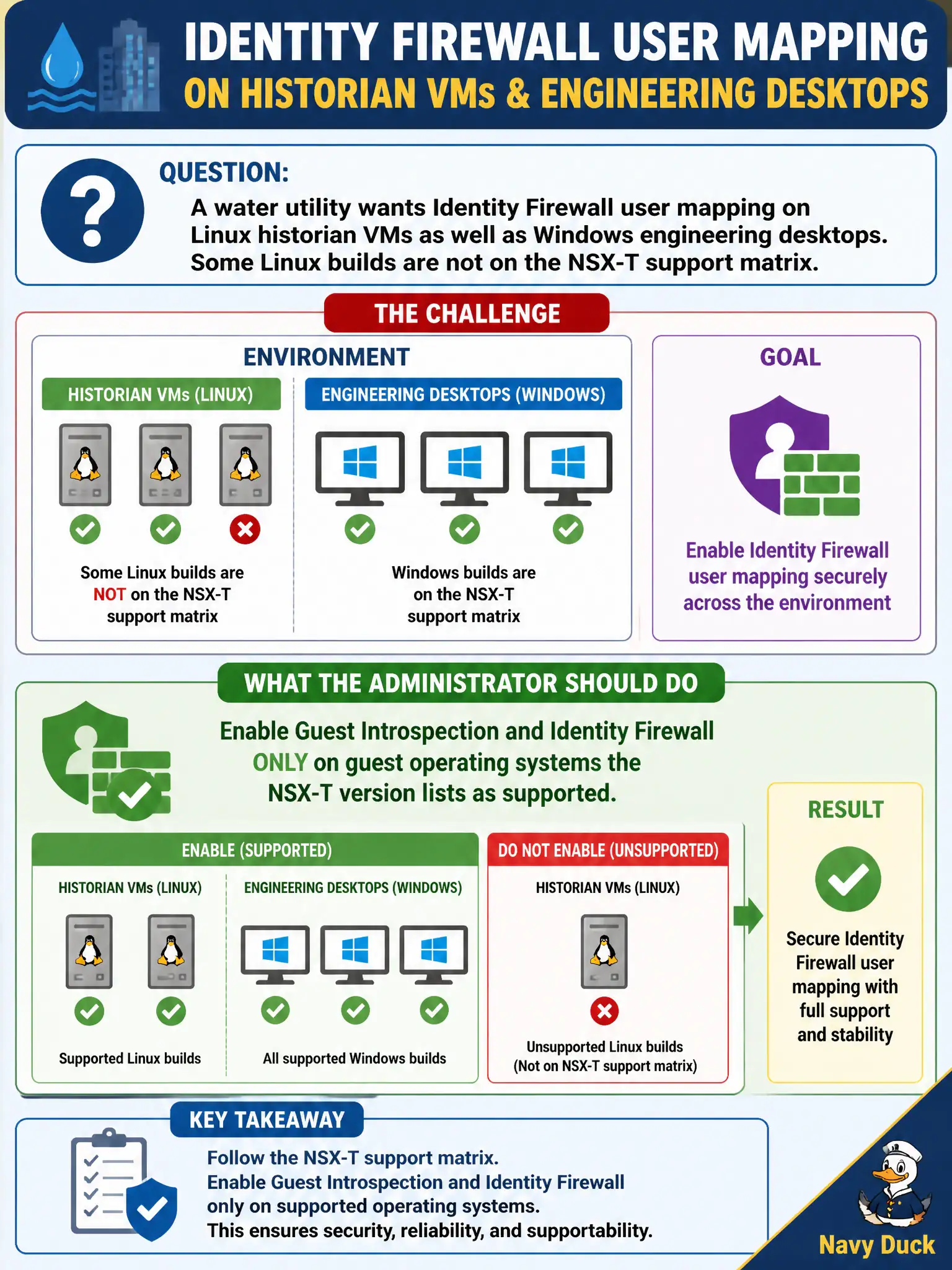
A water utility wants Identity Firewall user mapping on Linux historian VMs as well as Windows engineering desktops. Some Linux builds are not on the NSX-T support matrix. What should the administrator do?
Select an answer to reveal the explanation.
Short Explanation
GI and IDFW are picky about the guest OS. If the historian’s Linux is not on the support list, flipping the switch does not invent user mapping. Stick to supported guests.
Full Explanation
A water utility that wants Identity Firewall user mapping on Linux historian VMs must enable Guest Introspection and Identity Firewall only on guest operating systems the NSX-T version lists as supported. Unsupported Linux builds will not magically gain user mapping when the switch is flipped.
Enabling IDFW and GI on every Linux VM regardless of guest-OS support invites broken mappings and unsupported configs. Treating Carbon Black Live Response as a supported GI identity source on unsupported Linux is false. Installing only file introspection and assuming identity mapping works on every distribution skips the support matrix for identity features.
Exam caveat: always check the NSX-T guest support matrix before promising IDFW on Linux historians.
Operational check: compare historian OS builds to the matrix, enable GI/IDFW only on supported guests, validate user mapping on a pilot, and document unsupported hosts as out of IDFW scope.
Support-matrix gating for Linux IDFW prevents water-utility false confidence. Label unsupported historians as network-microsegmented only via non-IDFW controls, and revisit when NSX-T versions add support rather than forcing GI on unsupported kernels.