
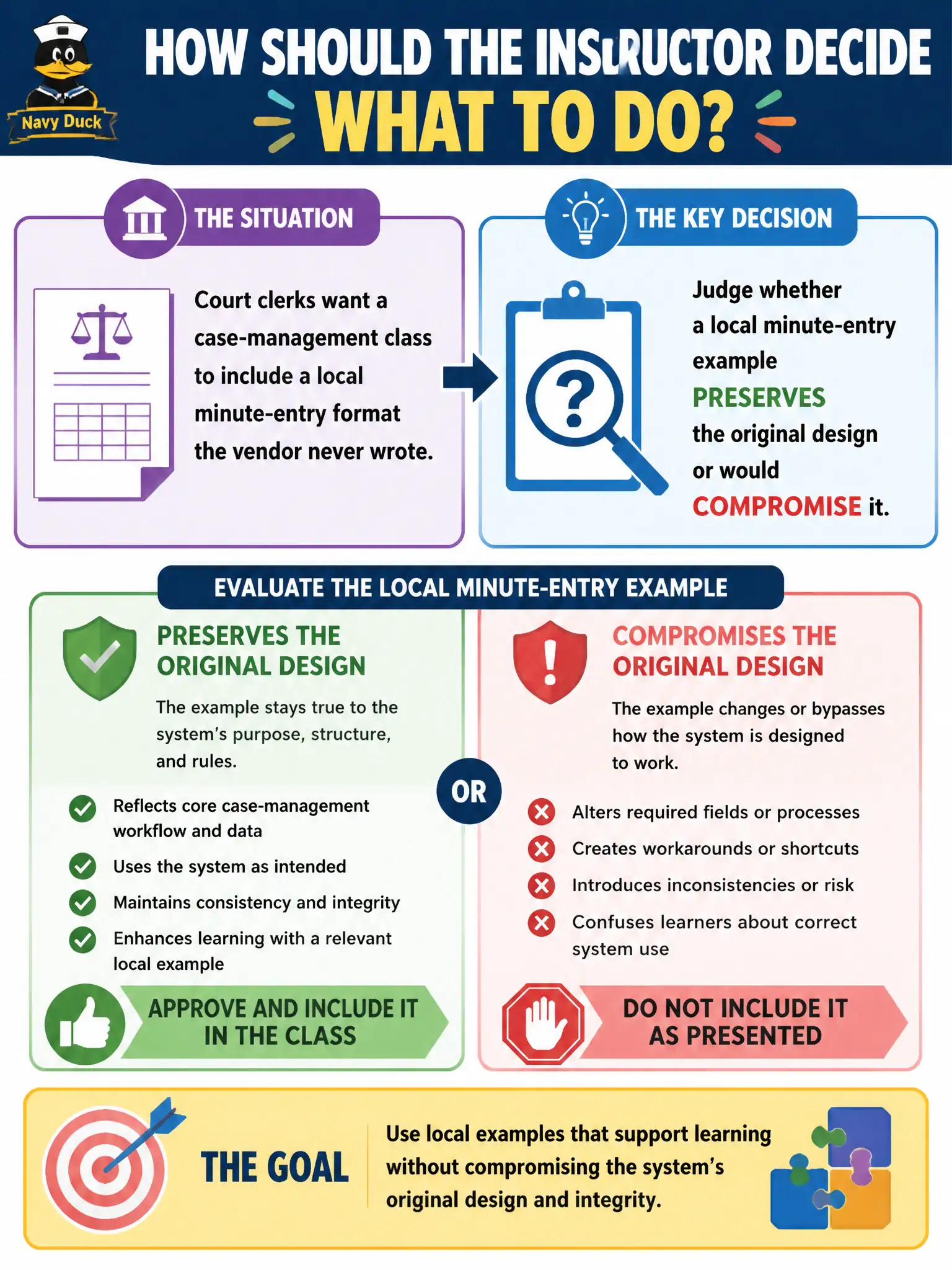
Court clerks want a case-management class to include a local minute-entry format the vendor never wrote. How should the instructor decide what to do?
Select an answer to reveal the explanation.
Short Explanation
Local minute-entry can be a perfect example—or a hijack. The test is whether the add-on still serves the designed objectives. If it does, customize; if it turns the class into a different course, don't.
Full Explanation
Local examples are appropriate only when they preserve original course design. Court clerks wanting a local minute-entry format the vendor never wrote should prompt the instructor to judge whether that example still serves the designed objectives or would compromise them into a different course. If the local form illustrates the same skills, customize; if it hijacks time and outcomes, refuse or escalate redesign. Always adding every local form because “customization has no limits” abandons design integrity. Refusing all local examples because vendor materials “cannot be touched” rejects legitimate within-design adaptation. Asking the vendor to delay class until a new edition ships with the local form postpones civic training for an optional media preference. Exam caveat: CTT+ customization questions hinge on whether the change preserves objectives, methods, and assessments—not on sponsor enthusiasm alone. Operational check: compare the local minute-entry form to each published objective, time the add-on, and approve it only if objectives and assessments remain intact. Courts run on local minute conventions; vendors ship generic samples. The instructional test is whether a local form still teaches the designed minute-entry skill inside the time box. CTT+ customization questions fail candidates who either rubber-stamp every local request or refuse all adaptation. Time a dry run with the local form; if it displaces core assessments, escalate redesign instead of quietly hijacking the class.