
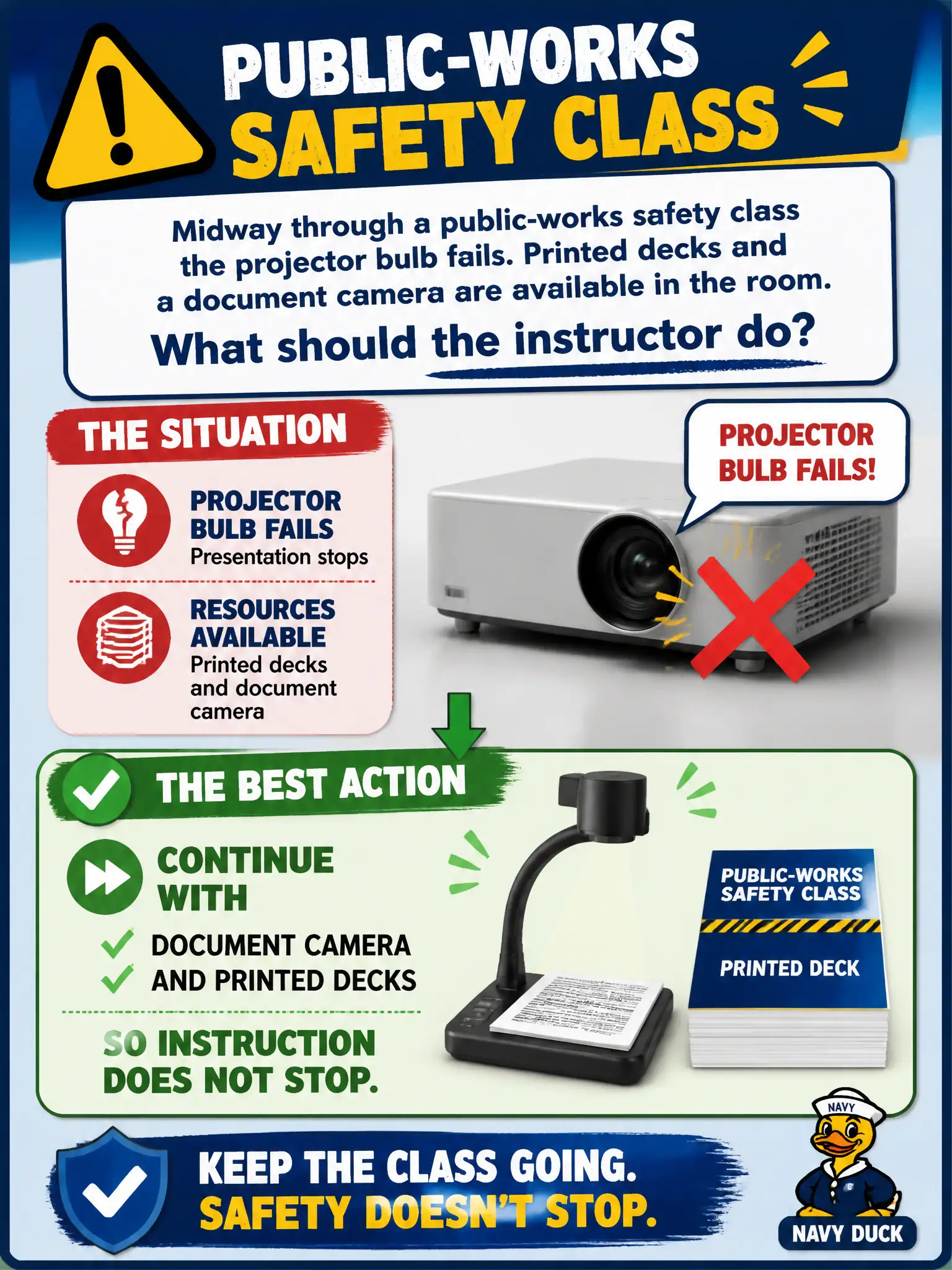
Midway through a public-works safety class the projector bulb fails. Printed decks and a document camera are available in the room. What should the instructor do?
Select an answer to reveal the explanation.
Short Explanation
A dead bulb is a speed bump, not a snow day. Grab the document camera and the printed decks and keep teaching. Public-works learners should not be sent home because one lamp burned out.
Full Explanation
Minor media failures are handled by substituting available media and continuing instruction so municipal learners still meet the objective. When a projector bulb fails mid public-works safety class and printed decks plus a document camera are already in the room, continuing with those backups preserves the safety content without treating a lamp failure as a full stop. Continuity of instruction is the professional standard.
Dismissing the class until facilities replaces the bulb fails by concept: a recoverable display problem does not justify sending crews home from required safety learning. Waiting silently through the remaining hour fails by burning instructional time without advancing the objective. Switching to an unplanned outdoor tour to avoid mentioning the failed projector fails because abandoning the designed safety lesson for an improvised activity does not meet the stated outcomes.
Exam caveat: CTT+ distinguishes catastrophic stoppers from minor media problems. If backups exist, substitute and continue; do not equate projector failure with class cancellation.
Operational check: before safety offerings, stage printed decks and confirm the document camera works; if the bulb fails, announce the switch in one sentence, continue the same safety sequence, and ticket facilities after learners are still learning.