
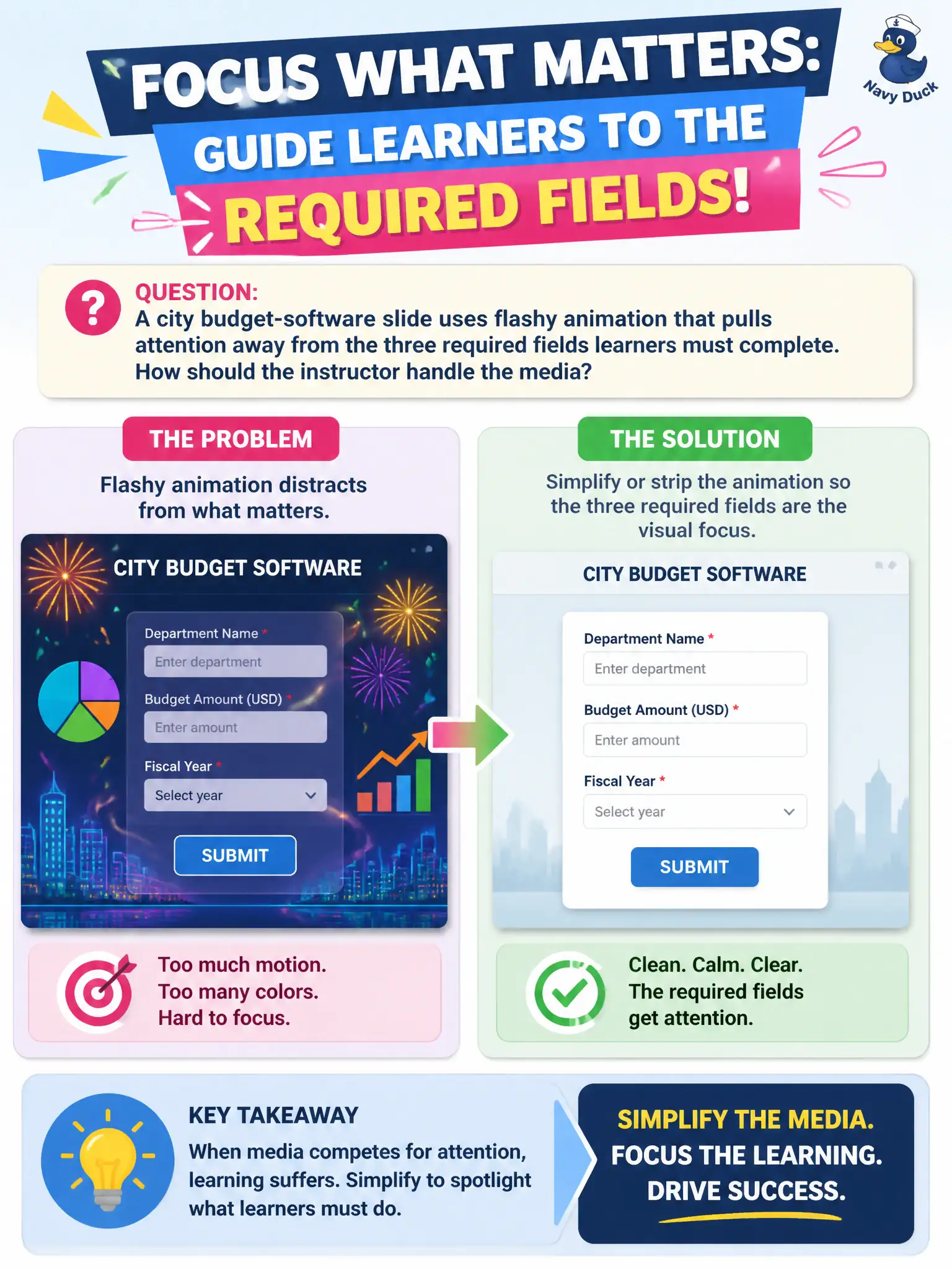
A city budget-software slide uses flashy animation that pulls attention away from the three required fields learners must complete. How should the instructor handle the media?
Select an answer to reveal the explanation.
Short Explanation
Flashy motion that hides the three fields is a magician's cape over the actual trick. Strip the animation so the required boxes are what people see. Media should carry the objective, not pick a fight with it.
Full Explanation
Instructors enhance or simplify media so visuals support, rather than compete with, the learning point. A city budget-software slide whose flashy animation pulls attention away from three required fields undermines the objective of accurate completion. Simplifying or stripping the animation so those fields become the visual focus is purposeful enhancement: the medium is edited to make the municipal task visible and teachable.
Leaving the animation because “excitement always increases retention” fails by concept; decorative motion that hides required fields decreases clarity of the skill. Adding bounce effects to every field fails by compounding distraction rather than directing attention. Skipping the slide and telling learners to discover the fields later on the live system fails by abandoning guided focus when the media problem was fixable in the moment.
Exam caveat: CTT+ treats media enhancement as instructional judgment—add, simplify, or substitute to serve objectives. Flash is not automatically good design.
Operational check: open the budget slide in edit view; remove or freeze nonessential animation; verify the three required fields are the first visual focus within three seconds; teach the completion path with that cleaned slide before learners touch the live municipal system.