
After each module of a public-health clinic EHR class, what interval of application should the instructor use?
Select an answer to reveal the explanation.
Short Explanation
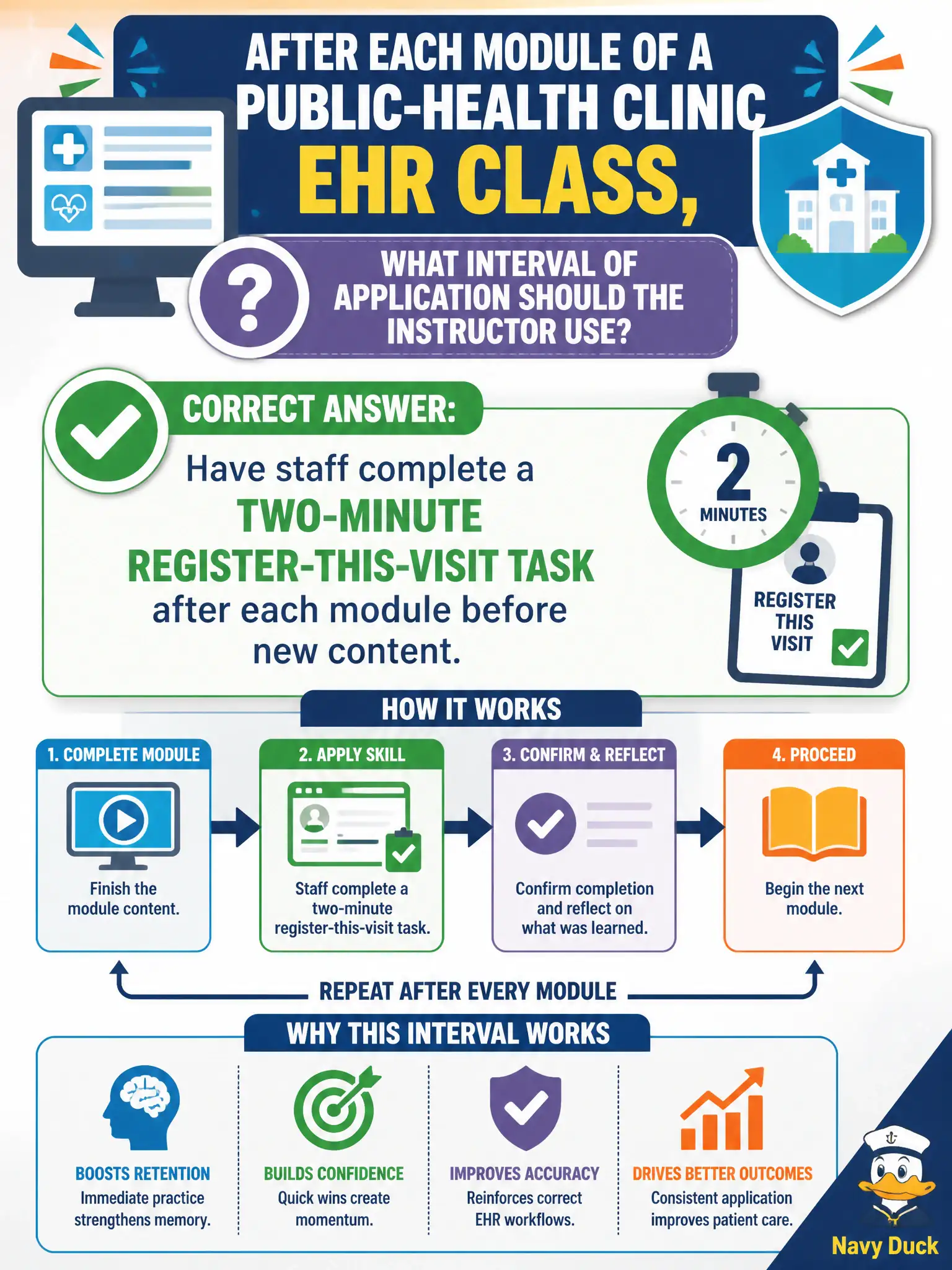
Dumping slides until late afternoon is a firehose. A two-minute register-this-visit after each module is a sip of practice while the idea is still warm. Adults remember what they just did, not what they only heard.
Full Explanation
Application should be frequent and brief after content chunks. After each module of a public-health clinic EHR class, staff should complete a two-minute register-this-visit task before new content so practice interleaves with instruction. Holding all practice until a single 4 p.m. lab after every slide finishes creates cognitive overload and delayed feedback. Skipping application in class for a take-home packet removes coaching. Replacing each module with untimed free-play that has no registration task abandons objective-focused practice. Exam caveat: CTT+ delivery emphasizes spaced application aligned to objectives, not marathon lecture then one dump of practice. Operational check: end each module with a timed registration micro-task, circulate for coaching, then advance only after the task maps to that module’s objective. Clinic EHR modules stack quickly; two-minute register tasks after each chunk stabilize skill before interference builds. End-of-day mega-labs arrive too late for coaching. CTT+ favors interleaved application. Prefill a micro-task card per module so facilitators do not invent practice under time pressure. Maintain that civic standard in the session file so auditors and future instructors can see how design integrity was preserved under real municipal constraints.