
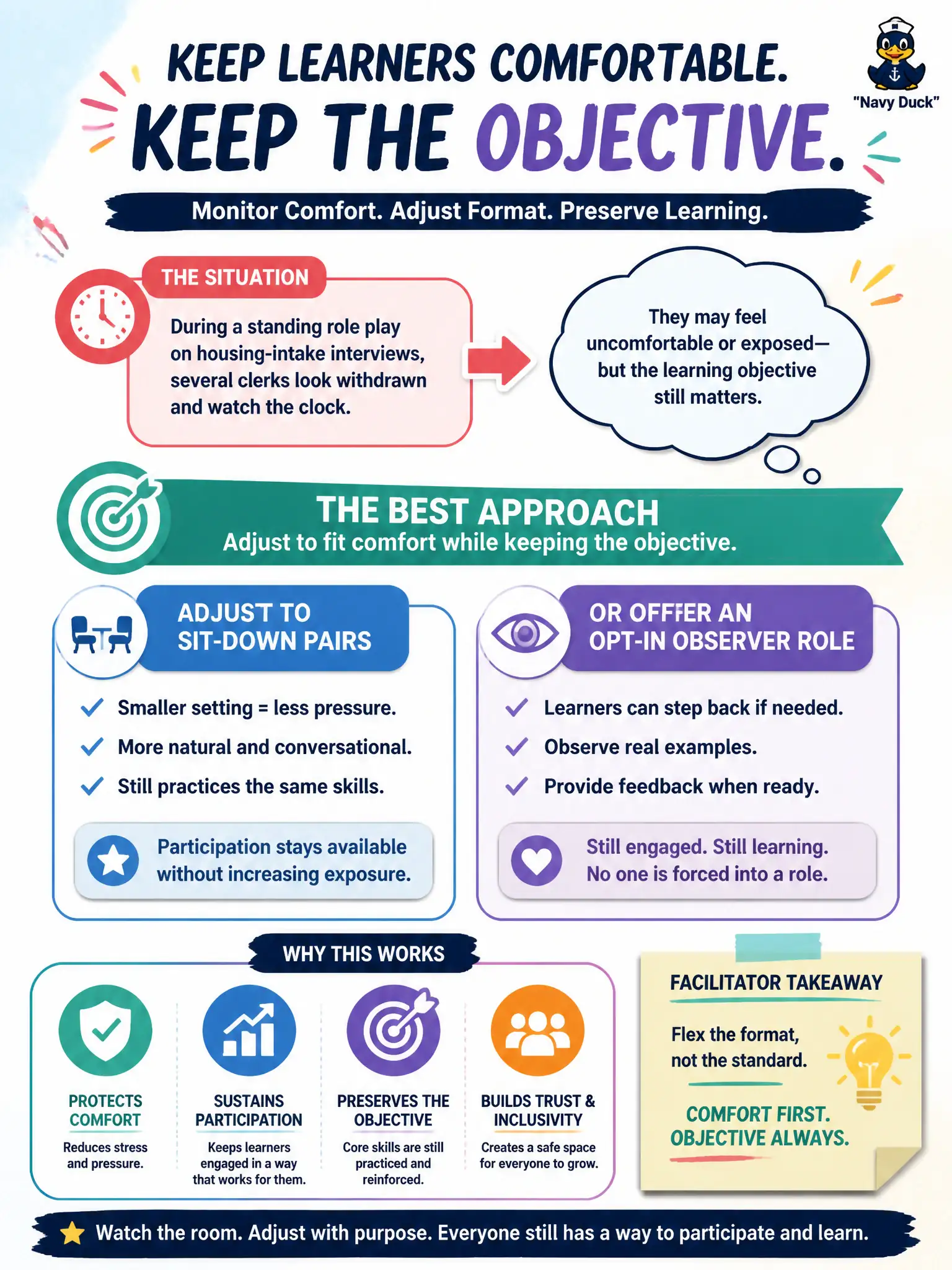
During a standing role play on housing-intake interviews, several clerks look withdrawn and watch the clock. How should the instructor monitor comfort and still keep the objective?
Select an answer to reveal the explanation.
Short Explanation
Comfort is not a bonus round—it is how people stay in the activity. If standing role play has clerks checking the clock, sit them in pairs or let someone observe first. The interview skill stays; the spotlight shrinks.
Full Explanation
Participatory methods need comfort monitoring without abandoning the objective. During a standing role play on housing-intake interviews, withdrawn clerks watching the clock signal the instructor to adjust—sit-down pairs or an opt-in observer role—so participation stays available without forcing the same high-exposure format. Keeping the standing role play unchanged so every clerk experiences identical pressure ignores affective barriers that block learning. Ending the activity and converting the rest of class to lecture removes practice entirely. Calling out withdrawn clerks by name and requiring front-of-room performance escalates discomfort and damages psychological safety. Exam caveat: CTT+ facilitation includes reading comfort cues and adapting method intensity while preserving the skill objective. Operational check: offer seated pairs and observer notes as legitimate roles, rotate volunteers for higher-exposure turns, and still assess intake talk-track criteria for each learner path. Housing-intake role plays can intimidate; comfort monitoring with alternate participation roles preserves practice without humiliation. Forced identical exposure and public call-outs both fail adult learners. CTT+ facilitation includes affective adjustment. Brief observers with a checklist so non-speaking roles still produce assessable evidence of listening for intake criteria.