
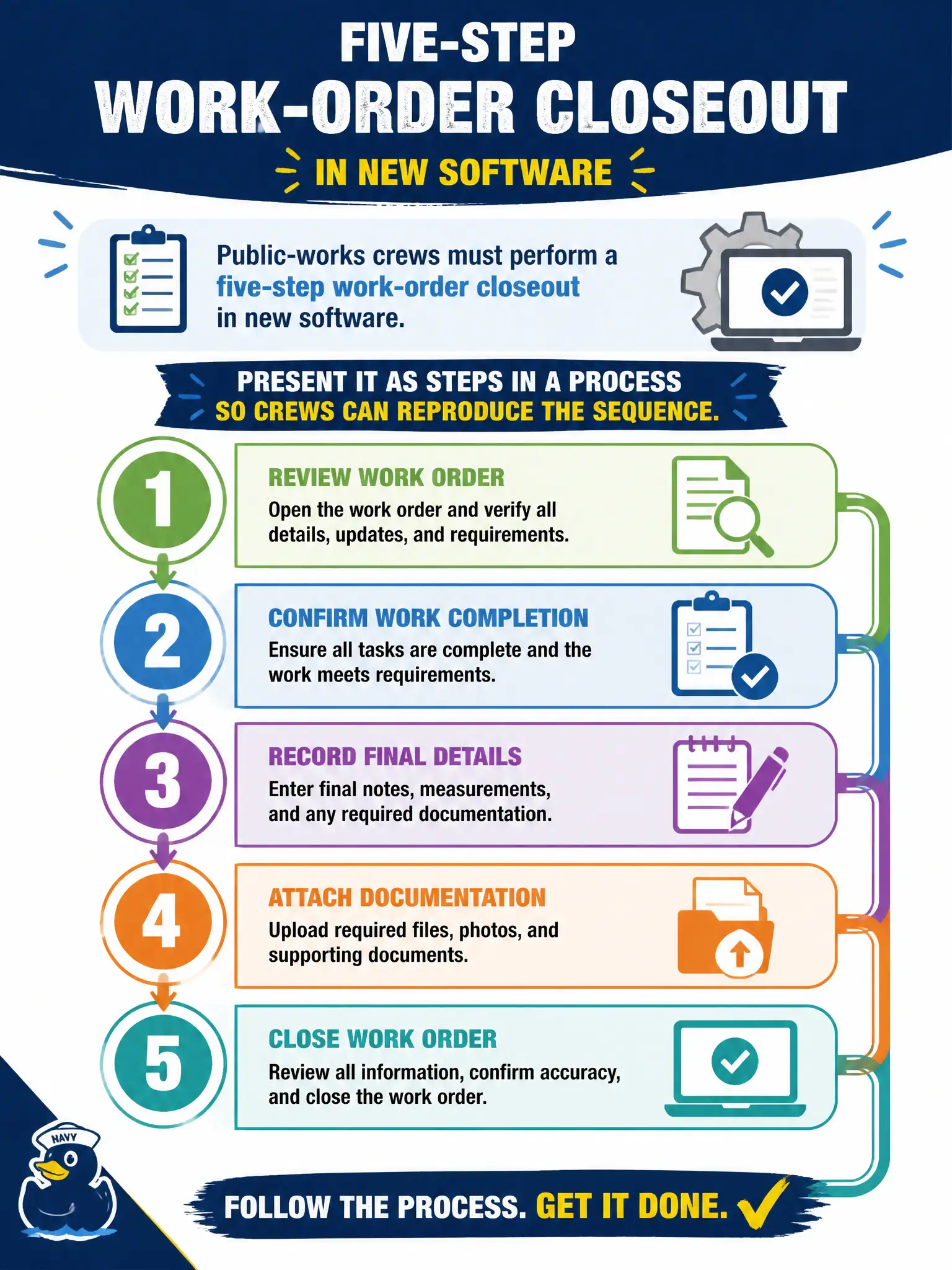
Public-works crews must perform a five-step work-order closeout in new software. How should the instructor introduce that content?
Select an answer to reveal the explanation.
Short Explanation
Closeout is a recipe: step 1, then 2, then 3. Teach it as a process so the crew can run the same sequence tomorrow—not as a handful of tips in random order.
Full Explanation
Procedural software tasks belong as steps in a process. Public-works crews performing a five-step work-order closeout in new software should see the content introduced as an ordered process they can reproduce. Offering disconnected tips in whatever order questions arise fragments the sequence crews must execute in the field. Comparing the software to an unrelated permitting system instead of teaching closeout order substitutes analogy for procedure. Hiding the five steps until a final exam so learners “discover” the sequence withholds the instructional model adults need. Exam caveat: CTT+ process organization is the expected pattern for ordered operational procedures. Operational check: display the five steps, demo them in order, have crews execute the same order on a sample work order, and check sequence fidelity. Work-order closeout is a sequence; teaching it as ordered steps lets crews reproduce it under yard pressure. Tip salad and delayed reveal break that sequence. CTT+ process organization is the default for procedural software. Post the five steps on a laminated card in the shop after class so transfer survives beyond the projector. Maintain that civic standard in the session file so auditors and future instructors can see how design integrity was preserved under real municipal constraints.