
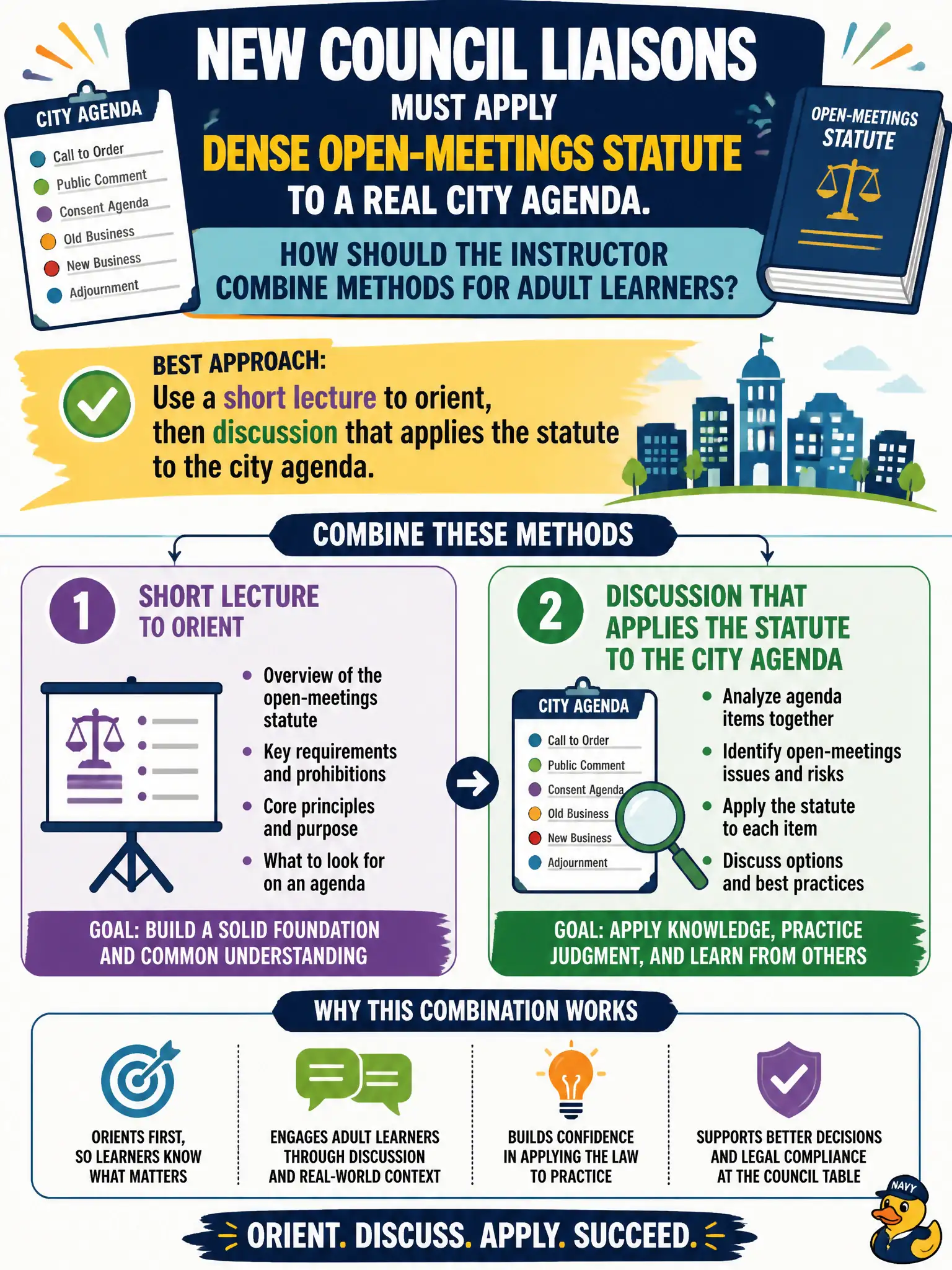
New council liaisons must apply dense open-meetings statute to a real city agenda. How should the instructor combine methods for adult learners?
Select an answer to reveal the explanation.
Short Explanation
Adults do not need a four-hour reading of the rulebook; they need here is the rule and then here is Tuesday's agenda. Short lecture plus job-relevant discussion is that combo.
Full Explanation
Adult learners facing dense statute content need orientation plus application. New council liaisons applying open-meetings rules to a real city agenda should get a short lecture to orient, then discussion that applies the statute to that agenda. Reading the entire statute aloud without application maximizes coverage theater and minimizes transfer. Skipping the statute for story-swap relevance alone leaves legal criteria untaught. Assigning the statute as homework and using class for unrelated icebreakers abandons guided application. Exam caveat: CTT+ often pairs brief content delivery with discussion or practice for complex civic policy topics. Operational check: teach the key open-meetings tests in a short block, open the real agenda, and facilitate discussion applying each test to agenda items before assessment. Open-meetings rules are dense; adults need a brief frame then immediate application to a real agenda they will face Monday. Lecture-only statute reading fails transfer. CTT+ method combinations for complex policy favor orient-then-apply. Use the actual upcoming council agenda when lawful, or a realistic redacted twin, so discussion stays authentic. Maintain that civic standard in the session file so auditors and future instructors can see how design integrity was preserved under real municipal constraints.