
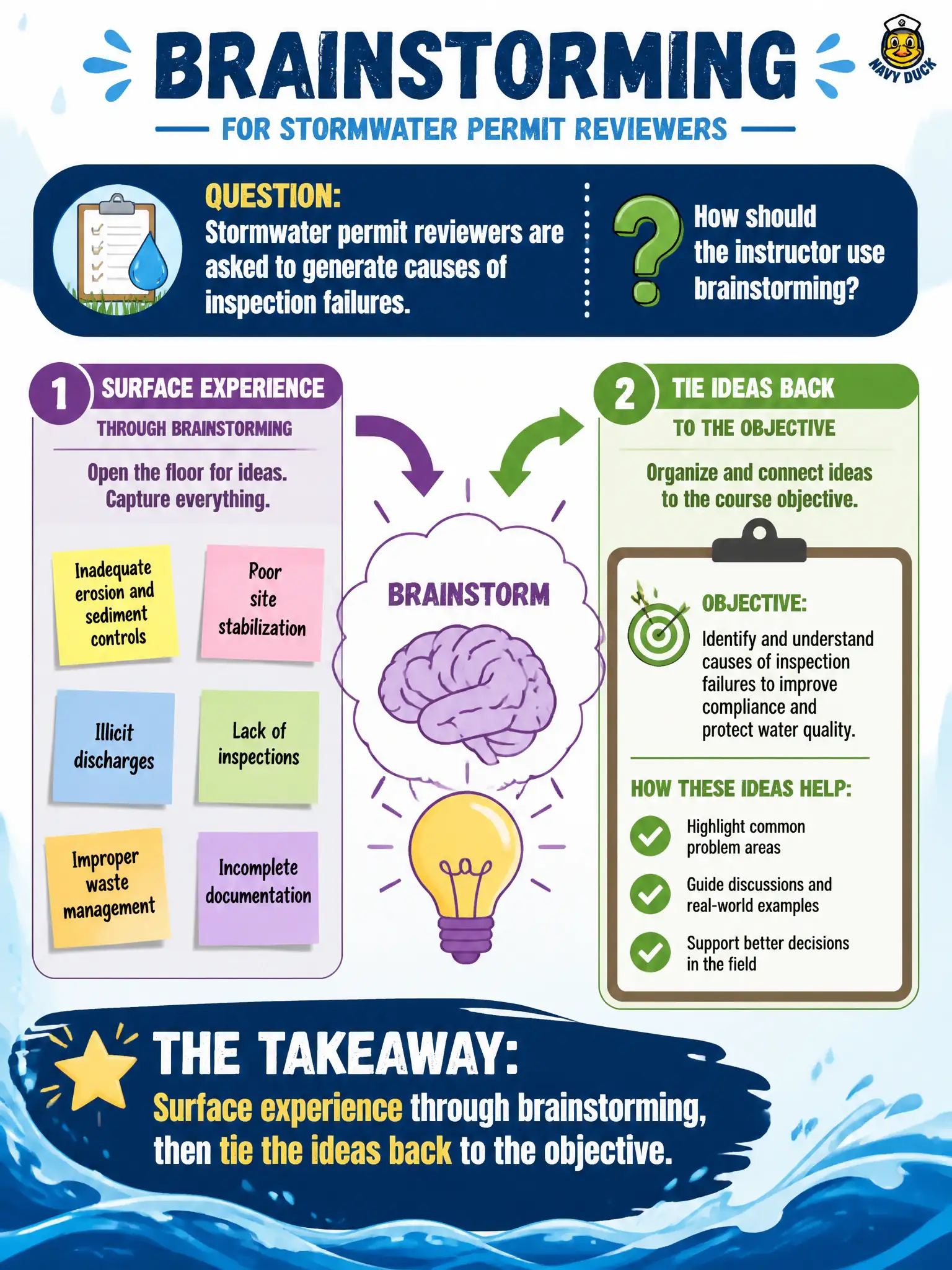
Stormwater permit reviewers are asked to generate causes of inspection failures. How should the instructor use brainstorming?
Select an answer to reveal the explanation.
Short Explanation
Brainstorming is a net, not a dumpster. Catch the reviewers' field experience, then sort it against the objective so it does not turn into an open-mic complaint hour.
Full Explanation
Brainstorming surfaces experience and then reconnects to the objective. Stormwater permit reviewers asked to generate causes of inspection failures should brainstorm, then have those ideas tied back to the learning objective rather than left as an unbounded complaint forum. Collecting ideas and dismissing any not already on the vendor slide punishes authentic expertise and trains silence. Skipping brainstorming because “only lecture stays aligned” abandons a useful generative method. Letting the session become pure complaint without objective linkage wastes time and erodes focus. Exam caveat: CTT+ treats brainstorming as valid when the instructor facilitates closure to objectives. Operational check: time-box idea generation, cluster causes on a board, map clusters to inspection-failure objectives, and discard only items that cannot be tied after fair discussion. Permit reviewers hold tacit knowledge brainstorming can harvest; facilitation must then bind ideas to inspection-failure objectives. Unbounded complaint forums and vendor-slide gatekeeping both fail that test. CTT+ brainstorming items hinge on closure to objectives. Photograph the final clustered board and file it as needs evidence for the next course revision.