
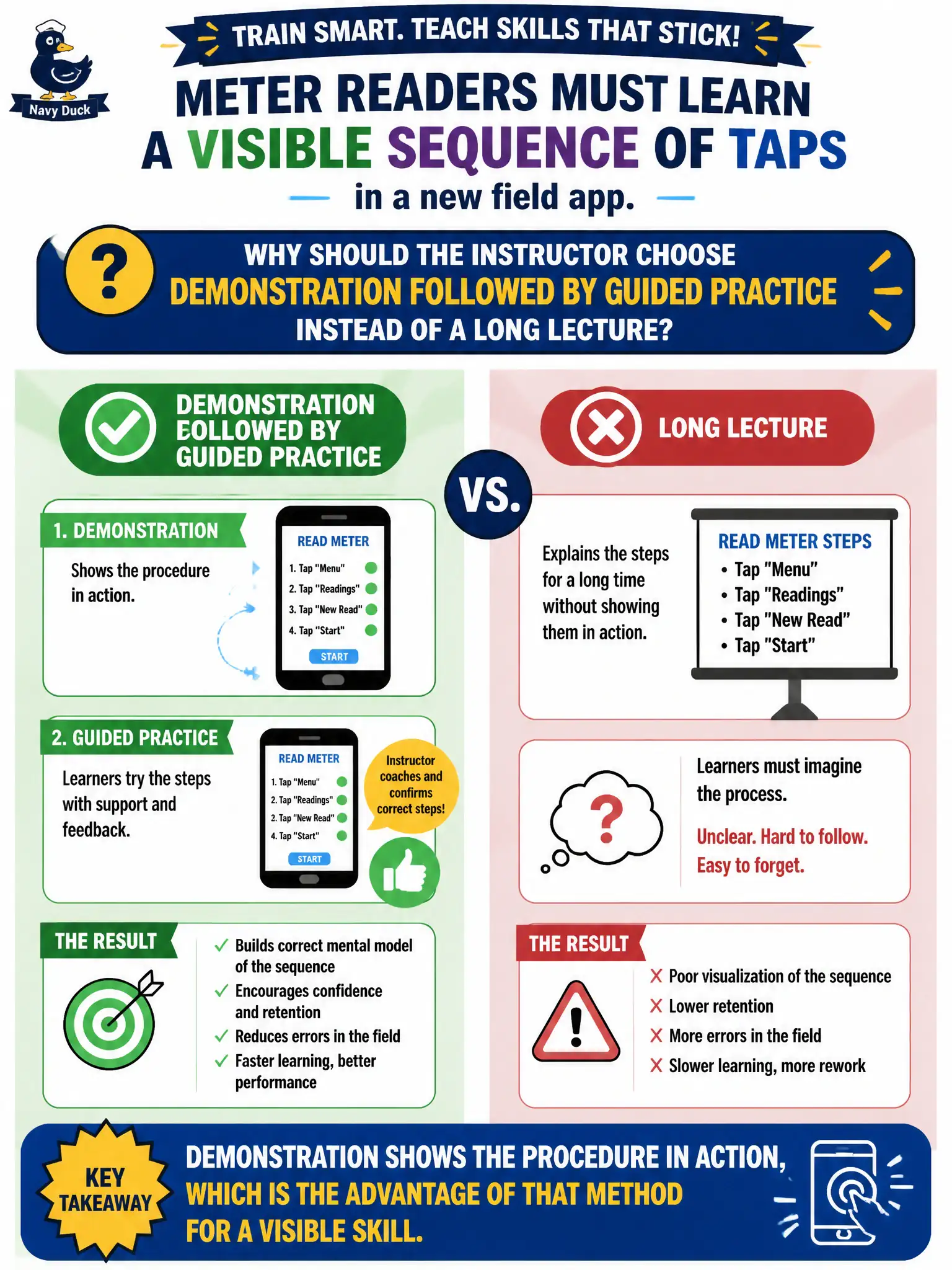
Meter readers must learn a visible sequence of taps in a new field app. Why should the instructor choose demonstration followed by guided practice instead of a long lecture?
Select an answer to reveal the explanation.
Short Explanation
You would not learn to change a tire from a speech—you watch it, then try it. A meter-app tap sequence is the same: demonstration plus guided practice beats a long talk about buttons.
Full Explanation
Visible procedural skills favor demonstration plus guided practice. Meter readers learning a sequence of taps in a new field app need to see the procedure in action—the core advantage of demonstration—then practice with guidance. Treating lecture as always faster and demonstration as optional enrichment misassigns method to a psychomotor, observable task. Claiming demonstration is required only when the vendor contract forbids lecture invents a contractual rule that is not the instructional rationale. Skipping guided practice because a lecture includes a screenshot of the last screen confuses a static image with skill acquisition. Exam caveat: CTT+ method selection matches objective type; observable sequences are classic demonstration-and-practice items. Operational check: demo the tap sequence on a projected device, have readers repeat with coaching, and check each critical tap before releasing them to independent practice. Tap sequences are visual-motor; learners need to see hands and screens move, then imitate with coaching. Demonstration-plus-guided-practice beats screenshot lectures for field apps. CTT+ method advantage items reward matching psychomotor objectives to demo methods. Use a document camera or mirrored device so the back row sees each tap, then check critical taps individually.