
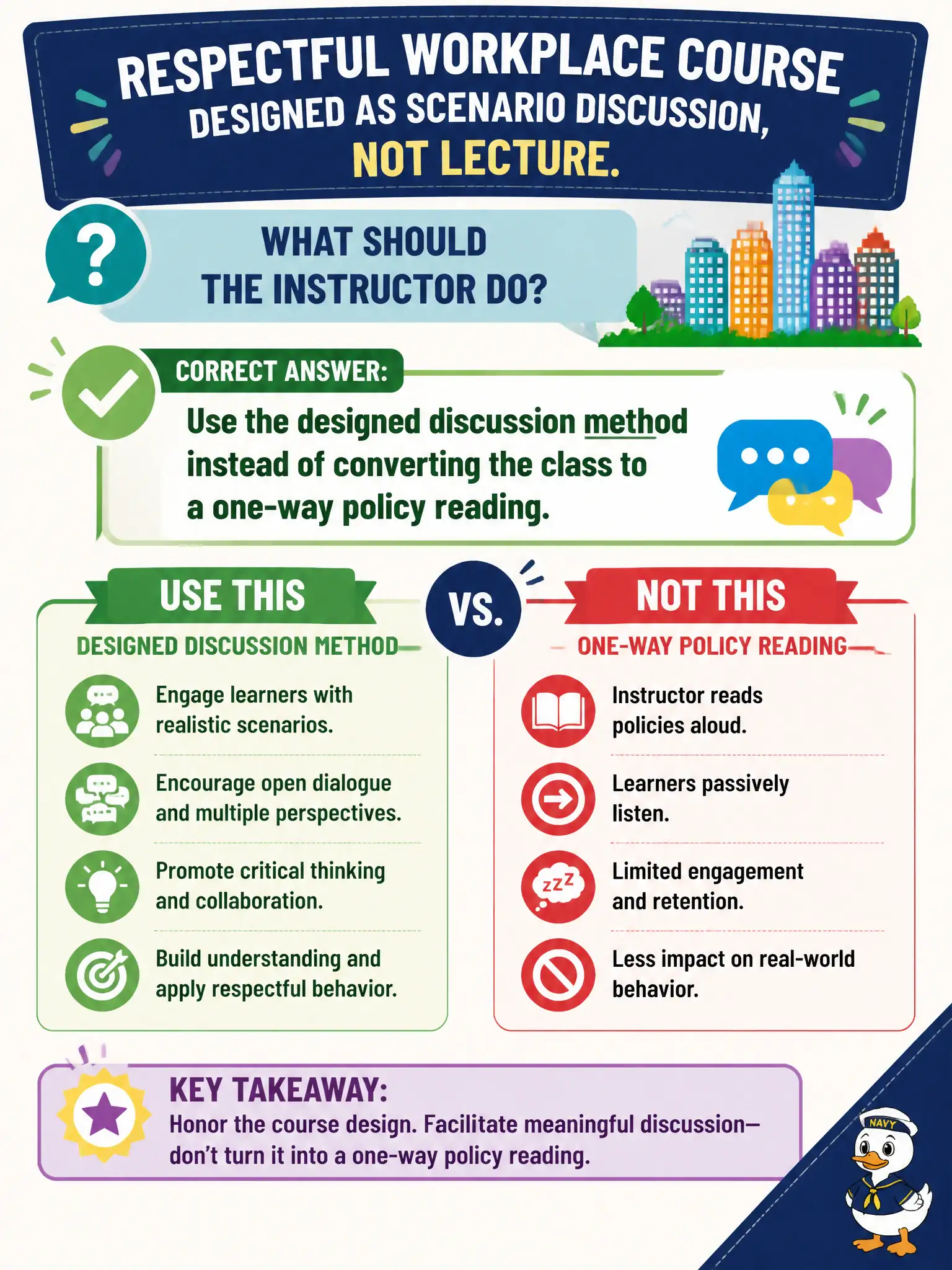
A city respectful-workplace course is designed as scenario discussion, not lecture. What should the instructor do?
Select an answer to reveal the explanation.
Short Explanation
If the recipe is a roundtable, do not turn it into a speech from the head of the table. The course was built as scenario discussion so people practice judgment—reading the policy at them throws that design away.
Full Explanation
Method fidelity matters when a course is designed as scenario discussion. For a city respectful-workplace course designed as scenario discussion, not lecture, the instructor should use the designed discussion method rather than converting to a one-way policy reading. Reading the policy aloud to “save time” because discussion seems optional decoration abandons the method that builds application and adult engagement. Skipping scenarios that might make managers uncomfortable and summarizing them as bullets avoids the affective practice the design requires. Replacing discussion with a recorded webinar so the instructor need not facilitate removes live processing of workplace scenarios. Exam caveat: CTT+ delivery expects instructors to honor designed methods unless a justified adaptation still meets objectives. Operational check: open with the first designed scenario, facilitate discussion to the objective, and resist converting to lecture even under time pressure until enrichment—not method—is trimmed. Respectful-workplace scenarios exist to practice judgment under social pressure; lecture conversions erase that practice. Honor the designed discussion method. CTT+ method fidelity matters when affect and behavior are the objectives. Prepare facilitator prompts and timing cards so discussion stays productive instead of drifting into unstructured venting.