
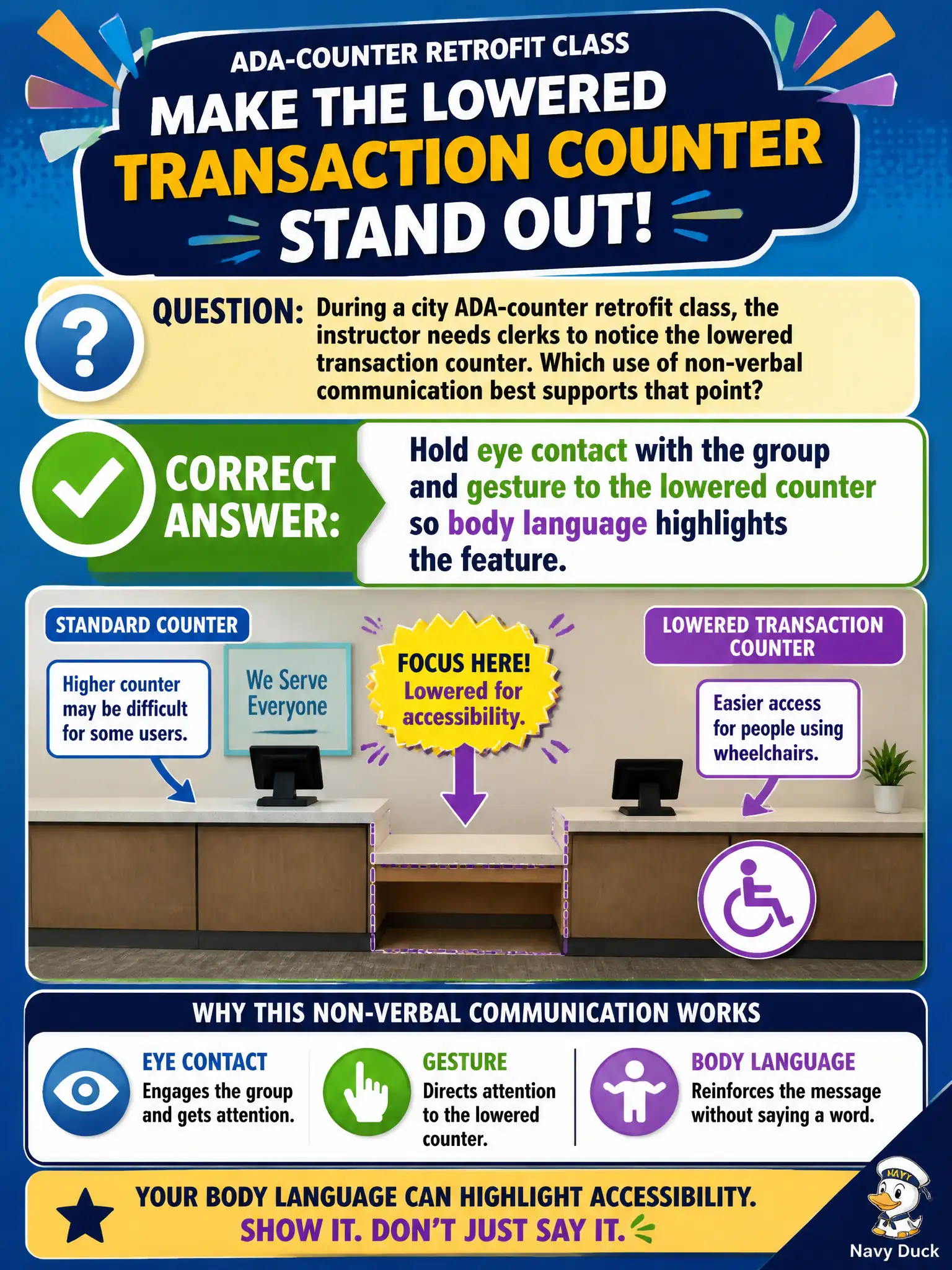
During a city ADA-counter retrofit class, the instructor needs clerks to notice the lowered transaction counter. Which use of non-verbal communication best supports that point?
Select an answer to reveal the explanation.
Short Explanation
Think of your hands as a highlighter, not a fidget toy. If the point is the lowered counter, look at people and point at the counter. Pacing the back wall just broadcasts nerves.
Full Explanation
Non-verbal communication should reinforce the instructional point rather than compete with it. During a city ADA-counter retrofit class, holding eye contact with the group and gesturing to the lowered transaction counter uses body language to highlight the physical feature clerks must notice for accessible service. Gesture and gaze direct attention to the municipal fixture that matters for the objective and make the retrofit tangible.
Pacing the back wall while only describing the counter fails by concept: movement away from the feature splits attention from the learning point and wastes the real object in the room. Folding arms at the podium and reading the ADA slide without looking at the fixture fails by ignoring available realia that makes the retrofit concrete for clerks. Spinning a laser pointer around the room fails by creating a competing visual distraction rather than spotlighting the lowered counter height change.
Exam caveat: CTT+ non-verbal items ask whether body language supports or competes with the content focus in the municipal classroom.
Operational check: stand near the lowered counter, gesture to the height change while maintaining group eye contact, and ask clerks what differs from the old counter before leaving the point.