
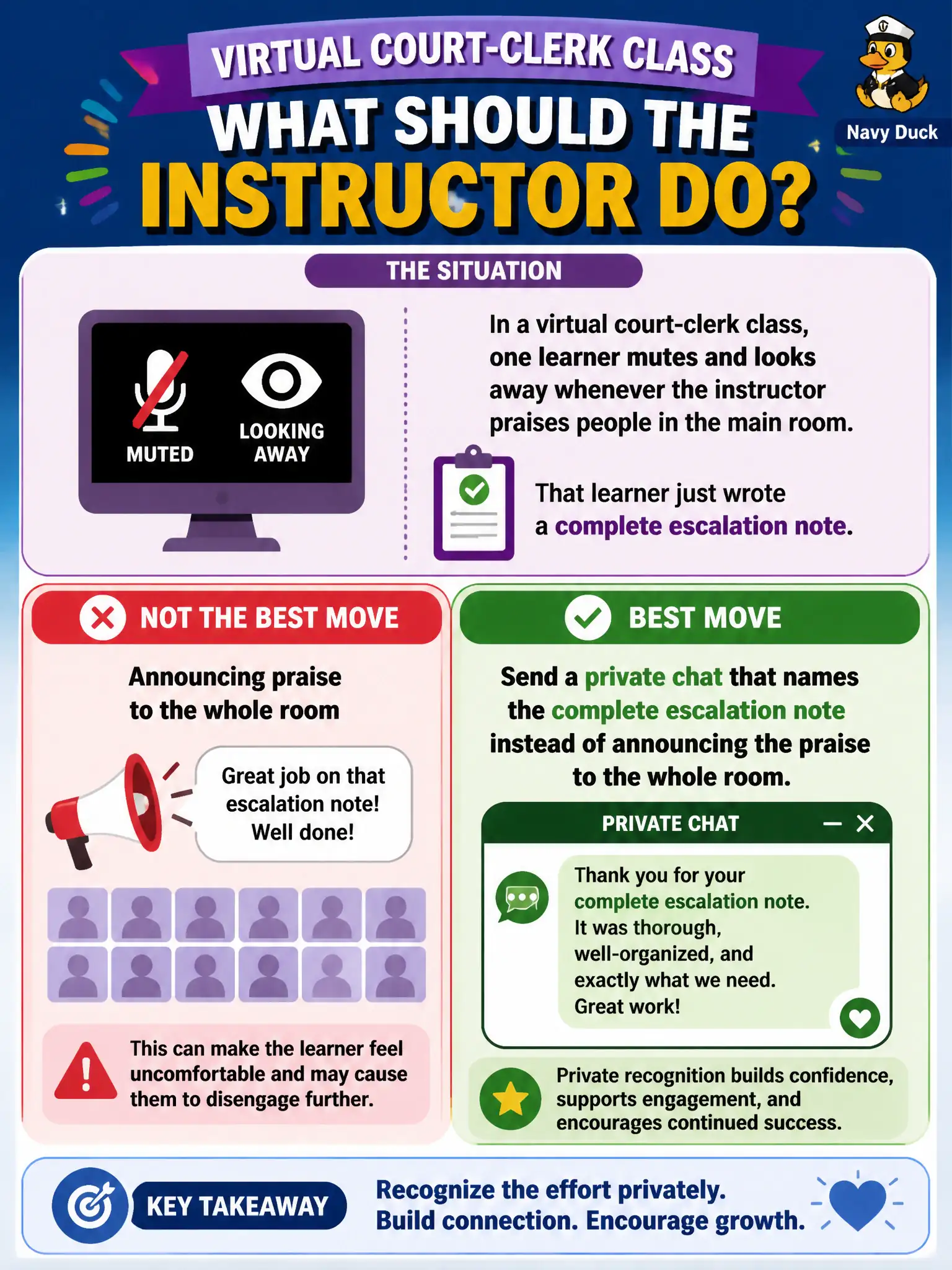
In a virtual court-clerk class, one learner mutes and looks away whenever the instructor praises people in the main room. That learner just wrote a complete escalation note. What should the instructor do?
Select an answer to reveal the explanation.
Short Explanation
For some clerks, a main-room shout-out is a spotlight they did not ask for. A private chat that says "that escalation note was complete" still puts a coin in the jar. Quiet reinforcement is real reinforcement — it just does not make them want to hide.
Full Explanation
In a virtual court-clerk class, a learner who mutes and looks away during main-room praise still deserves reinforcement after writing a complete escalation note—via private chat that names the complete note rather than a whole-room announcement. Individualizing recognition protects a quiet municipal learner while still strengthening the correct work product. Announcing the complete note to everyone fails individualization when prior behavior already showed public praise causes withdrawal. Skipping any comment because quiet learners "do not need reinforcement" fails the reinforcement duty: preference for privacy is not absence of need. Requiring an on-camera presentation as a "confidence builder" fails the consent-and-safety concept by forcing exposure that the learner's muted response already signaled as aversive. Exam caveat: private reinforcement is valid reinforcement; the exam is not asking you to broadcast every win. Operational check: send a private chat naming the complete escalation note fields, invite an optional follow-up question in chat, and verify the clerk continues producing complete notes without further withdrawal. Court clerks handling escalations need accurate notes under stress; private chat recognition preserves dignity for quiet professionals while still marking complete municipal work.