
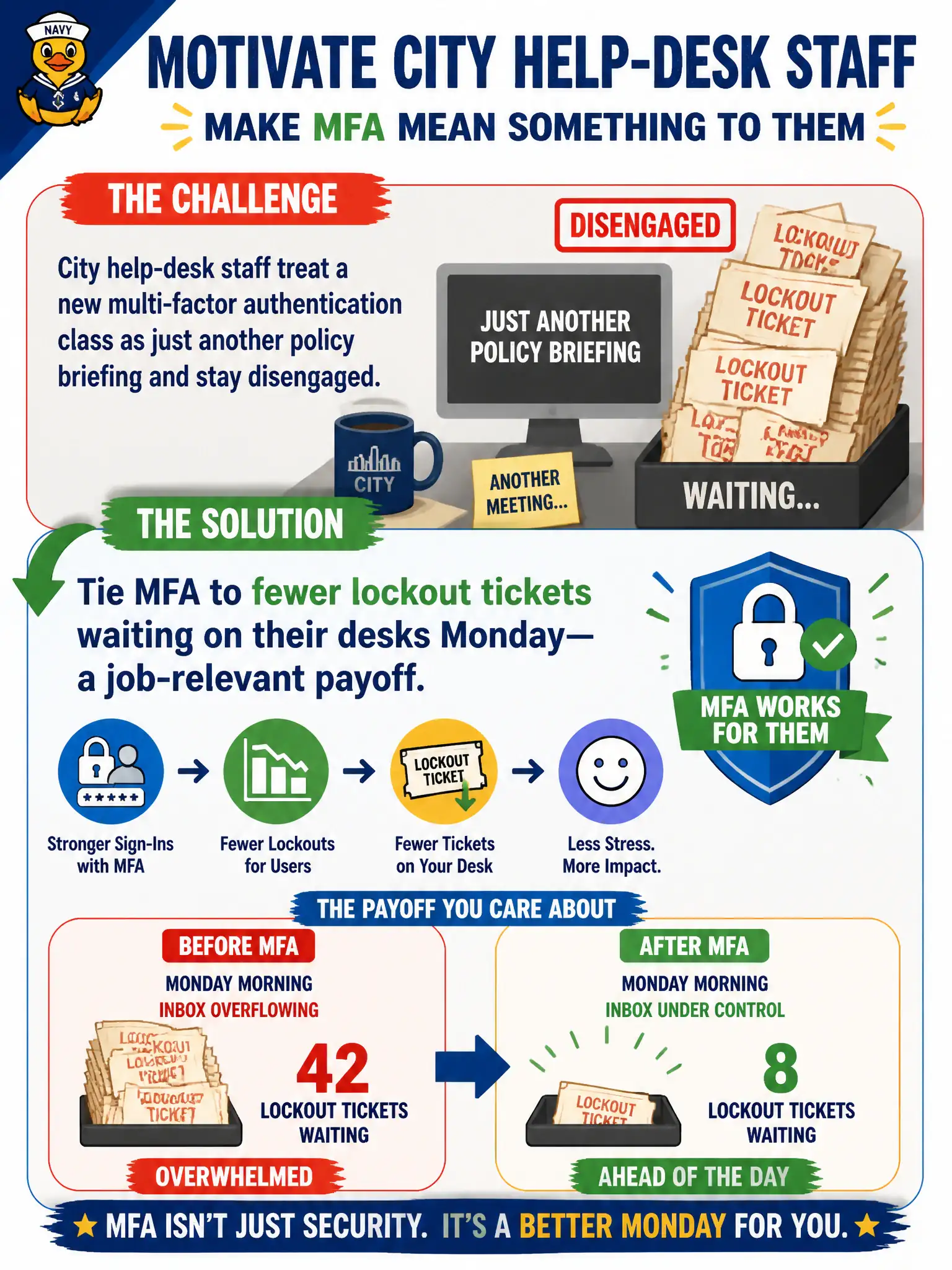
City help-desk staff treat a new multi-factor authentication class as just another policy briefing and stay disengaged. How should the instructor motivate them?
Select an answer to reveal the explanation.
Short Explanation
"Because policy" is a wet match — it rarely lights a help-desk room. Show them Monday: fewer lockout tickets stacked on their own desks. Job relevance is the fuel; a vendor slogan or a write-up threat is just smoke.
Full Explanation
When city help-desk staff treat multi-factor authentication training as just another policy briefing, motivation improves by tying MFA to fewer lockout tickets waiting on their desks Monday—a job-relevant payoff that connects the skill to their daily queue. CTT+ wants strategies matched to learner and organizational needs, not abstract compliance talk. Showing a concrete desk-level benefit makes the security control relevant to the people who reset passwords all day and still advances the city's authentication goal. Repeating that policy requires MFA and moving on fails the relevance concept; authority alone rarely re-engages a disengaged municipal audience. Saying the vendor recommended the product so debate is forbidden fails the professional-adult concept by substituting vendor decree for job meaning. Warning that quiz failure brings a write-up fails the fear-versus-motive concept: threat may produce short compliance and long silence instead of durable MFA skill. Exam caveat: job relevance is a motivator; policy quotation and punishment are not automatic substitutes when engagement is the problem. Operational check: open with a before-and-after ticket example (lockouts with and without MFA), ask staff to identify how the skill changes Monday's queue, then practice enrollment steps and confirm they can complete MFA setup while explaining the desk payoff.