
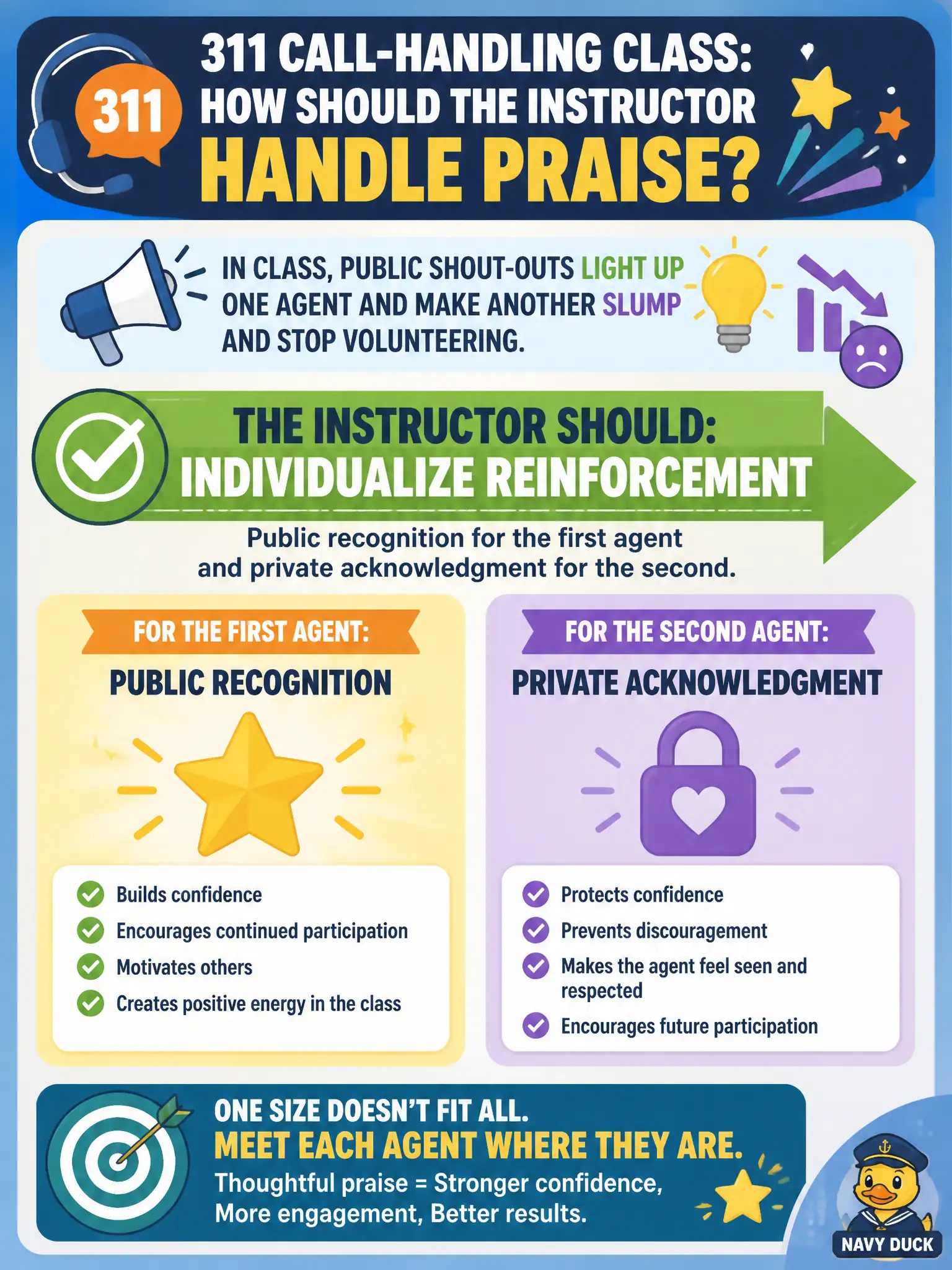
In a 311 call-handling class, public shout-outs light up one agent and make another slump and stop volunteering. What should the instructor do about praise?
Select an answer to reveal the explanation.
Short Explanation
Public praise is a spotlight — some 311 agents bloom in it and some want the blinds closed. Same candy for every personality is not fairness; it is a one-size hat. Watch the person, then pick public or private recognition so the boost actually lands.
Full Explanation
In a 311 call-handling class, shout-outs that energize one agent can silence another, so the instructor should individualize reinforcement: public recognition for the first agent and private acknowledgment for the second. CTT+ requires motivational strategies for individual learners; identical public praise is not fairness when personalities differ. Public praise for the agent who blooms under the spotlight and a quiet word or chat for the agent who withdraws both strengthen correct call-handling without forcing one climate on every seat. Praising both agents out loud so policy stays identical fails the individualization concept by confusing sameness of method with equity of effect. Stopping all praise so nobody feels singled out fails the reinforcement concept by removing a useful motivator instead of retargeting it. Requiring both agents to stand and recap their win fails the psychological-safety concept by escalating exposure for the learner who already slumped under milder public attention. Exam caveat: watch the person's response to praise, then choose public or private delivery; the exam answer is not "always public" or "never praise." Operational check: after the next strong call behavior, use public recognition for the agent who lights up and a private note for the agent who mutes, then verify both continue volunteering accurate responses rather than withdrawing.