
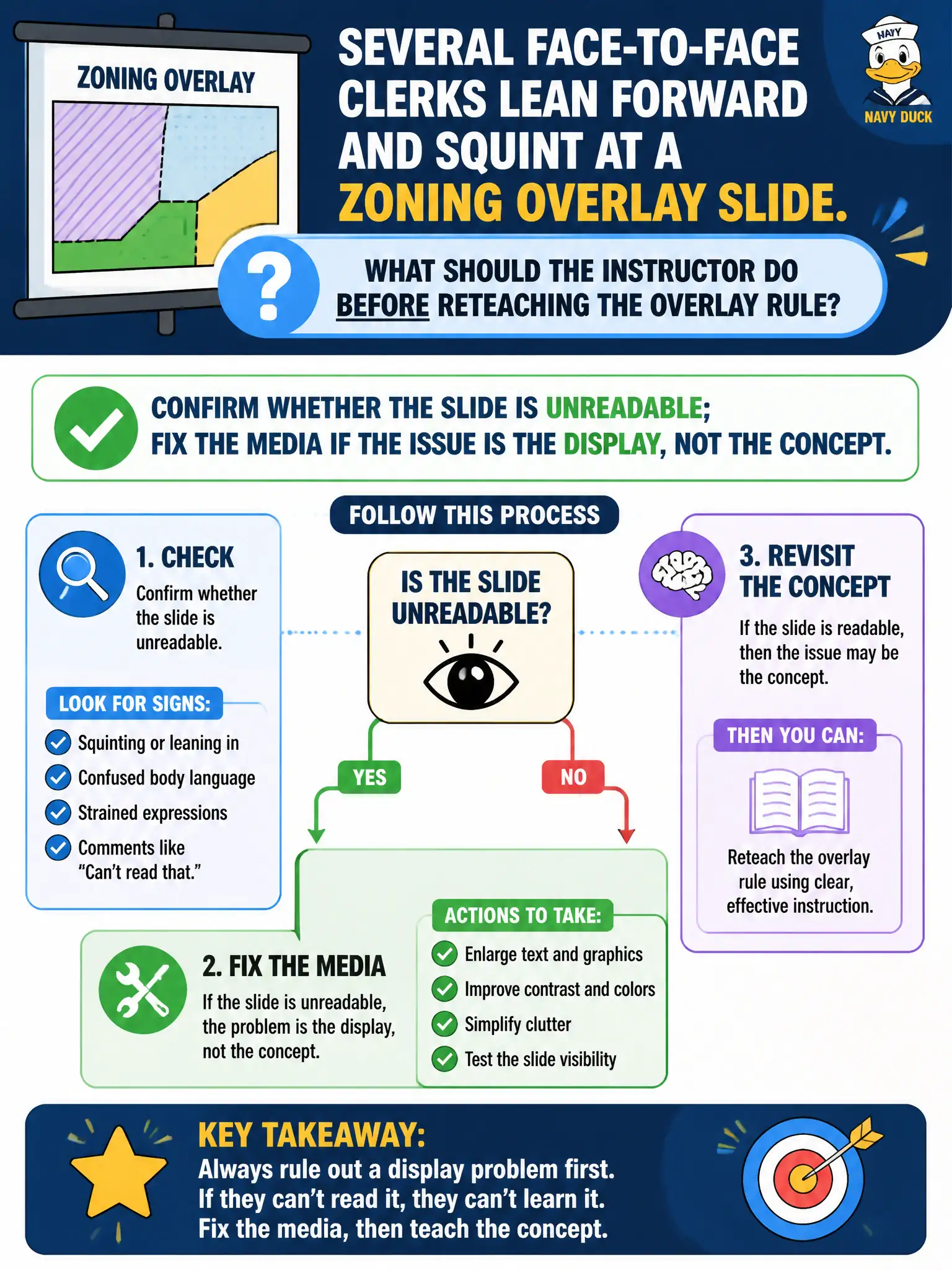
Several face-to-face clerks lean forward and squint at a zoning overlay slide. What should the instructor do before reteaching the overlay rule?
Select an answer to reveal the explanation.
Short Explanation
A room full of squints is often a projector problem, not a zoning-law problem. Check the slide first. If the overlay is a gray blur, no amount of reteaching the rule will help.
Full Explanation
Zoning overlay slides must be readable for face-to-face clerks who apply rules affecting property owners. When several learners lean forward and squint, confirm whether the slide is unreadable and fix the media if the issue is the display—not the concept—before reteaching the overlay rule. Environmental and media barriers can masquerade as conceptual failure.
Assuming the overlay concept is too advanced and canceling the module fails by concept: you may be diagnosing a projector problem as learner deficit. Speaking louder does not fix visual illegibility. Dimming lights further may worsen readability depending on the room and display.
Exam caveat: before reteaching content, rule out tool, media, and environment issues signaled by shared nonverbal strain. Fix the barrier, then assess whether concept reteach is still needed.
Operational check: ask if they can read the overlay labels from their seats, enlarge or reprint the graphic, verify readability, then ask a concept question to see whether misunderstanding remains. Shared squinting is an environment signal in face-to-face civic classrooms. Fixing media before reteaching content prevents blaming clerks for a projector the instructor controls. After readability is restored, re-ask a concept item; only then decide whether the overlay rule itself needs a second teach.