
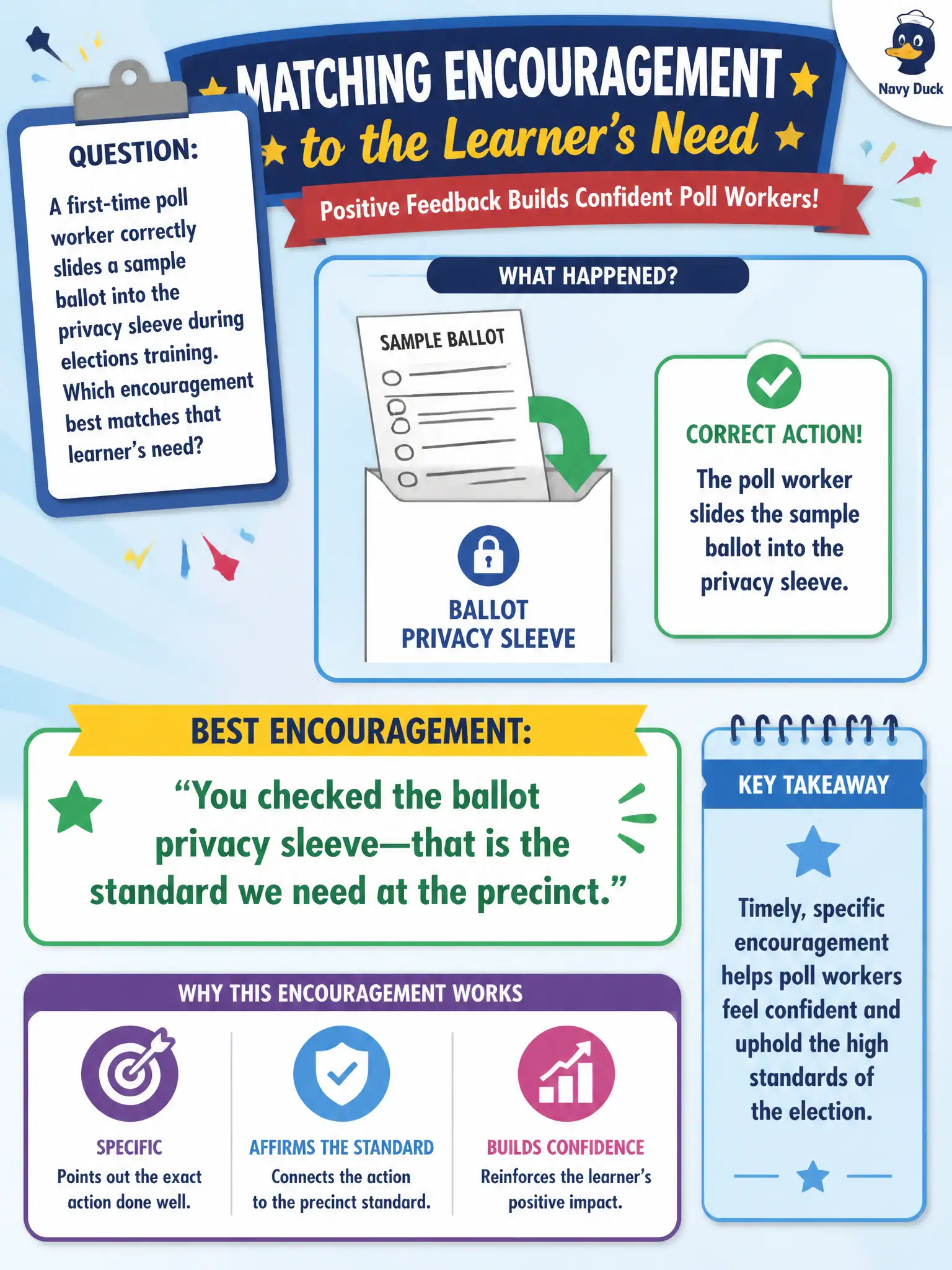
A first-time poll worker correctly slides a sample ballot into the privacy sleeve during elections training. Which encouragement best matches that learner’s need?
Select an answer to reveal the explanation.
Short Explanation
Cheerleading is cotton candy. The poll worker needs to hear the exact move that was right. Naming the privacy sleeve ties the praise to the job, not to a vibe.
Full Explanation
Elections training on ballot privacy sleeves protects voter secrecy—a core public trust requirement at the precinct. Encouragement that names the specific correct behavior—'You checked the ballot privacy sleeve—that is the standard we need at the precinct'—matches the learner's need with criterion-based recognition. Specific praise strengthens the exact civic behavior required.
Calling them a 'natural' and telling them to 'keep being awesome' fails by concept: personality praise does not reinforce the observable standard. Praising the whole table's energy dilutes feedback so the individual does not know what they did right. Saying not to worry because the scanner will catch mistakes undermines the privacy-sleeve standard and teaches dependence on downstream detection.
Exam caveat: effective encouragement for adults is specific, sincere, and tied to performance criteria—especially for first-time poll workers building confidence. Avoid empty flattery and avoid undercutting standards.
Operational check: when the sleeve step is done correctly, name it immediately, point to the posted precinct standard, and have the worker repeat the step once more to lock the habit. Ballot privacy is non-negotiable public trust. Specific encouragement that names the sleeve step teaches first-time poll workers which behaviors are the standard, not which personalities are ‘naturals.’ Immediate repetition of the correct sleeve action after praise helps lock the precinct habit before the next ballot handling error can form.