
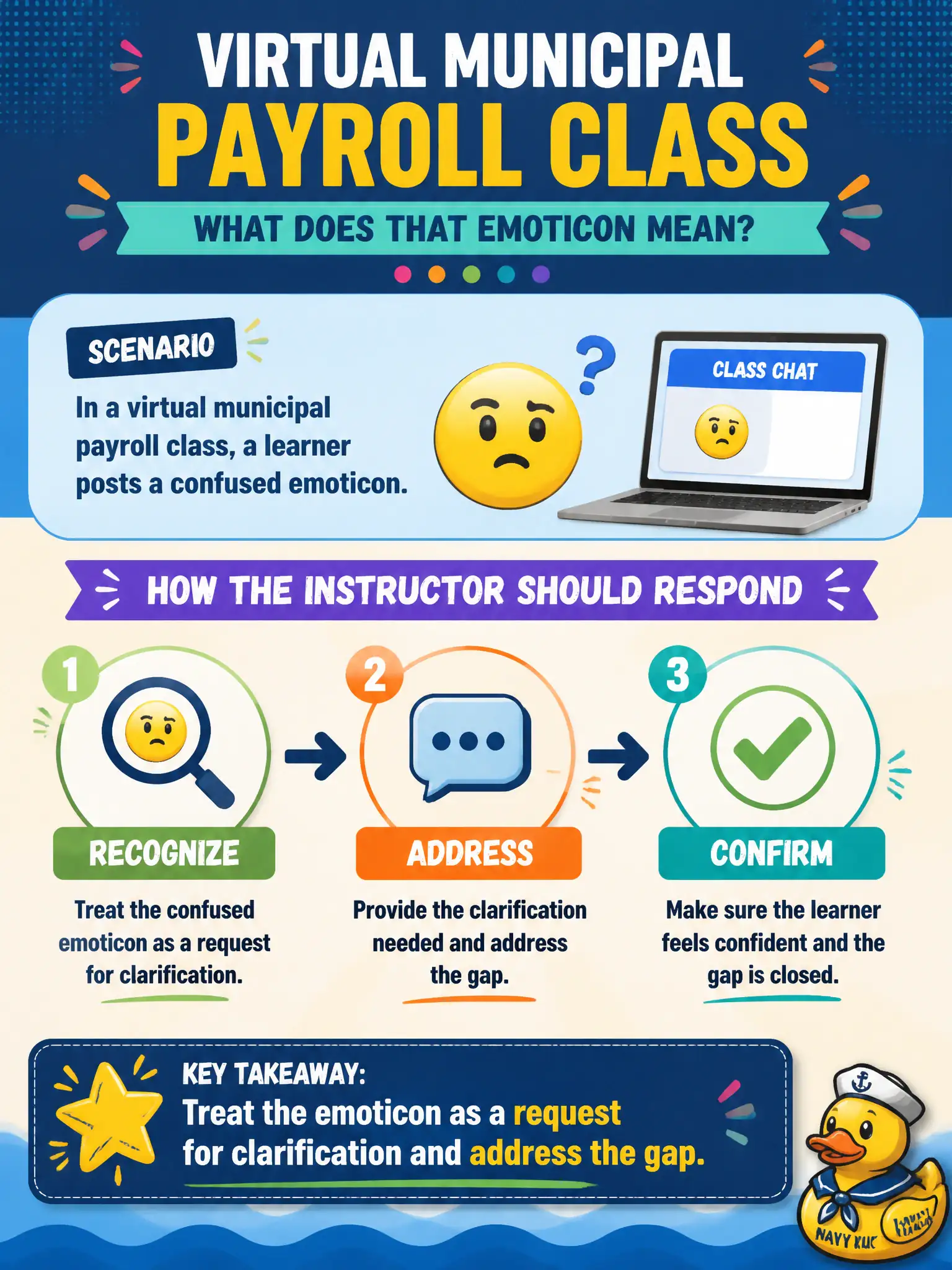
In a virtual municipal payroll class, a learner posts a confused emoticon. How should the instructor treat it?
Select an answer to reveal the explanation.
Short Explanation
That little confused face is a virtual raised hand. It is not a joke track. Pause and clear the payroll step that just broke.
Full Explanation
Virtual municipal payroll training must catch confusion early so pay errors do not harm employees or the public employer. Treating a confused emoticon as a request for clarification and addressing the gap is appropriate reading of a technical nonverbal in chat. Virtual cues replace some face-to-face body language and deserve the same responsive facilitation.
Ignoring it as humor fails by concept: you may miss a real comprehension gap while protecting the lecture clock. Muting the learner for unofficial symbols punishes a low-bandwidth help signal. Closing chat to prevent distraction removes a primary virtual contribution and clarification channel.
Exam caveat: not every emoji is a cry for help—context matters—but a confused face after a payroll step is reasonably treated as a clarification need. Confirm briefly, then reteach or demonstrate.
Operational check: acknowledge the emoticon, ask what part of the payroll step is unclear, clarify for the group if shared, and require a quick sandbox action to verify the gap closed. Payroll mistakes harm city employees and create public-employer liability. A confused emoticon is a cheap signal compared with an incorrect paycheck. Treat it as clarification need, confirm the unclear step, reteach briefly, and require a correct sandbox entry so the virtual cue produces verified competence—not only a reassuring emoji reply.