
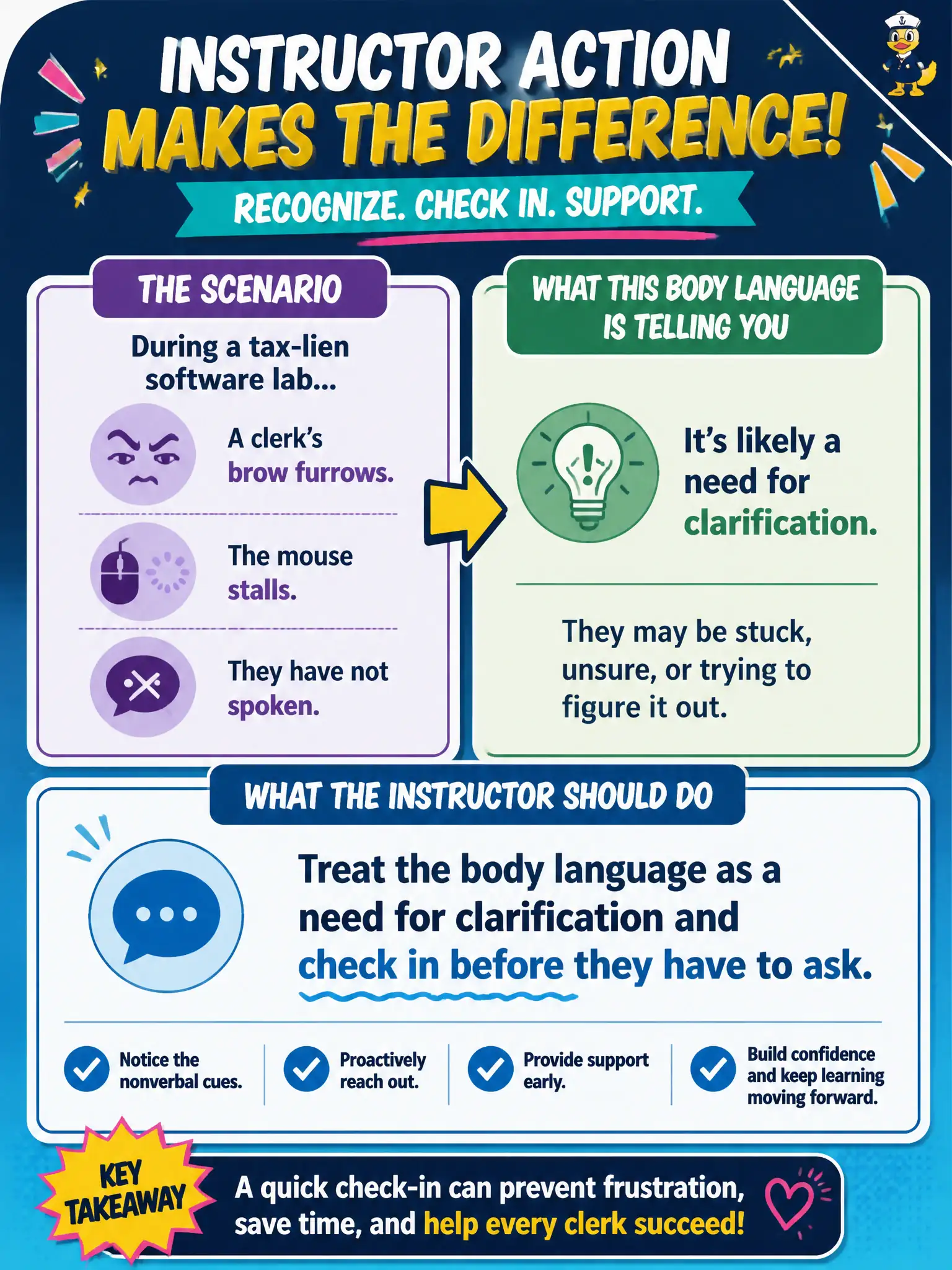
During a tax-lien software lab, a clerk's brow furrows and the mouse stalls. They have not spoken. What should the instructor do?
Select an answer to reveal the explanation.
Short Explanation
A stalled mouse is a raised hand that never made it up. Furrowed brow means the tax-lien screen is not landing. Check in now, and do not wait for a speech.
Full Explanation
Tax-lien software labs support lawful collection processes that affect property owners' rights and city revenue. When a clerk's brow furrows and the mouse stalls without a spoken question, the instructor should treat that body language as a need for clarification and check in before they have to ask. Facilitators monitor nonverbal cues as legitimate signals of confusion.
Waiting only for verbal questions fails by concept: many adults will not announce confusion, especially in civic cohorts with hierarchy concerns. Calling them unmotivated for sitting still misreads a learning cue as a character flaw. Advancing to the next module to keep time abandons a learner mid-struggle.
Exam caveat: body language is ambiguous—confirm rather than assume motive—but it is within the instructor's job to notice and check. Private check-ins often work best.
Operational check: quietly ask whether the lien screen matches what they expected, identify the stuck field, clarify once, and watch them complete the next click successfully before leaving the station. Tax-lien work affects owners’ rights; furrowed silence can mean a clerk is about to encode an error into a sensitive record. Checking in early is protective facilitation. Keep the first contact low-key, identify the stuck control, clarify once, and watch a successful next action before you walk away—then note whether others show the same nonverbal pattern.