
After a public-works snow-route overview, which question is higher-order rather than a request to recite the policy title?
Select an answer to reveal the explanation.
Short Explanation
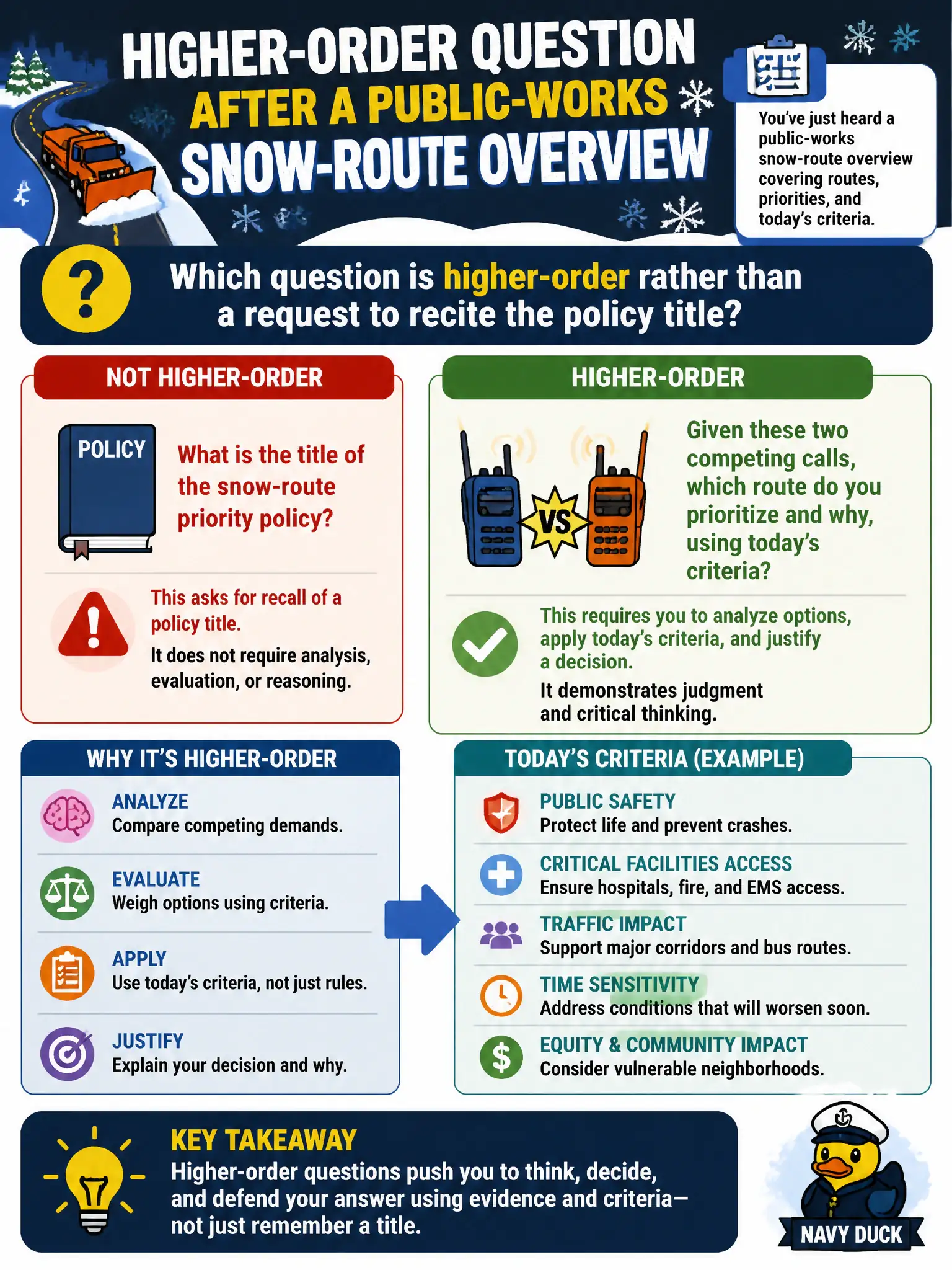
Naming the policy is a label on the binder. Picking a snow route with reasons is the work. Higher-order questions make people use the criteria, not recite the cover.
Full Explanation
Public-works snow-route decisions affect which streets—and which residents—are cleared first in a storm. Asking which of two competing calls to prioritize and why, using today's criteria, is higher-order application rather than reciting a policy title. Higher-order items require using criteria to decide, not retrieving a label.
Asking for the snow-route policy title fails by concept: it is recall of a name, not prioritization judgment. Asking how many pages the packet has is irrelevant trivia. Asking who signed the cover memo likewise tests clerical recall unrelated to route decisions.
Exam caveat: higher-order questions need prerequisite knowledge; teach the criteria first, then ask the competing-calls item. A 'why' that only seeks a memorized slogan is not automatically analysis.
Operational check: present two call cards, require a priority choice referencing posted criteria (for example, arterial before cul-de-sac, hospital access), and coach any answer that cannot cite a criterion. Snow-route prioritization is distributive justice under weather constraints. Higher-order questions should force use of posted criteria that the public could, in principle, recognize as consistent. Require written priority rationales on two competing calls and peer-check whether each rationale cites a taught criterion rather than neighborhood preference or habit.