
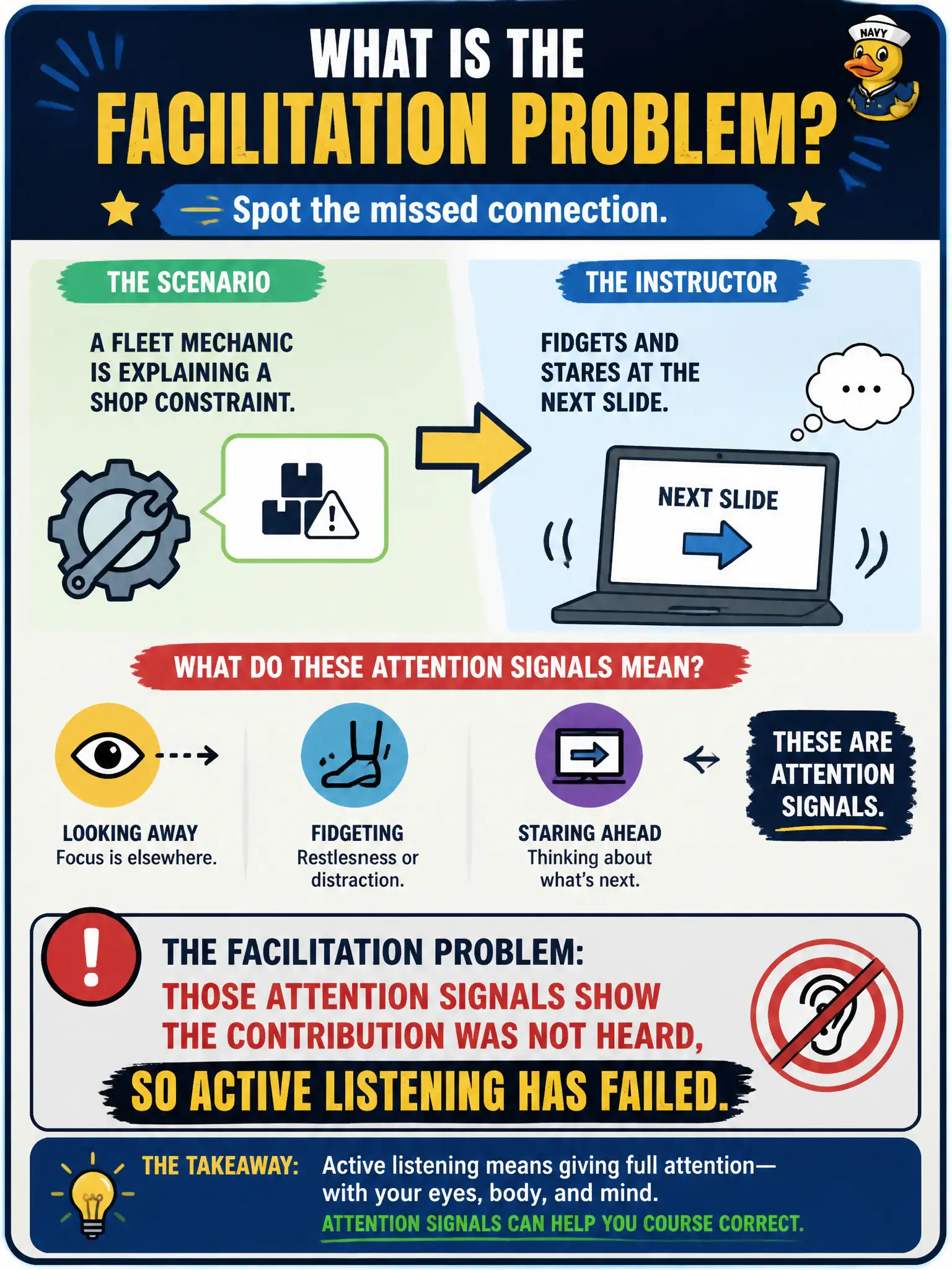
A fleet mechanic is explaining a shop constraint. The instructor fidgets and stares at the next slide. What is the facilitation problem?
Select an answer to reveal the explanation.
Short Explanation
Active listening has a face. If the trainer is already dating the next slide while the mechanic talks, the room learns the story does not matter. Eyes and stillness are part of the technique.
Full Explanation
Fleet mechanics bring shop constraints that affect vehicle readiness for public services. When the instructor fidgets and stares at the next slide during that explanation, those attention signals show the contribution was not heard—active listening has failed. Nonverbal instructor behavior either confirms or denies that the learner is being attended to.
Calling slide-staring a recommended advanced organizer during a contribution fails by concept: advanced organizers belong before content, not as distraction while someone speaks. Treating fidgeting as proof of energetic credibility confuses restlessness with rapport. Claiming mechanics should speak only in written evaluations denies discussion as a legitimate contribution channel.
Exam caveat: active listening includes attending behaviors—eye contact appropriate to culture, stillness, acknowledgment—then paraphrase and response. Multitasking through a contribution is a visible listening failure on the exam and in the room.
Operational check: stop advancing slides, face the mechanic, paraphrase the shop constraint, confirm accuracy, then decide whether to address it now or park it—without returning eyes to the next slide mid-sentence.