
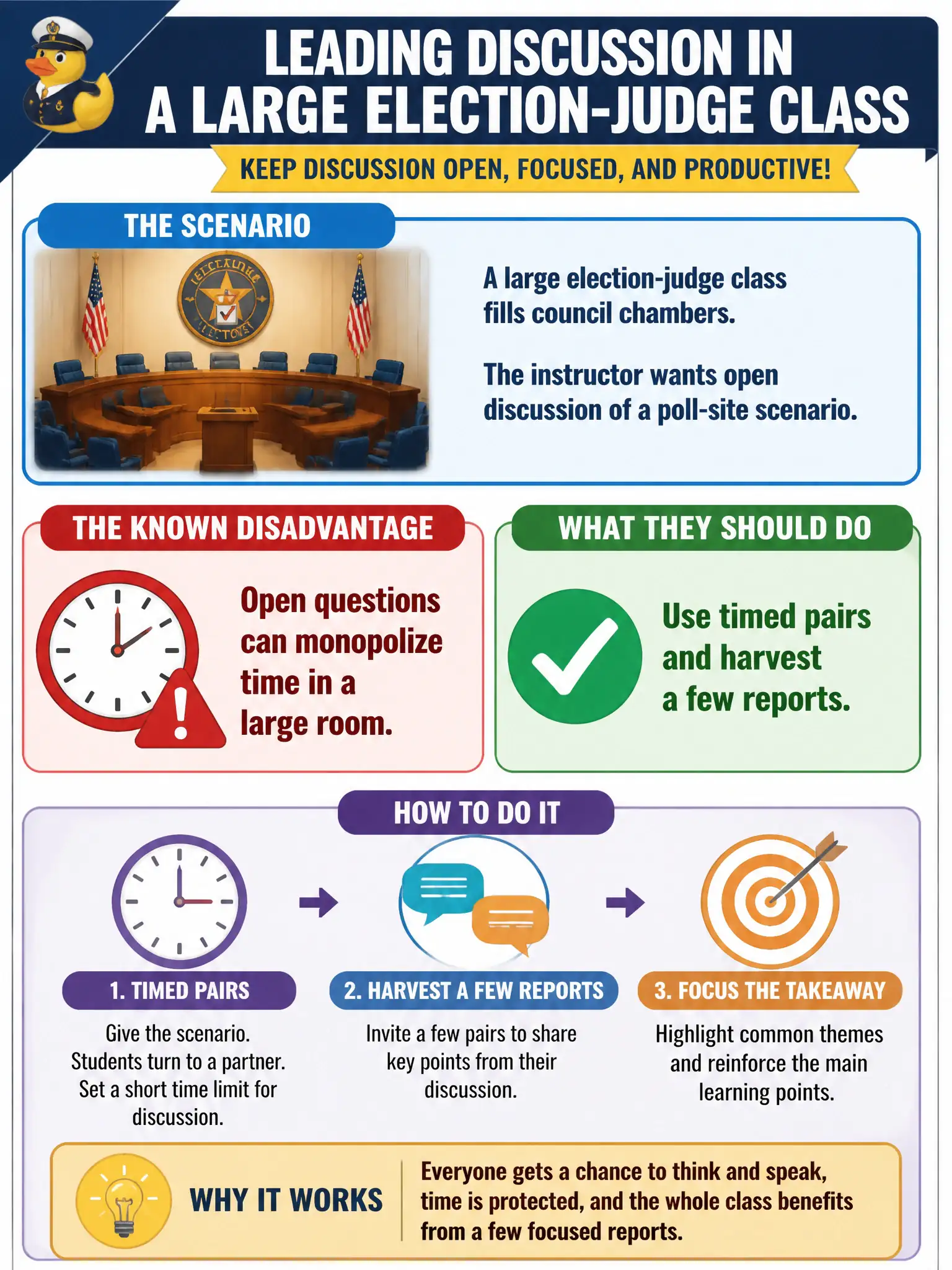
A large election-judge class fills council chambers. The instructor wants open discussion of a poll-site scenario. What is the known disadvantage, and what should they do?
Select an answer to reveal the explanation.
Short Explanation
An open question in a packed chamber is a microphone with no timer. One judge can eat the clock. Timed pairs keep the thinking and give the room a finish line.
Full Explanation
Large election-judge classes in council chambers prepare poll workers who safeguard public elections. Open questions can monopolize time in a large room, so the instructor should use timed pairs and harvest a few reports—preserving thinking while controlling airtime. Known disadvantage of open questions in large groups is time consumption by a few voices.
Claiming open questions always save time in large rooms fails by concept: unstructured whole-room open talk often expands without bound. Banning open questions in any class larger than ten overcorrects and discards valuable reasoning checks. Letting one talkative judge answer at length reproduces the monopoly problem.
Exam caveat: technique scales with group size—pairs, small groups, whiteboards, and sampled report-outs keep open cognition without a single microphone filibuster. Still verify accuracy of harvested reports against election procedures.
Operational check: pose the poll-site scenario, give two minutes in pairs with a visible timer, then call three pairs to report one decision each; correct against the judges' handbook before continuing. Election procedures demand accuracy under time pressure; large-room open discussion without structure invites both filibuster and folklore. Timed pairs preserve reasoning while sampled report-outs keep the chamber on the handbook. Correct every harvested report against the judges’ materials before the next scenario so speed never outruns lawful practice.