
A 311 customer-service class has become a one-way instructor Q&A. How should the trainer create opportunities for clerks to contribute to the discussion?
Select an answer to reveal the explanation.
Short Explanation
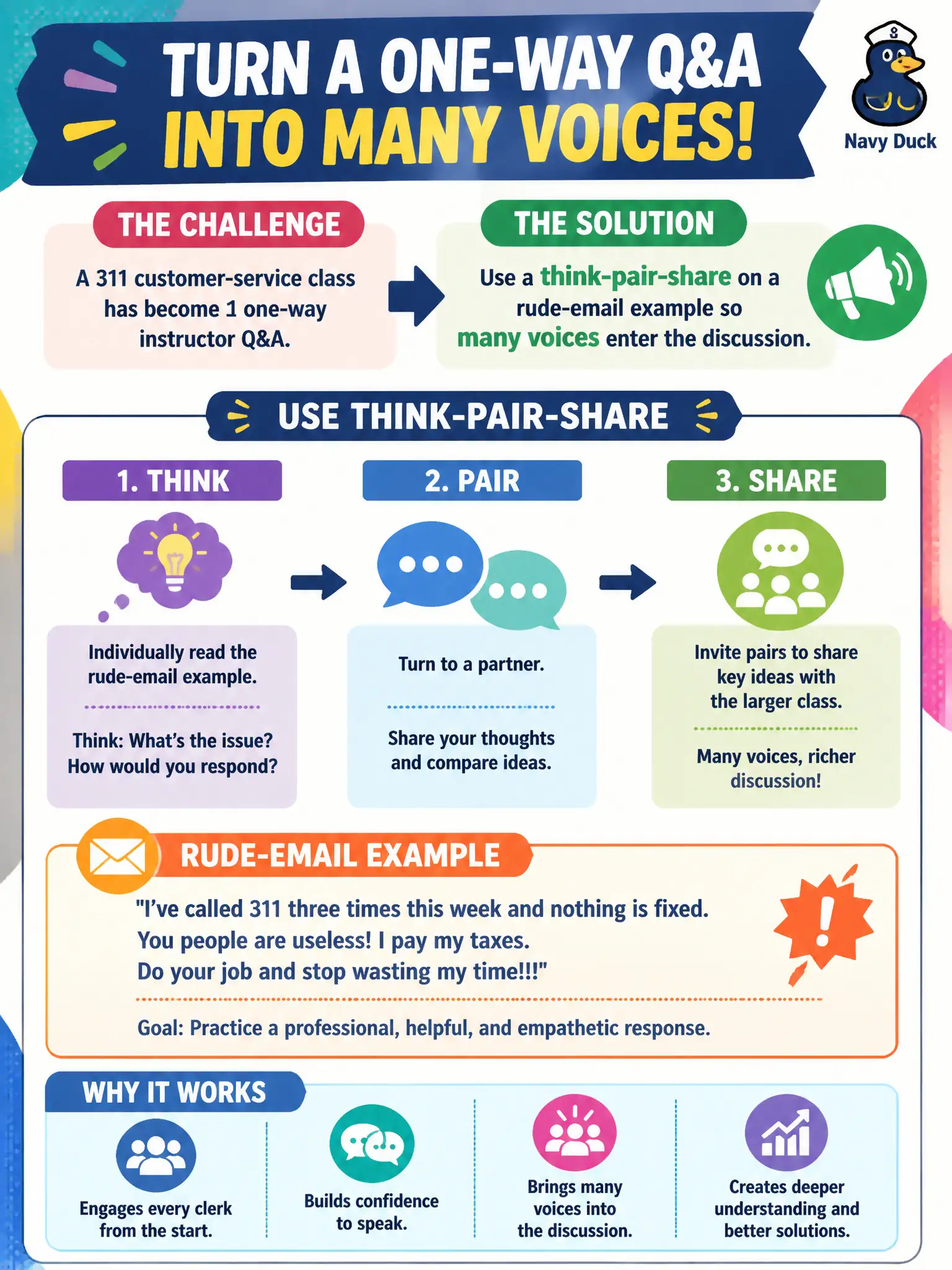
A meeting where only the chair talks is not a discussion. Think-pair-share on a rude email lets many 311 clerks speak before the room hears a few stars. Same-two-volunteers, lecture-only, and a post-class survey keep the rest of the voices out.
Full Explanation
311 customer-service classes prepare clerks who represent the city on every call and email. When the room has become one-way instructor Q&A, a think-pair-share on a rude-email example creates opportunities for many clerks to contribute before plenary discussion. Structured contribution techniques democratize talk time beyond the same two volunteers.
Keeping only the same two volunteers fails by concept: pace is preserved while most learners remain passive. Lecturing the email policy and skipping discussion removes contribution entirely. Moving all contribution to an anonymous post-course survey delays practice and denies real-time peer learning.
Exam caveat: think-pair-share is one valid method; the principle is designing multiple voices into discussion, not any single technique brand. Still keep the rude-email task tied to the customer-service objective and city tone guidelines.
Operational check: give thirty seconds of silent think, two minutes of pairs, then harvest three pairs' approaches to the rude email. Count how many distinct clerks spoke; if under a handful in a large class, run a second round with different partners. 311 tone with residents is a public-trust skill; think-pair-share multiplies practice opportunities that podium Q&A cannot. Structure the rude-email example with city communication standards visible so peer talk stays on policy, not venting. Harvest divergent approaches, map them to the standard, and have each pair revise one sentence of their reply before returning to instructor-led wrap-up.