
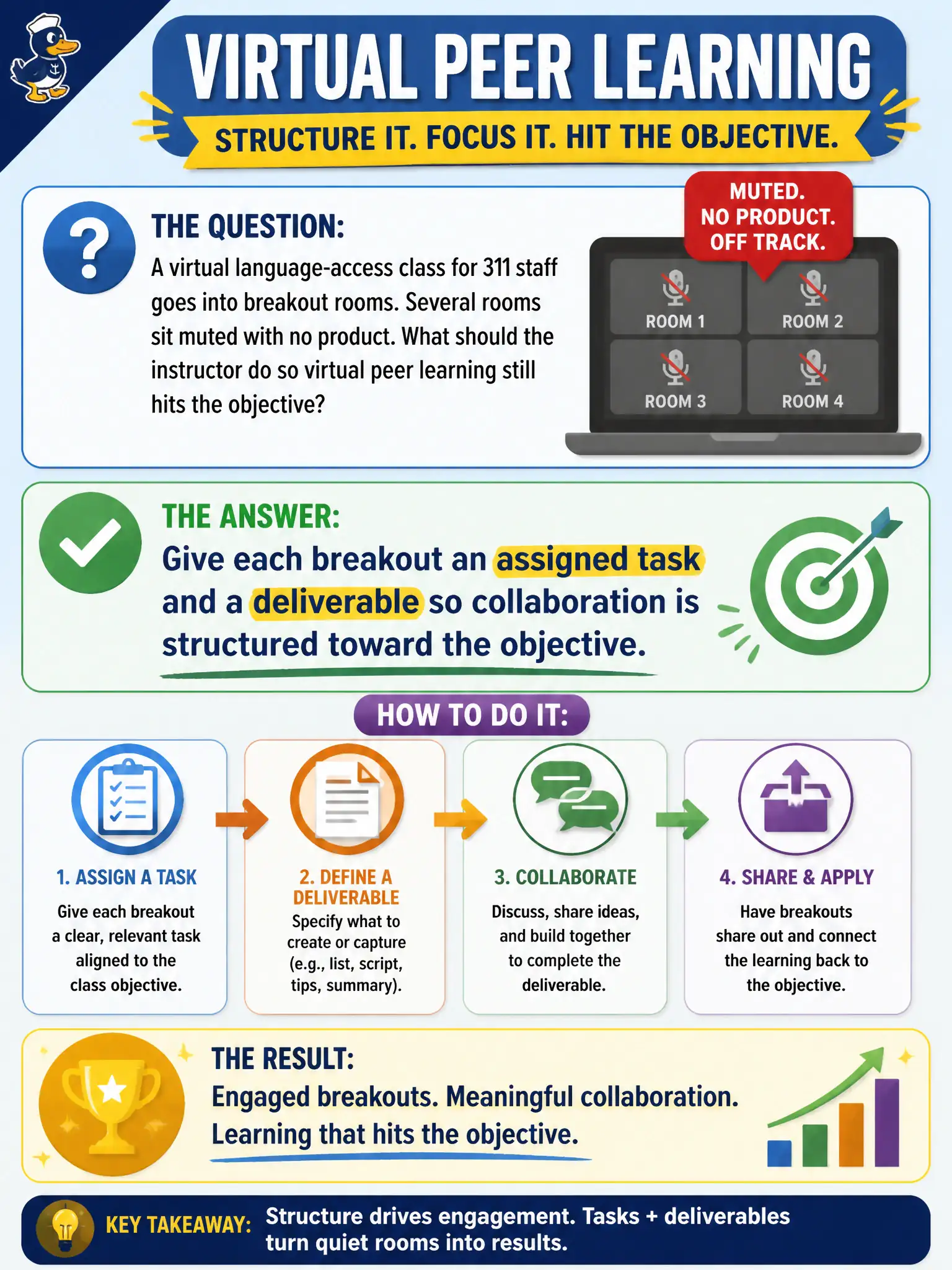
A virtual language-access class for 311 staff goes into breakout rooms. Several rooms sit muted with no product. What should the instructor do so virtual peer learning still hits the objective?
Select an answer to reveal the explanation.
Short Explanation
A breakout with no job is a hallway conversation with better lighting—people mute and wait. Hand each room a language-access scenario and something to bring back. Structure is what turns a virtual mute-fest into peer learning.
Full Explanation
Virtual language-access training for 311 staff protects equitable service for residents with limited English proficiency. Giving each breakout an assigned task and a deliverable structures collaboration toward the objective so peer learning still produces job-relevant output. Unstructured virtual rooms commonly mute out; civic trainers prevent that by defining the work product each room must bring back.
Leaving rooms unstructured so adults can 'network' fails by concept: social chat is not the same as peer learning aimed at language-access performance. Disabling breakouts and returning to unbroken lecture abandons a useful peer channel instead of fixing the missing structure. Treating the mute-fest as proof that virtual tools cannot support peer learning misdiagnoses design failure as technology impossibility.
Exam caveat: virtual peer learning still needs the same ingredients as face-to-face—clear task, roles, timebox, and report-out—plus tool-specific facilitation. Breakouts without deliverables are not evidence against virtual methods.
Operational check: before opening breakouts, display the scenario, the deliverable (for example, a three-step interpreter workflow), and the return time. On reconvene, require each room to show the deliverable; empty returns trigger a structured retry, not a lecture-only retreat.