
In a city planning GIS lab, the same senior mapper always takes the mouse while newer planners watch. What peer-learning move best builds confidence for each learner?
Select an answer to reveal the explanation.
Short Explanation
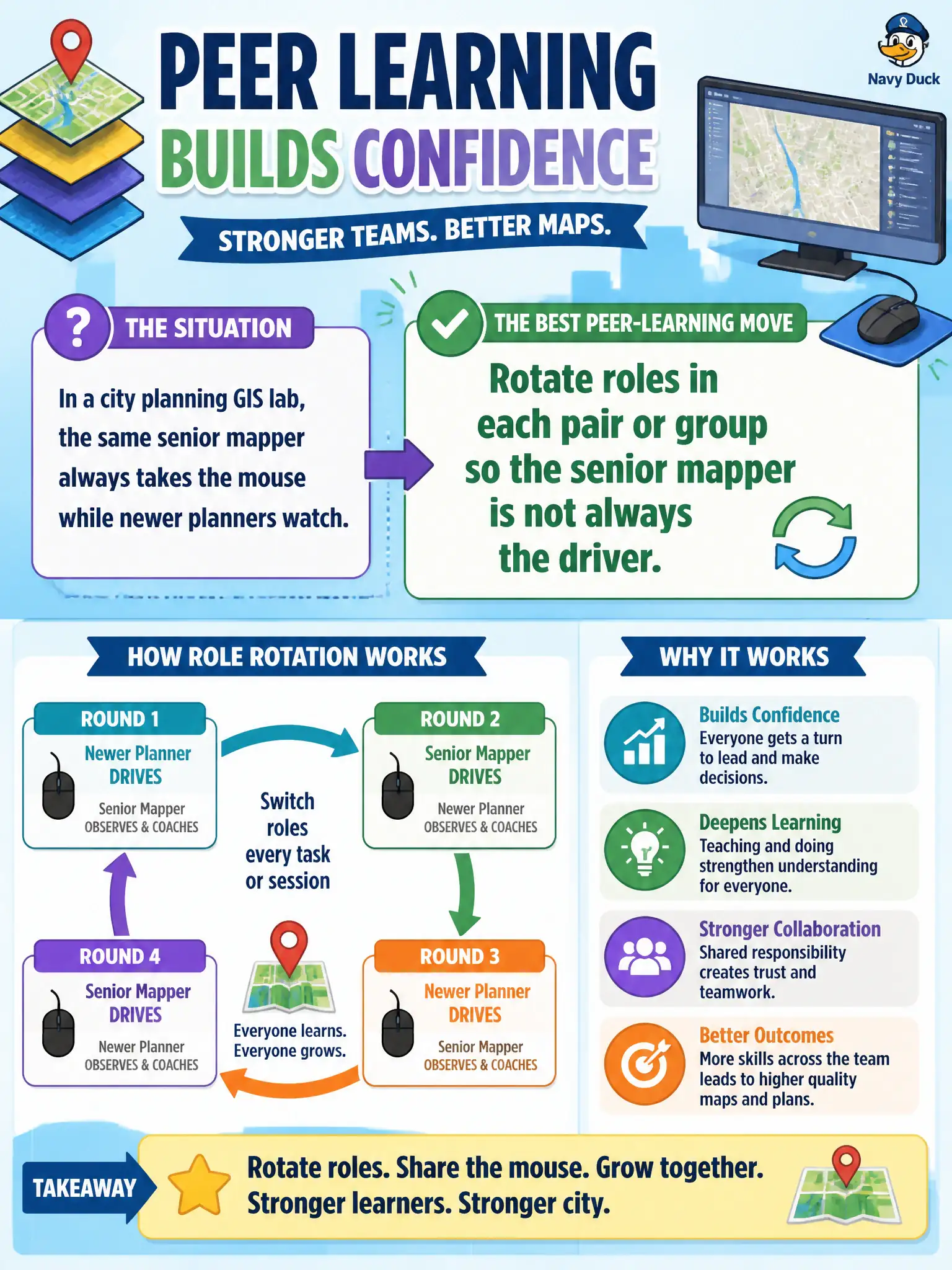
If only the parent ever holds the wheel, the kid never learns to drive. Peer labs work when roles rotate—navigator, driver, checker—so the same senior mapper is not glued to the mouse. Watching an expert all hour builds a fan club, not confidence.
Full Explanation
City planning GIS labs support land-use decisions that affect neighborhoods and public hearings. Rotating roles in each pair or group so the senior mapper is not always the driver is the peer-learning move that builds confidence for each learner. Peer learning in CTT+ expects structured participation—driver, navigator, checker—so expertise is shared rather than monopolized.
Letting the senior mapper keep driving because peers 'learn by watching' fails by concept: observation alone rarely builds procedural confidence on GIS tools newer planners must operate in civic reviews. Removing the senior mapper from the room discards a valuable peer resource instead of structuring how that expertise is shared. Converting the lab to a lecture eliminates hands-on practice and peer exchange that transfer to real mapping work.
Exam caveat: role rotation is about equitable practice opportunities, not punishing experts. Seniors can still contribute as navigators or reviewers while others drive the mouse.
Operational check: set a timer and require a role swap every ten minutes; spot-check that the person who was watching is now controlling the GIS session. If the same senior still has the mouse after the swap call, intervene and reassign roles before the next task.