
City timekeepers arrived expecting overtime-pay advice. The purchased course is how to use the timekeeping software. What should the instructor do?
Select an answer to reveal the explanation.
Short Explanation
Showing up for swimming lessons and expecting tax advice is a real mix-up—you name it, you do not fake the lesson. Tell timekeepers this class is the software, send pay questions to HR, and then teach the clicks. Pretending or walking away from the designed class helps nobody.
Full Explanation
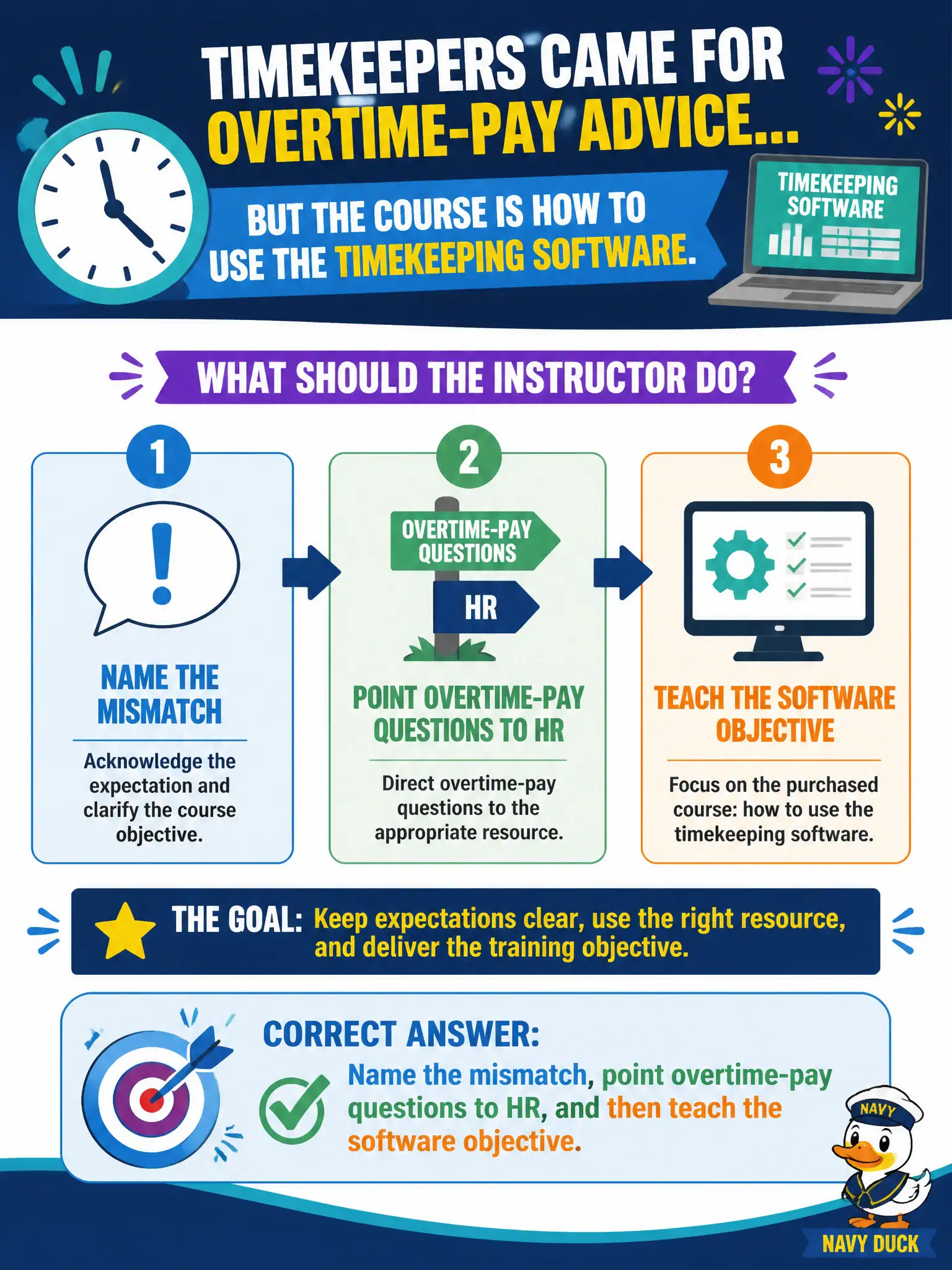
City timekeepers came expecting overtime-pay advice, but the purchased course teaches timekeeping software—the tool that records hours for public payroll integrity. The instructor should name the mismatch, route overtime-pay questions to HR, and then teach the software objective. Expectation management is a facilitation duty: acknowledge the civic concern, hand off what is out of scope, and protect the contracted learning outcome.
Abandoning the software course to run an HR pay clinic fails by concept: the instructor is not delivering the authorized objective and may give incomplete or incorrect pay guidance. Ignoring the mismatch and proceeding as if pay advice were covered breeds distrust when learners discover the gap. Canceling class until HR rewrites vendor materials for every personal expectation is an extreme delay that denies needed software training.
Exam caveat: redirecting out-of-scope questions is not dismissiveness when done transparently with a clear owner (HR). Do not pretend the vendor course answers policy questions it does not cover.
Operational check: open by stating today's objective (complete X timekeeping software tasks), post an HR contact for overtime-pay questions, and park those items visibly. If pay debates restart mid-lab, point to the parking lot and return to the software step in progress.