
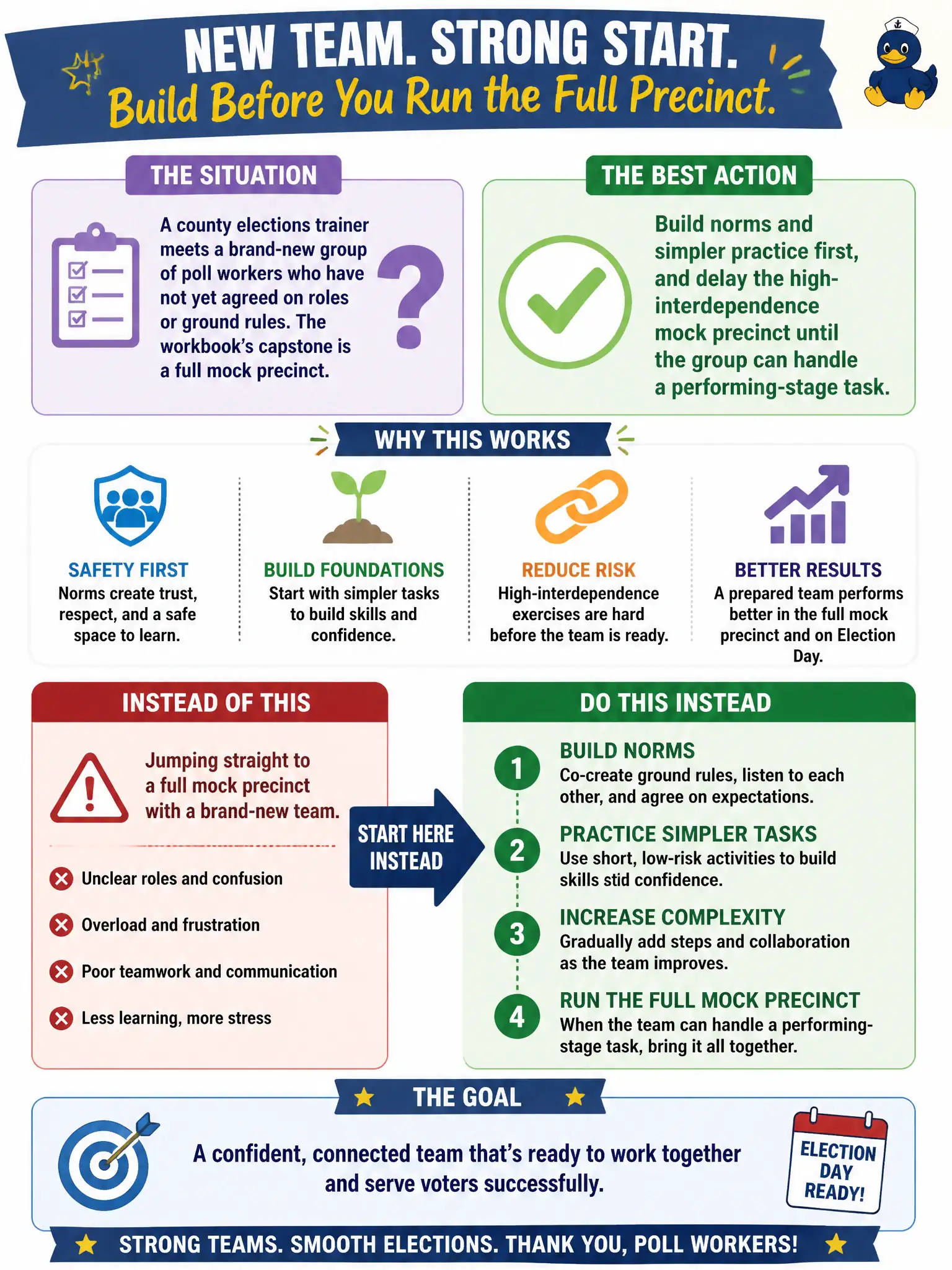
A county elections trainer meets a brand-new group of poll workers who have not yet agreed on roles or ground rules. The workbook's capstone is a full mock precinct. What should the instructor do?
Select an answer to reveal the explanation.
Short Explanation
You would not start a pickup team's first huddle with a full game if nobody knows positions yet. New election judges need norms before a mock precinct that depends on everyone. Build the group, then run the high-interdependence drill.
Full Explanation
County elections training protects ballot integrity and public confidence in poll sites. For brand-new poll workers who have not yet formed norms or roles, the instructor should build norms and simpler practice first, delaying the high-interdependence mock precinct until the group can handle a performing-stage task. Group-development concepts matter in civic classrooms: a full mock precinct assumes coordination that forming groups do not yet have.
Opening immediately with the full mock precinct fails by concept: it dumps a performing-stage task on a forming group and risks confusion, conflict, and unsafe shortcuts at the sample precinct. Canceling all group work and lecturing the manual all day denies the collaborative practice elections staffing requires. Assigning the mock precinct as silent individual homework erases interdependence and cannot rehearse the team behaviors a real precinct needs.
Exam caveat: delaying a complex group task is not avoiding practice; it is sequencing so norms, roles, and simpler drills precede high-stakes interdependence. Do not confuse 'covering the mock' early with preparing workers to perform it well.
Operational check: before launching the mock precinct, verify that ground rules are posted, roles are assigned, and a simpler paired drill (for example, check-in handshake) has succeeded. If role confusion still dominates, extend norms practice rather than forcing the full mock.