
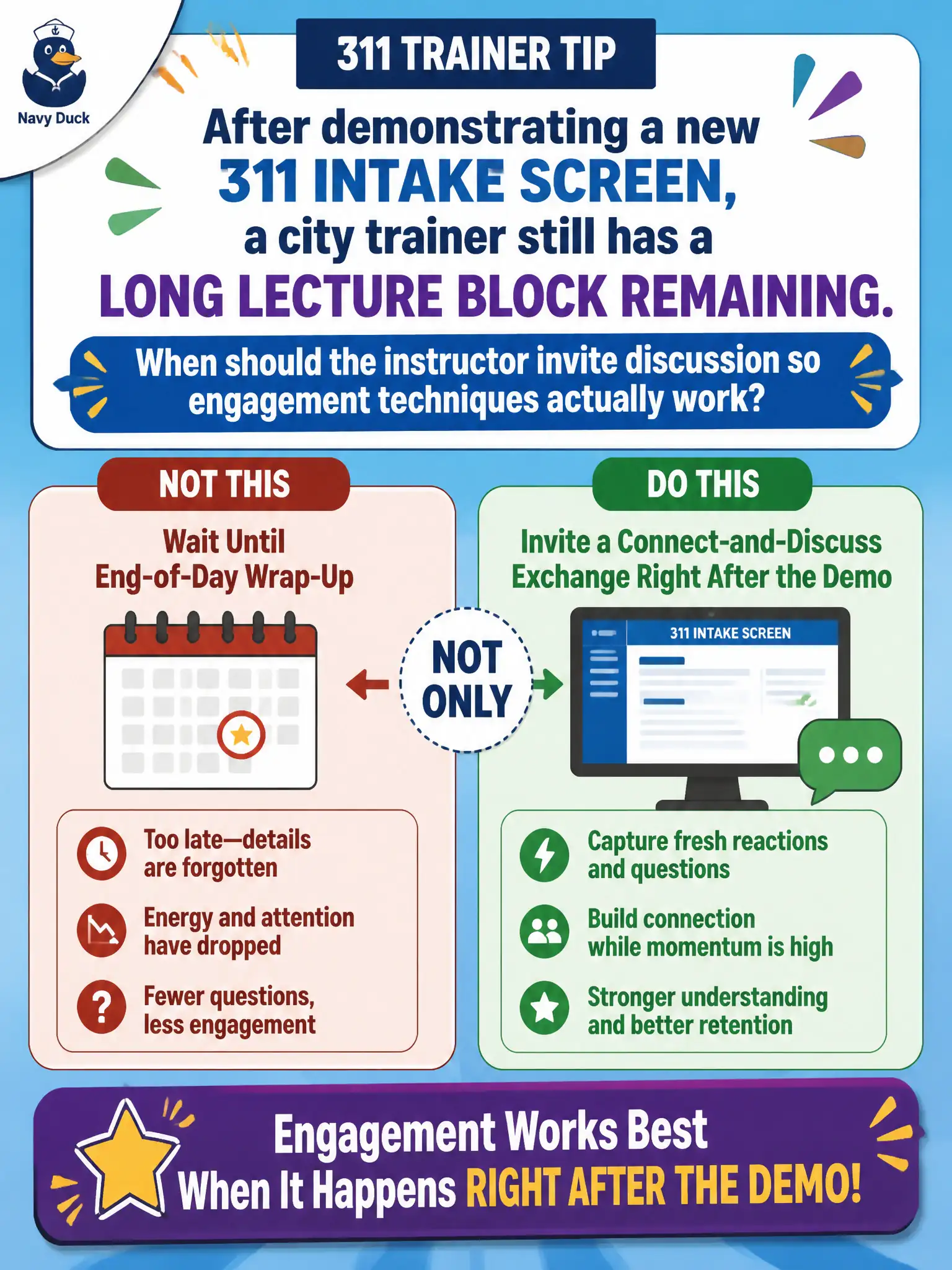
After demonstrating a new 311 intake screen, a city trainer still has a long lecture block remaining. When should the instructor invite discussion so engagement techniques actually work?
Select an answer to reveal the explanation.
Short Explanation
A cooking demo that waits until dessert to take questions is too late—people already forgot the sauce. Connect and discuss right after the 311 screen, while the clicks are still warm. End-of-day leftover talk is not the same as structured engagement.
Full Explanation
City 311 intake training serves residents who need accurate service requests on the first contact. Inviting a connect-and-discuss exchange right after demonstrating the new intake screen uses engagement while the demonstration is still cognitively fresh. CTT+ engagement techniques work when discussion is timed to learning moments, not deferred until attention and context have decayed.
Saving all discussion for the last five minutes fails by concept: end-of-day wrap-ups come too late for clarifying clicks, field meaning, or resident-facing phrasing from the demo. Skipping discussion because a demonstration 'proves' competence confuses instructor performance with learner performance—watching is not mastery of 311 intake. Moving discussion to an optional after-hours forum removes structured engagement from scheduled civic training time and leaves uneven access for shift workers.
Exam caveat: discussion after a demo is not an invitation to abandon the objective; keep connect-and-discuss tied to the demonstrated task and cut unrelated tangents. Lecture blocks that follow should build on what the discussion revealed, not ignore it.
Operational check: immediately after the 311 screen demo, pose one job-tied prompt (for example, which field would you confirm with the caller first?) and harvest two or three responses before returning to lecture. If nobody can speak to the screen, briefly re-demo the critical click and try the discussion again.