
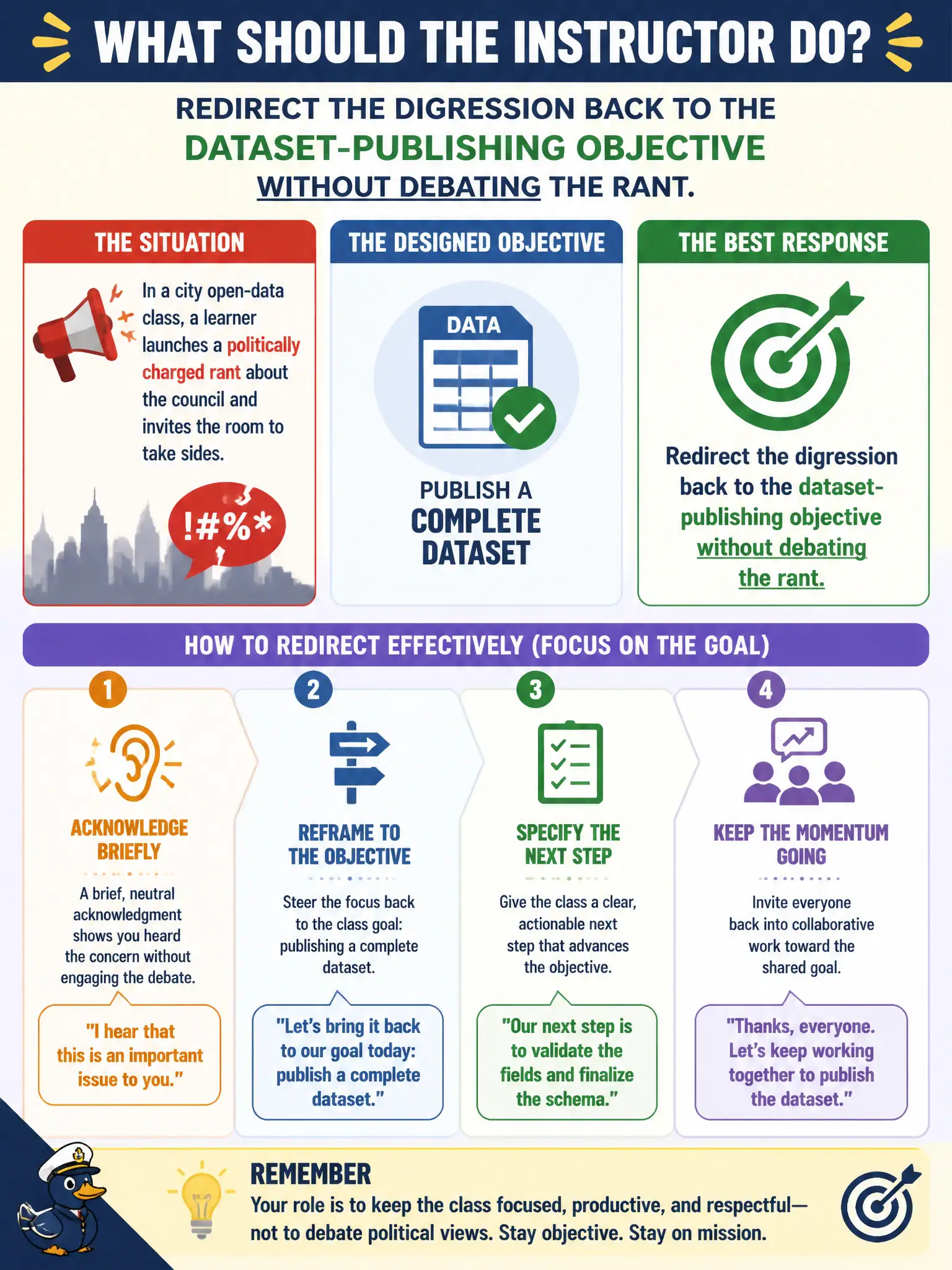
In a city open-data class, a learner launches a politically charged rant about the council and invites the room to take sides. The designed objective is publishing a complete dataset. What should the instructor do?
Select an answer to reveal the explanation.
Short Explanation
A council rant is a stalled car in the left lane. You do not argue with the driver about city hall—you get traffic moving again. Point back to the dataset job, park the politics, and keep the class on the objective.
Full Explanation
Instructors keep the environment focused on stated learning objectives and redirect politically charged digressions without debating them. In a city open-data class, when a learner launches a council rant and invites sides, redirecting back to the dataset-publishing objective protects instructional focus and avoids turning a skills lab into a political arena. Civic training can mention government without becoming campaign debate.
Debating the council’s record so the instructor appears informed fails by concept: it amplifies the digression and models political advocacy instead of facilitation. Allowing the rant to run to break because adults “own the agenda” fails when the designed objective is publishing a dataset, not open-ended politics. Ejecting the learner immediately and canceling remaining labs fails as disproportionate escalation when a firm redirect usually restores focus.
Exam caveat: CTT+ focus items reward redirect without humiliation or joining the political fight.
Operational check: interrupt briefly, decline to debate, restate the publishing task and time left, resume the dataset activity; park political discussion for appropriate non-class channels if needed. In civic public-training settings, that judgment protects both learner dignity and the municipality’s duty to leave staff actually able to perform the job after class—not merely to finish slides or keep a schedule looking tidy.