
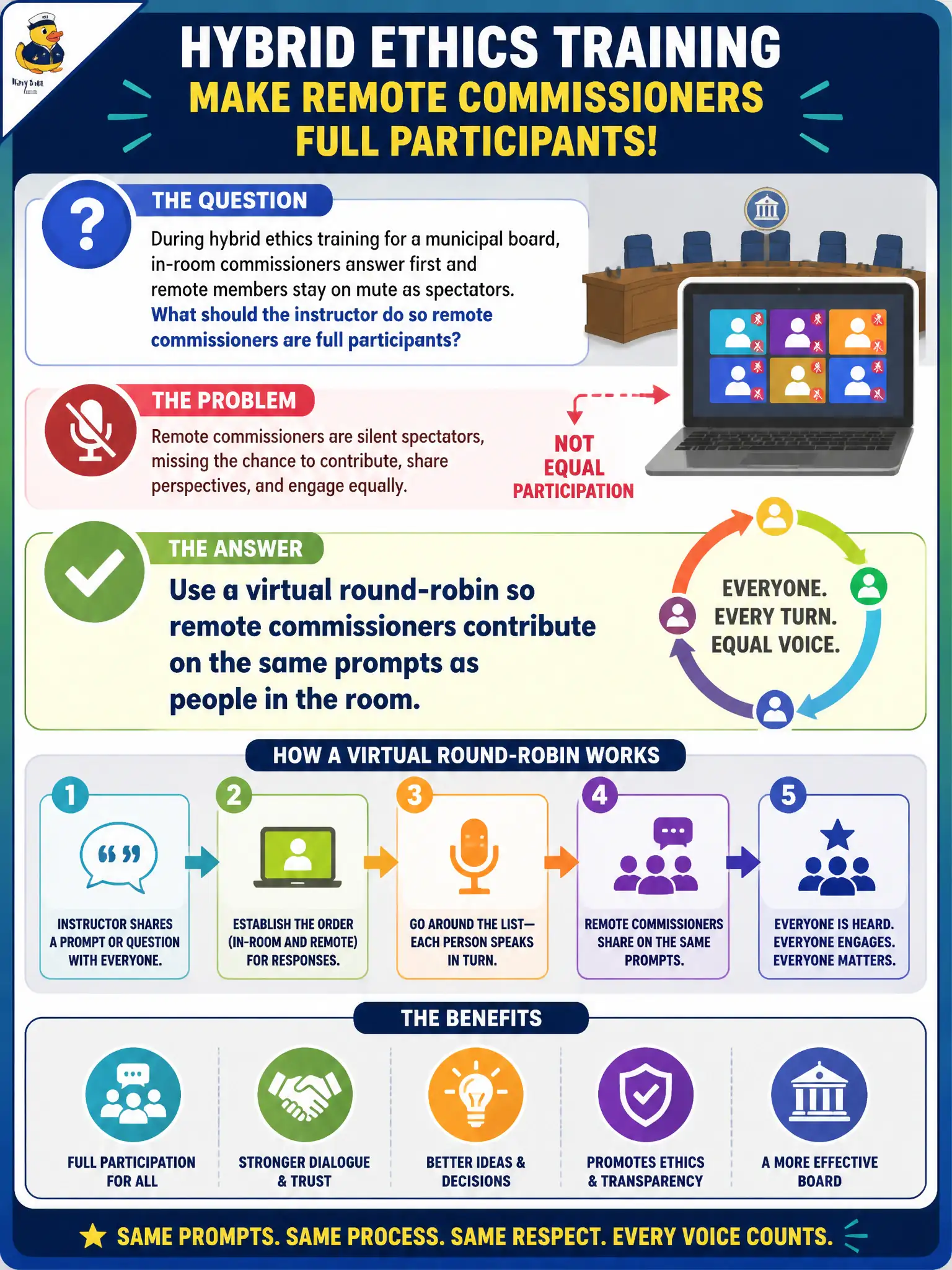
During hybrid ethics training for a municipal board, in-room commissioners answer first and remote members stay on mute as spectators. What should the instructor do so remote commissioners are full participants?
Select an answer to reveal the explanation.
Short Explanation
A hybrid board class that only hears the people at the table is a meeting with a livestream bolted on. Round-robin the remote commissioners on the same ethics prompts. If they never talk, they are furniture, not learners.
Full Explanation
Hybrid municipal sessions must treat remote learners as full participants, not spectators. During ethics training for a municipal board, when in-room commissioners answer first and remotes stay muted, the instructor should use a virtual round-robin so remote commissioners contribute on the same prompts as people in the room. Facilitation design—not proximity—determines whose voice counts in hybrid civic training.
Letting the in-room majority keep answering because they are easier to hear fails by concept: convenience is not equity and trains remotes to disengage. Asking remote commissioners to watch a recording later instead of speaking live fails by demoting them from participants to later consumers. Disabling remote audio so in-room discussion is never interrupted fails by intentionally silencing part of the board during a live ethics session.
Exam caveat: CTT+ virtual/hybrid items expect intentional inclusion techniques for remote learners in the same activity.
Operational check: announce a round-robin that names remotes first on rotating prompts; confirm each remote speaks at least once per major ethics scenario; do not accept “we’ll catch the recording” as participation. In civic public-training settings, that judgment protects both learner dignity and the municipality’s duty to leave staff actually able to perform the job after class—not merely to finish slides or keep a schedule looking tidy.