
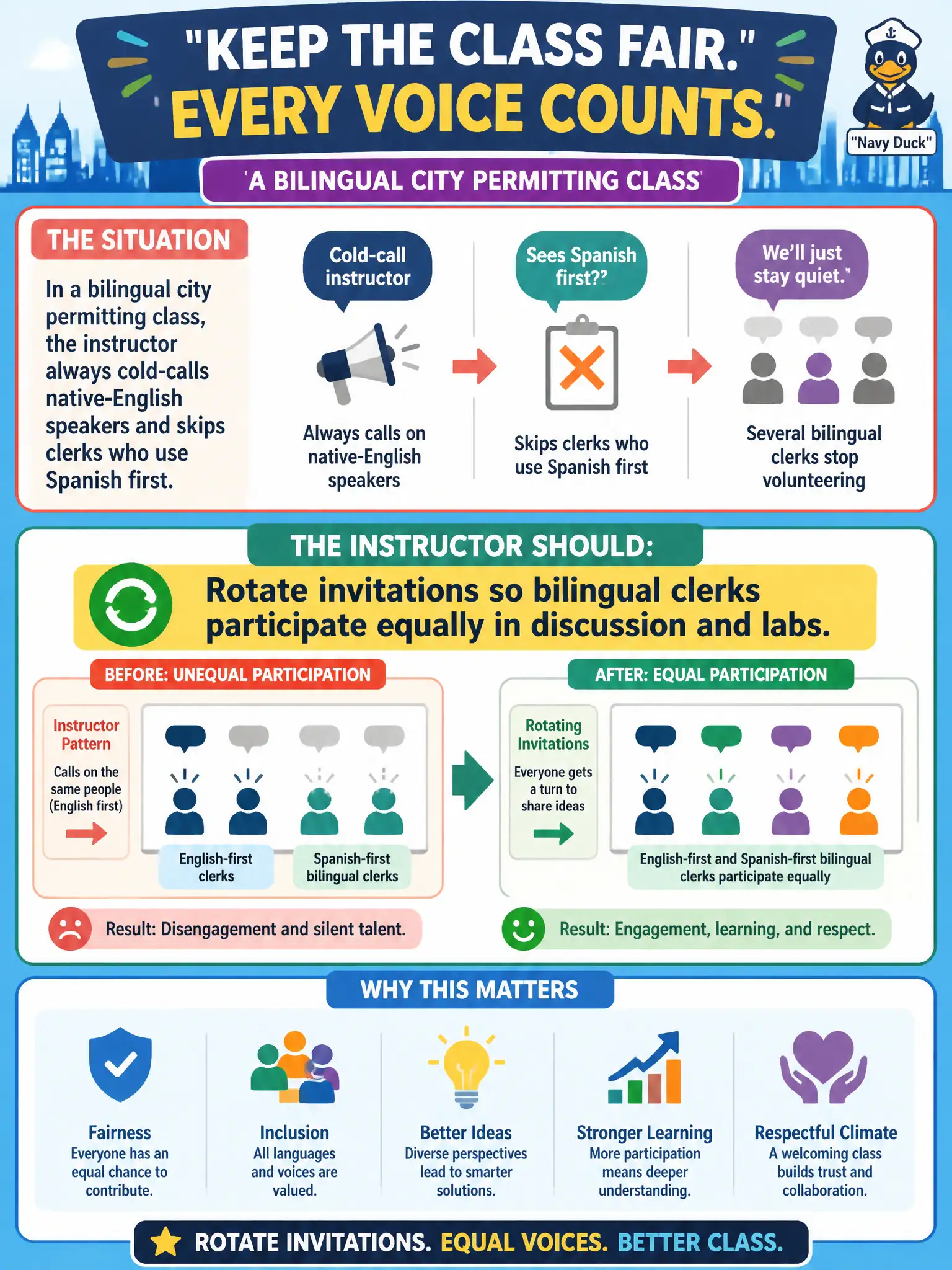
In a bilingual city permitting class, the instructor always cold-calls native-English speakers and skips clerks who use Spanish first. Several bilingual clerks stop volunteering. What should the instructor do to keep the climate free of that bias?
Select an answer to reveal the explanation.
Short Explanation
If the mic only ever lands on one language, that is a climate problem, not a “pace” trick. Rotate the invitations so Spanish-first clerks work the same permit screens out loud. Bias in cold-calling shuts people down faster than a hard quiz.
Full Explanation
A learning climate free of bias requires equitable invitation to participate across language communities. In a bilingual city permitting class, always cold-calling native-English speakers while skipping clerks who use Spanish first teaches a hierarchy of voice and causes bilingual clerks to stop volunteering. Rotating invitations so bilingual clerks participate equally in discussion and labs corrects that bias and keeps municipal permitting practice inclusive.
Continuing to call only native-English speakers to keep answers fast fails by concept: speed is not a license for language bias and starves the instructor of evidence from half the room. Moving bilingual clerks to an observer row fails by segregating learners instead of facilitating equitable practice. Requiring every answer in unaccented English before permit-screen practice fails as an unlawful and unprofessional gate that confuses accent with competence.
Exam caveat: CompTIA CTT+ climate items include language-related bias. Equitable rotation—not “efficiency” excuses—is the instructional standard.
Operational check: track who is invited across a module; alternate language communities on cold calls and demos; explicitly invite a Spanish-first clerk into the next permit lab with the same support given to English-first peers.