
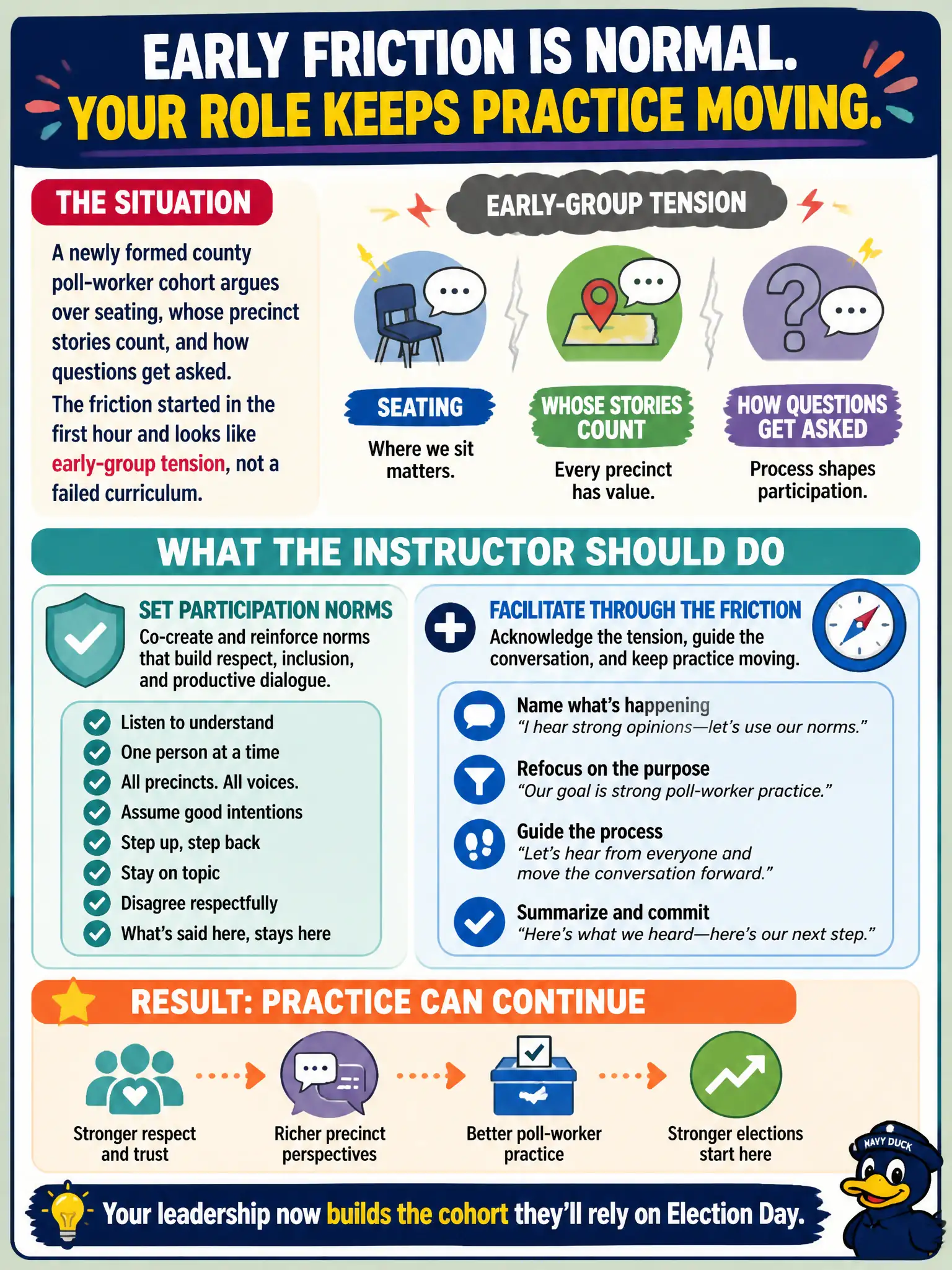
A newly formed county poll-worker cohort argues over seating, whose precinct stories count, and how questions get asked. The friction started in the first hour and looks like early-group tension, not a failed curriculum. What should the instructor do?
Select an answer to reveal the explanation.
Short Explanation
New crews scrape bumpers before they convoy. That early argument is a group finding its gears, not a reason to tow the class off the lot. Put the rules of the road on the board and keep coaching, instead of panicking or turning the hour into a name-the-phase trivia round.
Full Explanation
Early-group friction is a facilitation problem: set participation norms and help the group work through tension so skill practice can continue. A newly formed county poll-worker cohort arguing over seating, whose stories count, and how questions are asked shows forming-stage conflict, not automatic curriculum failure. Norm-setting and facilitated process let municipal election training proceed.
Canceling remaining labs and sending everyone back to the warehouse until the mood improves fails by concept: mood is addressed through facilitation, not abandonment of poll-worker practice. Ignoring friction and speeding through the poll-book demo fails because unresolved norms will keep erupting and blocking learning. Quizzing development-phase theorist labels before any skill practice fails by substituting jargon about groups for actual group facilitation.
Exam caveat: CTT+ group-development items reward norms and facilitation through early conflict—not cancellation or theory quizzes as the first move.
Operational check: pause content briefly; co-create norms for speaking, stories, and questions; apply one norm immediately to the seating dispute; then return to poll-book practice with those norms visible.